


Brand positioning guide 2026: how small businesses stand out
- Pawan Samarakoon
- 1 day ago
- 9 min read

Standing out in a crowded market feels impossible when every competitor seems to offer similar solutions at comparable prices. Many small businesses struggle with this exact challenge, losing potential customers to larger brands with bigger budgets. The solution lies not in outspending competitors but in clear brand positioning that makes your unique value instantly recognizable. This guide will teach you how to define and execute a brand positioning strategy that attracts the right customers, increases profitability, and helps you compete effectively against businesses of any size.
Table of Contents
Key takeaways
Point | Details |
Positioning drives profitability | Effective positioning directly impacts lead quality, conversion rates, and long-term revenue growth. |
Specialization wins | Trying to appeal to everyone dilutes your message and weakens your competitive advantage in saturated markets. |
Clarity creates conversions | Clear positioning simplifies customer decision-making by making your unique value proposition immediately obvious. |
Small beats big | Focused positioning allows small businesses to outcompete larger competitors through strategic market differentiation. |
Understanding brand positioning and why it matters
Brand positioning is not a tagline, logo, or slogan. Positioning is a deliberate choice of what your business will be known for and what you choose not to compete on. This strategic decision defines how customers perceive your business relative to alternatives in the market. When executed correctly, positioning creates a mental shortcut that makes choosing your business the obvious decision for your ideal customers.
Think of positioning as claiming a specific territory in your customer’s mind. You cannot own every category or appeal to every need. The businesses that try to be everything to everyone end up being nothing to anyone. Instead, successful positioning requires selecting a narrow focus where you can dominate and deliver exceptional value. This might mean specializing in a particular industry, solving a specific problem better than anyone else, or serving a defined customer segment with unmatched expertise.
The power of positioning becomes clear when you consider the customer’s perspective. Buyers face overwhelming choices in nearly every market. Clear positioning cuts through this noise by communicating exactly who you serve, what problem you solve, and why you are the best choice. This clarity reduces friction in the buying process and attracts customers who value precisely what you offer. A branding guide for small business owners can help you understand how positioning integrates with your overall brand strategy.
Small businesses possess a unique advantage in positioning that larger competitors cannot easily replicate. You can pivot quickly, specialize deeply, and build intimate relationships with niche audiences. A local accounting firm positioning itself as the tax specialist for creative freelancers can dominate that segment despite competing against national chains. A boutique marketing agency focusing exclusively on healthcare startups can command premium rates because of its specialized expertise. Your size becomes an asset when your positioning is sharp and defensible.
Consider these positioning fundamentals:
Positioning defines your competitive advantage, not just your features
Effective positioning resonates emotionally while delivering rational benefits
Your position must be credible and provable through customer results
Positioning guides every business decision from pricing to partnerships
“The essence of positioning is sacrifice. You must be willing to give up certain customers, certain features, and certain markets to own the territory that matters most.” This principle separates businesses that thrive from those that merely survive.
Preparing to define your brand positioning
Before crafting your positioning statement, you need solid groundwork. Rushing into positioning without preparation leads to generic claims that fail to differentiate your business. Start with comprehensive market research that reveals both competitor strategies and unmet customer needs. Analyze what similar businesses promise, how they communicate, and where gaps exist in the market. This research uncovers opportunities for differentiation that you might otherwise miss.
Identifying your ideal target audience requires specificity beyond basic demographics. Age ranges and income brackets tell you little about what motivates buying decisions. Instead, define your audience by their challenges, aspirations, and decision-making criteria. A business targeting “small business owners” competes with thousands of others. A business targeting “solo consultants struggling to systematize client onboarding” owns a specific niche. The narrower your focus, the stronger your positioning becomes.
Small businesses often fail in saturated markets by avoiding specialization and trying to appeal to everyone. This mistake stems from fear of limiting opportunities. The reality works oppositely. Broad positioning attracts price-sensitive customers who view you as interchangeable with competitors. Focused positioning attracts ideal customers who value your specific expertise and willingly pay premium rates. Your revenue grows when you serve fewer customer types exceptionally well rather than serving everyone adequately.

Clarifying your unique strengths requires honest self-assessment. What can you deliver better than anyone else in your market? This might be a proprietary process, uncommon expertise, or a service combination competitors do not offer. Your strengths must align with what your target audience values most. Being the fastest provider matters only if speed ranks high in customer priorities. Being the most thorough provider matters when quality and completeness drive decisions. Match your strengths to audience needs for positioning that resonates.
Prepare these elements before finalizing your positioning:
Detailed competitive analysis identifying positioning gaps
Specific target audience profiles with psychographic details
Clear documentation of your unique capabilities and proof points
Understanding of customer pain points and desired outcomes
Honest assessment of what you will not compete on
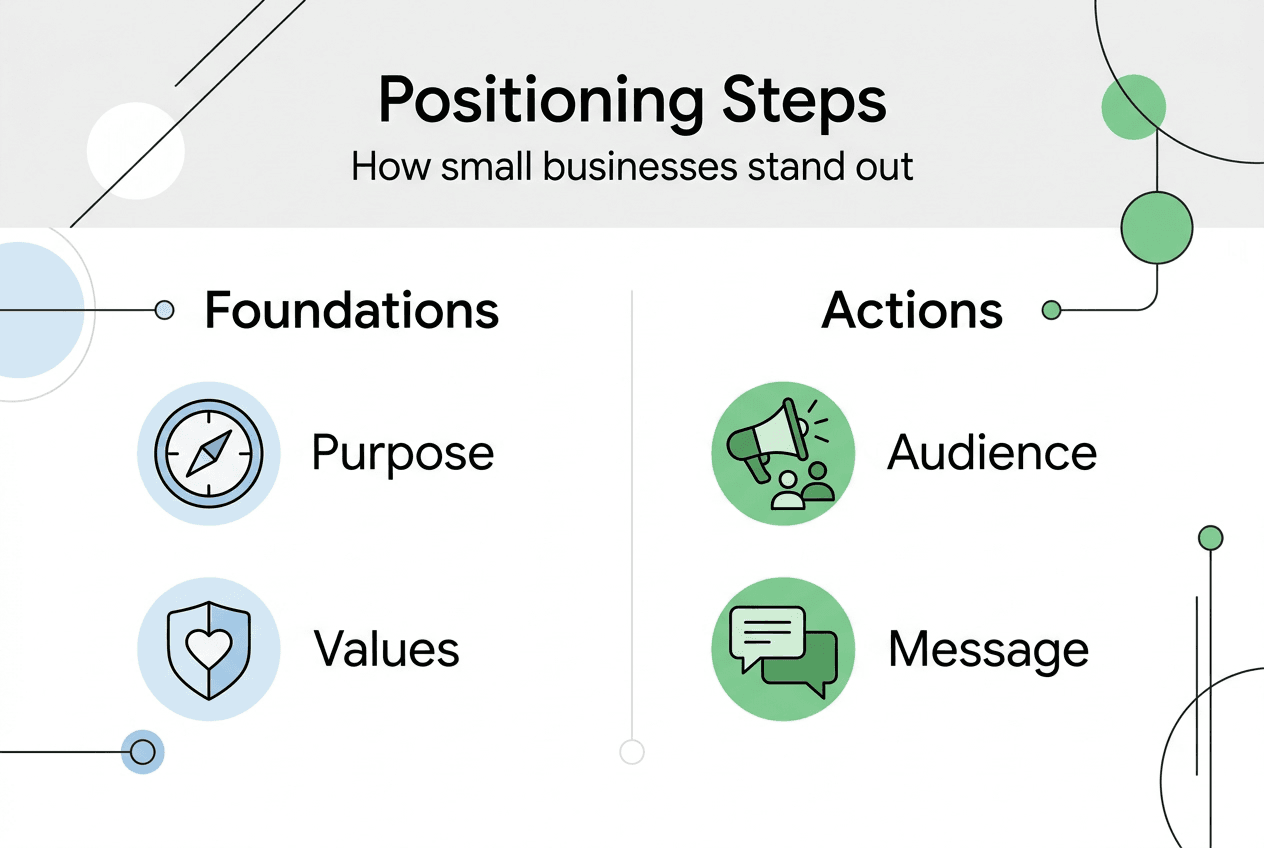
Your business purpose and values provide the foundation for authentic positioning. Customers increasingly choose brands that align with their beliefs and priorities. A branding strategy insights 2026 approach helps integrate these elements into a cohesive positioning framework. Define what your business stands for beyond profit, and let these values inform your positioning choices. Authenticity builds trust, and trust converts prospects into loyal customers.
Step-by-step guide to creating your brand positioning
Creating effective brand positioning follows a systematic process that transforms research into a compelling market position. Follow these steps to develop positioning that drives business growth:
Define your target market with precision. Move beyond broad categories to identify the specific segment where you can dominate. Consider industry verticals, company sizes, geographic regions, or customer psychographics that align with your strengths.
Identify your unique value proposition. Articulate the specific benefit customers receive from choosing your business. This value must be meaningful, measurable, and difficult for competitors to replicate. Focus on outcomes rather than features.
Choose your differentiation strategy. Decide whether you will compete on specialized expertise, superior service, innovative methodology, or a unique combination of offerings. Your differentiation must matter to your target audience and be defensible over time.
Craft your positioning statement. Write a concise declaration that captures who you serve, what you deliver, and why you are the best choice. This statement guides all marketing and business decisions moving forward.
Validate your positioning concept. Test your positioning with current customers and target prospects before full implementation. Gather feedback on clarity, relevance, and competitive differentiation. Refine based on responses.
Effective positioning directly impacts lead quality, conversion rates, and long-term profitability for small businesses. The difference between vague and focused positioning shows clearly in results. Consider this comparison:
Approach | Generic Positioning | Focused Positioning |
Target audience | All small businesses | SaaS startups in healthcare |
Value proposition | Quality web design services | HIPAA-compliant websites that convert |
Differentiation | Great customer service | Healthcare regulatory expertise |
Lead quality | Price-sensitive, high churn | Value-focused, long-term clients |
Conversion rate | 2-3% industry average | 8-12% niche authority |
Your positioning statement should be memorable and actionable. A strong example: “We help solo financial advisors automate client reporting so they can focus on relationship building instead of spreadsheet management.” This statement clearly identifies the target (solo financial advisors), the benefit (automated reporting), and the outcome (more time for clients). Anyone reading this immediately knows whether the service fits their needs.
Pro Tip: Before finalizing your positioning, present it to five current customers and five target prospects. Ask them to explain what makes your business different in their own words. If they cannot articulate your unique value clearly, your positioning needs refinement. Customer language often reveals the most compelling way to communicate your position.
Implementing your positioning across all touchpoints ensures consistency. Your website, proposals, social media, and sales conversations must reinforce the same position. Mixed messages confuse prospects and weaken your competitive advantage. A branding strategies for small businesses resource can help you maintain alignment across channels. Every customer interaction should strengthen the perception you have worked to create.
Verifying and maintaining your brand positioning
Validating your positioning effectiveness requires tracking specific metrics that reveal market response. Monitor lead quality by analyzing how well incoming prospects match your ideal customer profile. High-quality leads understand your value proposition before the first conversation and focus discussions on fit rather than price. If most leads ask generic questions or immediately negotiate on cost, your positioning may lack clarity or target the wrong audience.
Sales metrics provide direct feedback on positioning strength. Track conversion rates from initial contact to closed deal. Increasing conversion rates indicate that your positioning resonates with the right audience and differentiates you effectively. Also measure average deal size and customer lifetime value. Strong positioning attracts customers who value your expertise and invest accordingly. Declining metrics signal the need for positioning adjustments.
Customer feedback reveals how your market perceives your position. Conduct regular surveys asking customers why they chose your business over alternatives. Their responses should reflect your intended positioning. If customers cite reasons unrelated to your positioning strategy, a disconnect exists between your message and market perception. Use this feedback to refine how you communicate your position or adjust the position itself.
Market conditions change, requiring periodic positioning reviews. New competitors enter your space, customer priorities shift, and technological advances alter buying criteria. Schedule quarterly reviews of your competitive landscape and annual deep dives into your positioning strategy. Clear positioning reduces friction in decision-making and makes the right choice obvious for the right audience, but only when it stays current with market realities.
Maintain positioning consistency across these critical areas:
Website messaging and visual identity
Sales presentations and proposals
Marketing content and advertising
Customer onboarding and service delivery
Team training and internal communications
Your team must understand and embody your positioning. Every employee who interacts with customers should articulate your unique value consistently. Invest in regular training that reinforces your positioning and provides examples of how it applies to daily work. When your entire organization lives your positioning, customers experience coherent brand interactions that build trust and loyalty.
Pro Tip: When market changes require positioning adjustments, pivot gradually rather than abandoning your established position entirely. Test new positioning elements with a segment of your audience before rolling out changes broadly. This approach minimizes confusion among existing customers while allowing you to validate new directions. A brand refresh guide 2026 can help you navigate positioning evolution without losing brand equity.
Enhance your brand positioning with expert help
Developing powerful brand positioning requires both strategic thinking and creative execution. LOOM Brand Designs specializes in helping small businesses define and communicate positioning that drives growth. Our basic branding package provides the foundation you need, including positioning strategy, visual identity development, and messaging frameworks that attract your ideal customers.

Our branding portfolio showcases successful positioning solutions across industries, from healthcare startups to professional services firms. Each project demonstrates how strategic positioning translates into compelling brand experiences that differentiate businesses in competitive markets. We combine positioning strategy with comprehensive website design services that bring your brand to life online, ensuring every digital touchpoint reinforces your unique market position and converts visitors into customers.
Frequently asked questions
What is brand positioning and why is it important?
Brand positioning defines what sets your business apart in the market and why customers should choose you over alternatives. It matters because clear positioning improves lead quality, increases conversion rates, and helps you compete effectively regardless of company size. Strong positioning also streamlines your marketing efforts by providing a consistent framework for all business decisions and customer communications.
How can I avoid the common mistake of trying to appeal to everyone?
Avoid broad positioning by identifying a specific target niche where you can deliver exceptional value. Focus on serving one customer type or solving one problem better than anyone else in your market. Specialization attracts ideal customers who value your expertise and are willing to pay premium rates, while broad positioning commoditizes your services and triggers price competition.
What steps should I take to create an effective brand positioning statement?
Start by identifying your unique value proposition and the specific audience segment you serve best. Define your key differentiators that competitors cannot easily replicate. Craft a concise statement that communicates who you help, what problem you solve, and why you are the best choice. Validate your positioning with current customers and target prospects before implementing it across all business touchpoints.
How do I know if my brand positioning is working?
Measure positioning effectiveness through lead quality, conversion rates, and customer feedback. High-quality leads should understand your value before initial conversations and focus on fit rather than price. Track whether customers cite your intended differentiators when explaining why they chose your business. Monitor competitor activities and market trends to ensure your positioning remains relevant as conditions change, adjusting your strategy when metrics decline or new opportunities emerge.
Recommended
Comments