


Content marketing for branding: grow recognition fast
- Pawan Samarakoon
- Apr 1
- 8 min read

Content marketing isn’t just a tool for Fortune 500 companies with massive budgets. Small businesses that invest in strategic content see ROI up to $36 for every dollar spent, outpacing nearly every other marketing channel. Yet most small business owners still treat content as an afterthought, something to post when there’s spare time. That’s a costly mistake. In this article, you’ll discover how content shapes brand identity, which content types deliver the biggest branding punch, how it stacks up against paid ads, and the practical frameworks you can use to build lasting recognition without burning through your budget.
Table of Contents
Key Takeaways
Point | Details |
Content is your core asset | Consistent, high-value content is the foundation of brand recognition and trust for small businesses. |
Long-term value outpaces ads | Content offers compounding value and lowers costs over time, unlike fleeting paid promotions. |
Strategic focus drives results | Choosing content pillars and mastering channel consistency leads to stronger branding than trying every tactic at once. |
Measure what matters | Go beyond pageviews—success means engagement, leads, and clear branding impact. |
How content shapes brand identity
Most people think brand identity means a logo and a color palette. It’s actually much more than that. Your brand identity is the full personality of your business: the words you use, the stories you tell, the values you stand by, and the promise you make to every customer. Content is the vehicle that carries all of it.
Every blog post, social caption, video, and email is a chance to show your audience who you are. Systematic branding research confirms that consistent content signals build recognition faster than any single visual asset. When your tone, message, and values stay aligned across every piece of content, customers begin to trust you before they even buy.
For small businesses, this matters even more. You don’t have a national ad budget or a celebrity spokesperson. What you do have is the ability to own your narrative completely. No algorithm can take away the blog you wrote, the guide you published, or the email series you built. That’s a powerful competitive advantage.
83% of marketers say content is the most effective tool for demand generation, and the reason is simple: content educates before it sells.
Here’s what strong brand content consistently does:
Communicates your mission and core values clearly
Differentiates you from competitors in the same space
Builds emotional connection with your target audience
Establishes authority in your niche or specialty
Keeps your brand top of mind between purchases
“Your content is your brand’s voice when you’re not in the room. Make sure it says exactly what you’d want it to.”
Pro Tip: Anchor every piece of content around one core message tied to your mission. If a post doesn’t reflect what your business stands for, it doesn’t belong in your content plan. Use a brand identity guide to define your voice before you create anything. Understanding branding explained at a foundational level will save you months of inconsistent output. A solid branding checklist helps you stay aligned as you scale.
Content types and their branding impact
Not all content is created equal. Each format serves a different branding purpose, and choosing the right one for your goals is what separates scattered posting from a real strategy.
Long-form content over 1,500 words consistently outperforms shorter formats for both engagement and SEO, which means your detailed guides and in-depth blogs are doing double duty: building authority and driving organic traffic at the same time.
Look at what iFixit drives monthly: 3 million visits per month powered almost entirely by branded DIY guides and educational content. That’s the compounding power of content done right.

Here’s a breakdown of how each content type supports your branding:
Content type | Primary branding benefit | Best use case |
Blog posts | Thought leadership, SEO | Answering customer questions |
Video | Humanizes brand, builds trust | Product demos, behind-the-scenes |
Guides and eBooks | Establishes deep expertise | Lead generation, onboarding |
Email newsletters | Deepens loyalty, high ROI | Nurturing existing customers |
Social media posts | Visibility, engagement | Repurposing existing content |
A few key points worth noting:
Blogs are your SEO engine. A well-written article can rank for years and bring in qualified leads on autopilot.
Video is the fastest way to humanize your brand. People buy from people they feel they know.
Guides and eBooks position you as the go-to expert, not just another vendor.
Email consistently delivers the highest ROI of any digital channel and keeps your brand present in your customer’s inbox.
Social media works best as a distribution layer, not a primary creation platform.
70% of consumers prefer learning about brands through articles rather than ads. That preference is a signal. Meet your audience where their attention already is. Pair your content with strong storytelling for branding to make every format more memorable. Exploring different branding strategies will help you match the right content type to the right audience segment.
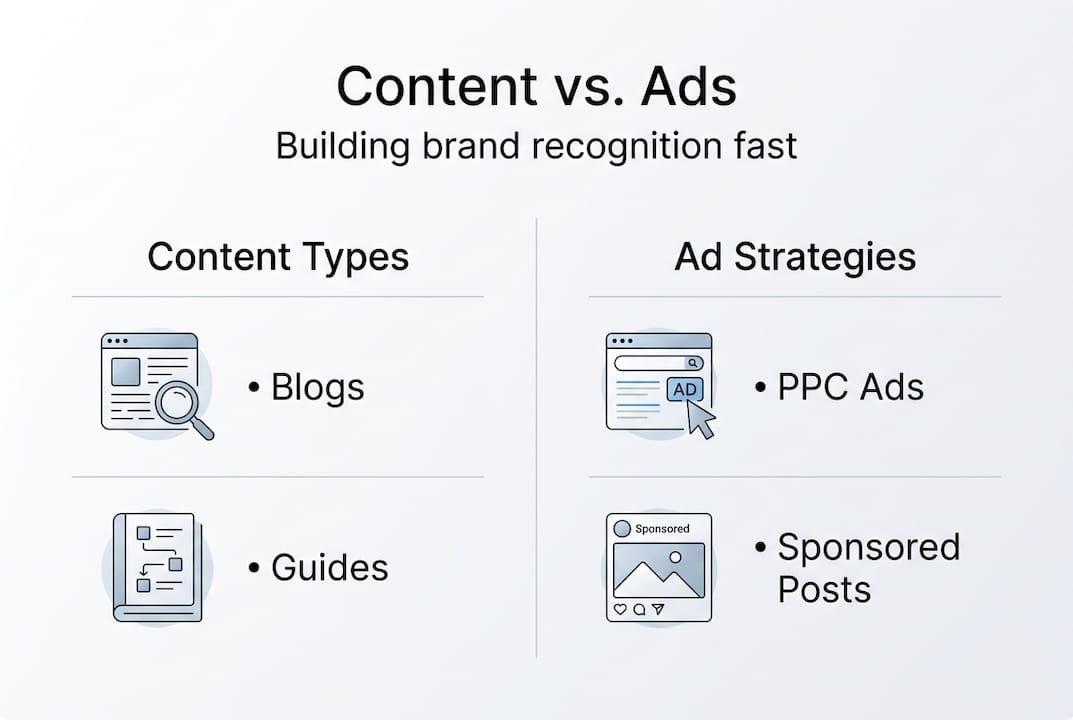
Content vs. paid ads: cost, longevity, and results
Paid ads have their place. But if you’re a small business owner choosing where to put your limited marketing dollars, the comparison between content and ads is eye-opening.
Content compounds for years while ads only drive results when spending continues. The moment your ad budget runs out, so does your visibility. A well-optimized blog post, on the other hand, can generate traffic and leads for three to five years with zero additional spend.
Here’s a direct comparison:
Factor | Content marketing | Paid advertising |
Upfront cost | Moderate | Low to moderate |
Long-term cost | Decreases over time | Constant or rising |
Traffic after stopping | Continues | Stops immediately |
Brand trust built | High | Low |
Repurposability | Very high | Very low |
Customer acquisition cost | Drops over time | Stays flat or rises |
So when does each approach make the most sense?
Use content when you want to build long-term brand authority and reduce acquisition costs over time.
Use paid ads when you need immediate traffic for a product launch or time-sensitive promotion.
Use content when you want to establish expertise and earn customer trust organically.
Use paid ads to amplify content that’s already performing well.
Use content when you want assets that grow in value the longer they exist.
“Ads rent attention. Content owns it.”
The smartest branding strategy for most small businesses combines both, but leans heavily on content as the foundation. Content builds the brand equity that makes your ads more effective when you do run them. Strong brand positioning amplifies every dollar you spend on paid channels. Reviewing content marketing strategies from brands that have scaled this way gives you a proven roadmap.
Strategic frameworks for content-driven branding
Knowing content is valuable is one thing. Building a system that actually delivers consistent results is another. Here’s how to do it without overwhelming yourself.
Research on hybrid content and ads approaches confirms that content yields the best long-term branding effects, especially when it’s built around clear strategic pillars rather than random topics.
Start with these core practices:
Define your content pillars. Pick three to five core topics that connect directly to your expertise and your audience’s needs. Every piece of content you create should fit within one of these pillars.
Prioritize consistency over volume. Publishing one high-quality post per week beats publishing five mediocre ones. Your audience needs to know they can count on you.
Master one platform first. Trying to be everywhere at once is the fastest way to burn out and produce weak content. Pick the channel where your audience is most active and own it before expanding.
Measure what matters. Traffic is a vanity metric on its own. Track leads generated, email sign-ups, time on page, and direct conversions tied to specific content pieces.
Repurpose your wins. A high-performing blog post can become a video script, a social carousel, an email series, and a downloadable guide. One idea, multiple formats, maximum reach.
Pro Tip: Set a monthly brand alignment check. Review your last four pieces of content and ask: do they all clearly reflect the same brand voice, values, and audience focus? If not, recalibrate before creating more. Avoid the scattergun approach that kills momentum for most small businesses. Your digital marketing strategy should map directly to your content pillars. A clear digital branding guide will help you connect your online presence to your broader brand goals.
A branding truth few experts mention
Here’s something most content marketing advice glosses over: doing more is rarely the answer. The brands that grow fastest aren’t the ones publishing daily across six platforms. They’re the ones who got very clear on one message, one audience, and one or two channels, and then repeated that message consistently until it stuck.
We see small business owners exhaust themselves chasing every new content trend, from short-form video to AI-generated newsletters, without ever building real brand equity. The result is a lot of noise and very little recognition.
Brands that avoid the scattergun approach and focus deeply on one channel succeed faster. That’s not a theory. It’s a pattern we see repeatedly.
The uncomfortable truth is that clarity is harder than volume. It takes real work to define what your brand stands for and then say it in a way that resonates. But once you do, every piece of content becomes easier to create and more effective at building trust.
Long-term trust is worth more than a viral moment. A single post that reaches a million people once does less for your brand than 50 posts that reach 500 loyal customers consistently. Focus on depth, not breadth. Build a SME branding strategy that prioritizes your core audience over chasing reach.
Level up your branding with expert-designed content solutions
Applying these strategies takes clarity, consistency, and the right creative foundation. That’s exactly what we build at LOOM Brand Designs.
Whether you’re starting from scratch or refining an existing brand, our tailored packages are designed to give small businesses the tools they need to compete. From our basic branding package that establishes your visual identity and brand voice, to professional graphic design services that make your content stand out, to fully custom website design services that turn visitors into customers, we cover every layer of your brand presence. Let’s build something that lasts.
Frequently asked questions
What content works best for building a small business brand?
Educational guides, storytelling blogs, and consistent social posts are proven to establish expertise and trust. Long-form articles and guides outperform shorter formats for both branding and SEO, making them the top choice for most small business owners.
How is content marketing different from paid ads for small businesses?
Content continues building your brand long after it’s published, while ads stop delivering the moment you stop paying. Content compounds over time, creating lasting effects on trust and customer loyalty that ads simply can’t replicate.
Does my content need to be everywhere to grow my brand?
No. Mastering one or two relevant channels is far more effective than spreading yourself thin. Channel mastery consistently outperforms scattered efforts across every platform.
How can I measure the branding impact of my content?
Track leads, engagement rates, and direct conversions rather than traffic alone. Brand impact measurement is most accurate when you combine engagement data with regular brand audits to assess clarity and message alignment.
Recommended
Comments