


What is brand positioning: a guide to gaining market edge
- Pawan Samarakoon
- Mar 23
- 9 min read

Brand positioning isn’t just another marketing buzzword or a catchy tagline you slap on your website. It’s the strategic foundation that determines how your target customers perceive your brand relative to competitors, and it directly impacts your bottom line. Companies with strong positioning achieve 20-40% higher profit margins, 2-3x faster revenue growth, and ROI up to 348%. This guide cuts through the confusion to explain what brand positioning truly means, the strategic types you can leverage, the nuances that separate winners from failures, and how to apply positioning principles to gain a sustainable competitive edge in your market.
Table of Contents
Key Takeaways
Point | Details |
Profitability uplift | Strong positioning is linked to twenty to forty percent higher profit margins, two to three times faster revenue growth, and ROI up to three hundred forty eight percent. |
Mushy middle avoidance | Clear differentiation prevents the mushy middle and makes messaging more efficient. |
Positioning types | The guide outlines categories such as value based, price and quality leadership, customer service, performance, lifestyle, innovation, and customer centric approaches. |
Ongoing adjustment | Positioning requires continual refinement to stay relevant and competitive. |
What is brand positioning and why it matters
Brand positioning is the strategic place your brand occupies in the minds of your target customers relative to competitors. It’s not what you say about yourself, it’s what customers believe about you when they compare options. This perception shapes every purchasing decision, loyalty pattern, and word-of-mouth recommendation your business receives.
The business impact of strong positioning is substantial and measurable. Companies with strong positioning achieve 20-40% higher profit margins, 2-3x faster revenue growth, and ROI up to 348% compared to brands with weak or unclear positioning. These aren’t marginal improvements. They represent the difference between thriving and merely surviving in competitive markets.
Strong brand positioning delivers tangible benefits across multiple dimensions:
Revenue acceleration through clearer value communication that converts prospects faster
Premium pricing power because customers perceive distinct value worth paying more for
Customer loyalty and retention as positioning creates emotional connections beyond transactions
Market share gains by owning a specific perception that competitors can’t easily replicate
Reduced marketing costs since clear positioning makes messaging more efficient and targeted
“Brands with clearly defined positioning see customer acquisition costs drop by 30-50% while simultaneously increasing conversion rates by 25-35%, creating a compounding effect on profitability and growth trajectory.”
Understanding what is branding helps clarify how positioning fits into your broader brand strategy. While branding encompasses your entire identity, positioning specifically addresses the competitive space you claim in customer minds. This distinction matters because you can have beautiful branding elements that fail to position your business effectively against alternatives.
The correlation between positioning strength and business outcomes isn’t coincidental. When customers clearly understand what makes your brand different and valuable, they make faster decisions, pay premium prices more willingly, and recommend you more frequently. This clarity reduces friction throughout the customer journey, from awareness to advocacy.
Types of brand positioning strategies
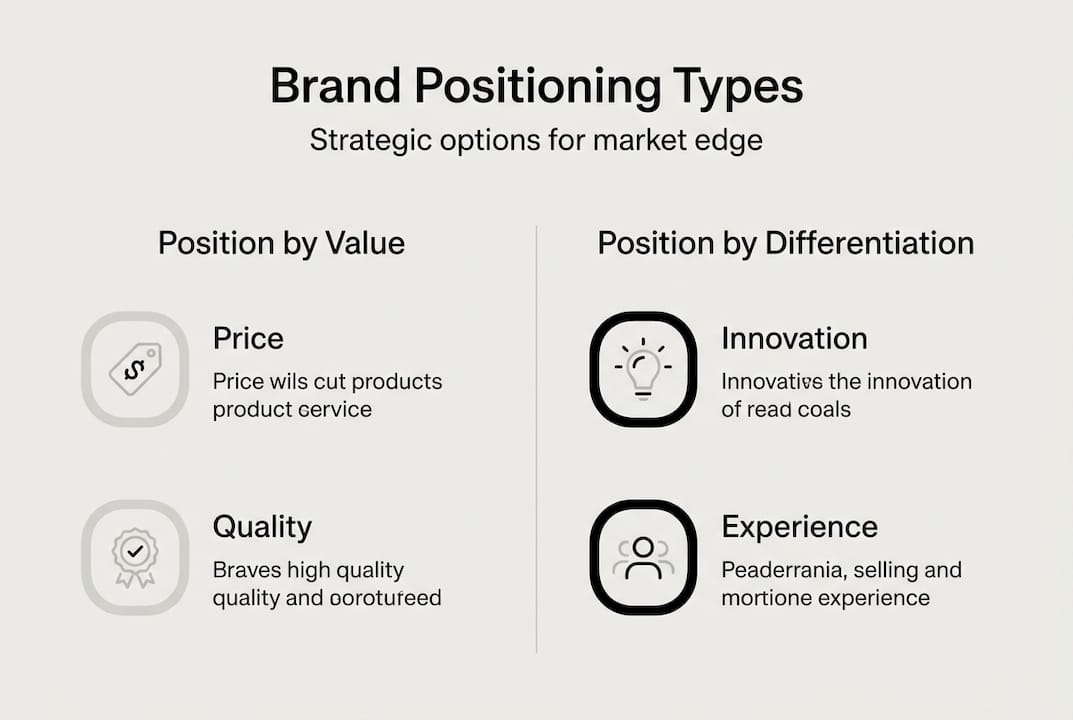
Choosing the right positioning type determines how effectively you differentiate from competitors and resonate with target customers. Types include value-based, price/quality leadership, customer service, performance, lifestyle, innovation-based, and customer-centric approaches, each serving different strategic objectives and market contexts.
Positioning Type | Primary Focus | Best For | Example Brands |
Value-based | Maximum benefit per dollar | Price-conscious markets | Costco, IKEA |
Quality leadership | Premium materials and craftsmanship | Affluent segments | Rolex, Patagonia |
Customer service | Experience and support excellence | Service-intensive industries | Zappos, Ritz-Carlton |
Performance | Superior functional results | Results-driven buyers | Tesla, Nike |
Innovation | Cutting-edge solutions | Early adopters and tech enthusiasts | Apple, Dyson |
Lifestyle | Identity and aspirational values | Emotionally-driven purchases | Harley-Davidson, Lululemon |
Customer-centric | Personalization and relationships | Relationship-focused markets | Amazon, Nordstrom |
Each positioning type carries specific advantages and potential pitfalls:
Value-based positioning attracts volume but risks commoditization if competitors match pricing
Quality leadership commands premiums but requires consistent delivery that justifies higher costs
Customer service differentiation builds loyalty but demands operational excellence across touchpoints
Performance positioning appeals to rational buyers but faces constant pressure from competitive improvements
Innovation-based approaches create excitement but require continuous R&D investment to maintain leadership
Lifestyle positioning generates passionate communities but limits addressable market size
Customer-centric strategies build retention but need robust data infrastructure to personalize effectively
Pro Tip: Choose positioning that authentically aligns with your brand’s core operational strengths, not aspirational claims you can’t defend. Customers quickly detect disconnects between positioning promises and actual delivery, which destroys trust faster than weak positioning ever could.
Domino’s provides a compelling example of innovation-based positioning. Rather than competing on taste alone, they repositioned around transparency and customer experience, showing pizza-making processes and delivery tracking in real time. This strategic choice differentiated them in a crowded market by claiming a perception space competitors hadn’t considered.

Exploring top types of branding strategies reveals how positioning choices integrate with broader strategic frameworks. The positioning type you select should complement your overall branding approach, creating consistency between what you claim and how you execute across all customer touchpoints.
Nuances, risks, and contrasting perspectives in brand positioning
Successful positioning requires passing three critical tests that separate viable strategies from wishful thinking:
Relevance: Does your positioning address needs that genuinely matter to target customers right now?
Defensibility: Can you actually deliver on positioning claims better than competitors can copy them?
Uniqueness: Does your position occupy distinct mental space, or does it blend into generic category noise?
Failing any single test creates vulnerability. Irrelevant positioning wastes resources on differentiation customers don’t value. Indefensible positioning invites competitive replication that erodes your advantage. Generic positioning traps you in what experts call the ‘mushy middle’ where brands become interchangeable and forgettable.
“The positioning void kills brands by leaving them stuck in the mushy middle, where they’re neither the cheapest option nor the premium choice, neither the most innovative nor the most reliable. This void creates a perception vacuum that competitors fill with their own narratives.”
Economic and cultural factors add complexity that many positioning frameworks ignore. Economic downturns shift customer priorities from premium quality to value optimization, potentially undermining quality-based positioning overnight. Cultural differences make positioning that resonates in one geography fall flat or offend in another. Brands expanding internationally often discover their domestic positioning requires significant adaptation.
Theoretical perspectives on positioning reveal fundamental tensions in how experts approach the challenge. Market-oriented positioning emphasizes customer perceptions as the primary driver, arguing brands should position based on how target segments already think and make decisions. This outside-in approach prioritizes market research and competitive analysis.
Conversely, brand-oriented positioning starts with company identity and capabilities, building positioning from authentic organizational strengths outward. This inside-out approach argues that sustainable positioning must reflect genuine brand essence rather than chasing customer preferences that shift with trends.
The tension between these perspectives isn’t academic hairsplitting. It determines whether you position based on current customer perceptions or attempt to reshape those perceptions around your unique strengths. Most successful positioning strategies balance both, identifying customer needs that align with defensible brand capabilities.
Treating positioning as a static label rather than a dynamic strategy represents another common failure mode. Markets evolve, competitors reposition, customer preferences shift, and technological disruptions redefine categories. Positioning that worked brilliantly five years ago may have become irrelevant or easily replicated today.
Understanding the strategic role of logos in visual positioning helps clarify how design elements reinforce or undermine strategic positioning. Your logo and visual identity should instantly communicate your positioning, creating immediate recognition of what makes you different before customers read a single word.
Applying brand positioning strategically for growth and differentiation
Implementing effective brand positioning requires systematic execution across research, definition, communication, and measurement:
Analyze your competitive landscape to identify positioning gaps and overcrowded perception spaces
Define your target customer segments with precision, understanding their decision criteria and perception patterns
Articulate your unique value proposition that passes relevance, defensibility, and uniqueness tests
Develop positioning statements that guide all marketing, sales, and product decisions consistently
Test positioning concepts with real customers before full rollout to validate resonance and differentiation
Align all brand touchpoints including messaging, visual identity, customer experience, and product features
Communicate positioning consistently across channels while adapting format to each medium’s strengths
Measure positioning effectiveness through brand perception studies, competitive win/loss analysis, and pricing power
Monitor market changes and customer feedback to identify when repositioning becomes necessary
Adjust positioning iteratively based on performance data rather than waiting for complete strategy overhauls
The measurable impact of strong versus weak positioning shows up clearly in financial performance:
Metric | Strong Positioning | Weak Positioning | Difference |
Profit Margin | 35-45% | 15-20% | +20-25 points |
Revenue Growth Rate | 25-40% annually | 8-12% annually | 3x faster |
Customer Acquisition Cost | $45-65 | $95-140 | 50% lower |
Customer Lifetime Value | $2,800-4,200 | $950-1,400 | 3x higher |
Brand Recall | 65-80% | 20-35% | 2-3x stronger |
Repositioning can drive significant growth, as demonstrated by Domino’s 14.3% sales jump after their bold transparency-focused repositioning and Olipop’s revenue surge from $73M to $100M by positioning as a healthy soda alternative rather than competing in the crowded functional beverage space.
Pro Tip: Reposition boldly when market conditions demand it, but maintain transparency with existing customers about why you’re evolving. Customers forgive strategic pivots when you explain the reasoning honestly, but they punish brands that seem to chase trends without authentic conviction.
Continuous monitoring separates positioning leaders from laggards. Set up quarterly brand perception tracking to measure how target customers describe your brand versus competitors. Analyze win/loss data from sales conversations to understand when positioning resonates and when it falls flat. Monitor social media sentiment and review content to spot emerging perception gaps before they become crises.
Aligning positioning with all branding elements creates consistency that reinforces your strategic claims. Your visual identity should instantly communicate your positioning before customers engage with messaging. Your customer experience should deliver on positioning promises at every touchpoint. Your product features should validate the differentiation you claim.
Exploring a brand refresh guide helps identify when your positioning needs updating versus when it requires complete repositioning. Minor positioning adjustments can address incremental market shifts, while major repositioning becomes necessary when your current position loses relevance or defensibility.
For comprehensive positioning development, reviewing brand positioning strategies specific to small business contexts provides frameworks scaled appropriately for resource constraints and competitive dynamics that SMEs face.
Discover expert branding services to sharpen your brand positioning
Establishing strong brand positioning requires both strategic insight and execution excellence. LOOM Brand Designs specializes in helping businesses develop positioning strategies that drive measurable competitive advantage and revenue growth.

Our basic branding package provides foundational positioning work including competitive analysis, target audience definition, and positioning statement development. For businesses seeking data-driven positioning intelligence, our AI brand intelligence enterprise solution analyzes market perceptions, competitive positioning gaps, and customer sentiment at scale to inform strategic decisions.
Once positioning strategy is defined, our graphic design services ensure visual elements align perfectly with your strategic positioning, creating immediate recognition and reinforcement. We help translate positioning strategy into tangible brand assets that communicate your differentiation instantly and consistently across all customer touchpoints.
Frequently asked questions
What distinguishes brand positioning from branding?
Branding encompasses your entire identity including visual elements, messaging, culture, and customer experience. Positioning specifically defines the competitive space you occupy in customer minds relative to alternatives. You can have strong branding with weak positioning if your identity doesn’t clearly differentiate you from competitors.
How often should businesses revisit their brand positioning?
Review positioning quarterly through brand perception tracking and competitive analysis, but only reposition when data shows your current position has lost relevance, defensibility, or uniqueness. Minor adjustments can address incremental shifts, while major repositioning should occur every 3-5 years or when significant market disruptions demand strategic response.
What are signs a brand needs repositioning?
Key indicators include declining profit margins despite stable sales, increasing customer acquisition costs, losing deals to competitors on price alone, brand perception studies showing weak differentiation, and difficulty articulating what makes you different. If customers describe you with generic category terms rather than unique attributes, repositioning is likely necessary.
How can startups choose the right brand positioning?
Start by identifying positioning gaps in your competitive landscape where customer needs aren’t adequately addressed. Select a position you can defend with genuine operational capabilities, not aspirational claims. Test positioning concepts with target customers before committing resources, and choose differentiation that matters enough to influence purchase decisions rather than interesting but irrelevant distinctions.
What role do customer perceptions play in positioning effectiveness?
Customer perceptions are the ultimate measure of positioning success because positioning exists entirely in customer minds, not in your marketing materials. You can claim any position you want, but if customers don’t perceive you that way relative to alternatives, your positioning has failed. Effective positioning aligns what you claim with what customers actually believe and experience.
Recommended
Comments