

TL;DR:
- Conversion optimisation increases the actions people take on your website by finding and removing barriers through research and testing.
- Copy improvements, especially headlines and value propositions, are usually the best place to start.
Conversion optimisation is the systematic process of increasing the share of website visitors who complete a desired action, such as buying, submitting a form or signing up for a newsletter. The standard industry term is conversion rate optimisation, usually shortened to CRO. CRO improves profitability without needing more ad spend or more traffic. It works by finding out why visitors leave without acting, then testing changes that remove those barriers. The elements that matter most in any CRO programme are headlines, value propositions, calls to action and trust signals. Businesses that treat CRO as a continuous, data-led discipline tend to beat those that rely on design instinct.
What is conversion optimisation and how does it work?
CRO is a structured, repeatable process with four stages: research, hypothesis, testing and refinement. Each stage feeds the next, so gains build over time. CRO is not the same thing as A/B testing. A/B testing is one tool within a wider approach that includes audience research, funnel analysis and alignment with revenue goals.

It starts with understanding your audience properly. Voice-of-customer research, which means going through support tickets, reading product reviews and listening to sales calls, shows you the exact words customers use to describe their problems. Those words become the raw material for persuasive copy. Skip this step and even well-designed tests produce weak results, because the message does not connect.
Research leads to a hypothesis. A strong one follows a clear structure: "If we change X, then Y will happen, because Z." The format makes you state the reason for a change, not only the change. Vague ideas such as "let's try a red button" produce noise, not insight.
Then you test. Reaching statistical significance at the 95% level is the usual standard for trusting a result. Act on a test below that threshold and you risk reacting to random variation rather than real behaviour. When a test ends, analyse the results, roll out the winner and feed what you learned into the next hypothesis.
Pro tip: never stop a test early because the first results look promising. Ending before you reach significance is one of the most common and expensive CRO mistakes.
Which conversion strategies have the most impact?
CRO changes are not all equal. It helps to think of them in three tiers.
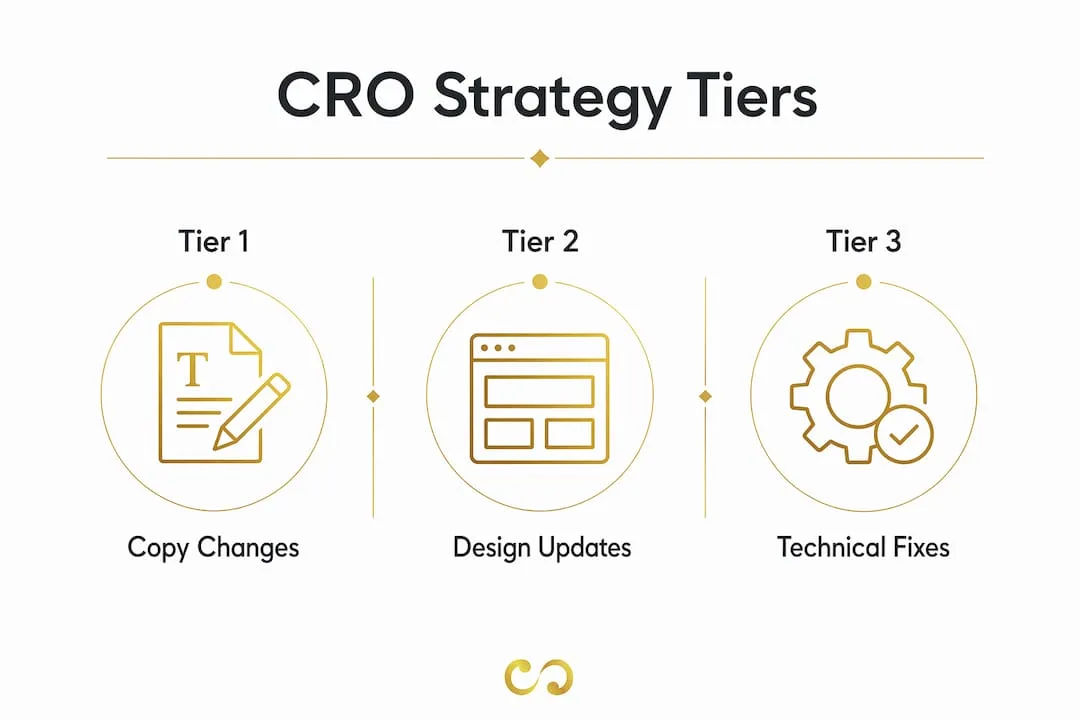
| Tier | Strategy type | Examples | What it fixes |
|---|---|---|---|
| Tier 1 | Copy-led changes | Headlines, value propositions, calls to action, proof elements | Unclear message and weak motivation to act |
| Tier 2 | UX and design improvements | Page layout, visual hierarchy, simpler forms | Friction and confusion on the page |
| Tier 3 | Technical changes | Site speed, mobile rendering, load time | Slow or broken experiences |
Copy-led changes are often where the biggest gains sit, yet many marketers spend most of their time on Tier 2 and Tier 3 work. The reason is psychological. Design and technical changes feel concrete and safe. Rewriting a headline feels risky because it needs a clear view of what the customer actually wants.
The headline deserves special attention. Many visitors read the headline and little else, so it does much of the persuading on any page. A headline that states the benefit plainly, speaks to the visitor's specific problem and sets accurate expectations will beat a clever or vague one.
Value propositions work the same way. A strong one answers three questions in a sentence: what you offer, who it is for and why it is better than the alternative. Many business websites bury this or write it in company-centred language that visitors do not see as relevant to them.
Pro tip: read your headline aloud and ask: "Would a first-time visitor immediately understand what this page offers and why it matters to them?" If not, rewrite it before running any other test.
How does conversion optimisation differ from SEO?
SEO and CRO solve different problems, but they work best together. SEO fills the top of the funnel by bringing more visitors through rankings and visibility. CRO converts the visitors who are already arriving, plugging the leaks that let potential customers slip away.
A business that invests only in SEO growth without CRO is filling a bucket with a hole in it. Traffic grows but revenue does not keep up. The reverse is true as well: a site that converts brilliantly but gets no organic traffic has nobody to convert. Each discipline makes the other more valuable.
The key differences:
- Goal: SEO targets search rankings; CRO targets what visitors do once they arrive.
- Main metric: SEO measures organic traffic and keyword positions; CRO measures conversion rate and revenue per visitor.
- Timeframe: SEO builds over months; CRO tests can show results in days or weeks.
- Audience: SEO speaks to search algorithms and intent signals; CRO speaks to the person reading the page.
- Tools: SEO uses keyword research, backlink analysis and technical audits; CRO uses A/B testing platforms, heatmaps, session recordings and customer research.
Together they reinforce each other. Pages that convert well often earn more links and keep visitors engaged for longer, both of which help search performance. Better SEO brings more qualified visitors, who convert better because they arrived with clear intent. Any serious digital marketing checklist should include both.
What practical techniques improve conversion results?
Effective CRO programmes share a set of habits. They start with customer research, prioritise changes by likely impact and measure everything carefully.
Voice-of-customer research is the foundation. Copy built from the language in support tickets, reviews and sales calls resonates because it uses the words customers already use about their own problems. Marketer-written language tends to be polished but generic. Customer language is specific, emotional and persuasive.
Techniques that work consistently:
- Heatmaps: show where visitors click, scroll and stop reading, so you can see what gets attention and what gets ignored.
- Session recordings: watching real sessions reveals friction that analytics alone cannot explain.
- Fewer form fields: removing unnecessary fields usually lifts submissions. Every extra field is another reason to give up.
- Social proof near the decision: testimonials, case studies and review counts placed close to calls to action reduce anxiety at the moment of choice.
- Mobile experience review: mobile optimisation affects conversion directly, because a poor mobile experience makes people leave before they act.
Prioritise with the ICE framework: impact, confidence and ease. Score each test idea on all three and run the highest scorers first. It stops teams spending weeks on small changes while the valuable ideas wait.
Good CRO ties improvements to revenue, not just page metrics. A 10% rise in form submissions means nothing if those submissions never turn into paying customers. Always trace a conversion back to its effect on actual revenue.
Pro tip: use exact customer quotes from reviews as headline or subheadline copy. People trust language that sounds like them, not like a marketing department.
Key takeaways
Conversion rate optimisation pays off most when it starts with audience research and puts copy changes ahead of design tweaks and technical fixes.
| Point | Details |
|---|---|
| Copy changes often matter most | Headlines, value propositions and calls to action are usually the best place to start testing. |
| Research before testing | Voice-of-customer research from reviews and support tickets produces more persuasive copy than marketer-written language. |
| Statistical rigour matters | Run tests to 95% significance before acting on results, to avoid false positives. |
| CRO and SEO reinforce each other | SEO brings qualified traffic and CRO converts it, growing revenue without a matching rise in ad spend. |
| Tie conversions to revenue | Page-level metrics only matter when traced back to their effect on actual revenue. |
Why I think most businesses get CRO backwards
The pattern I see most often with digital marketers and business owners is this: teams spend most of their CRO budget on design refreshes and technical performance, then wonder why conversion rates barely move. They are working on Tier 3 while their Tier 1 problems go untouched.
The uncomfortable truth is that a slow page with a brilliant headline will often beat a fast page with a weak one. A clearer headline is one of the quickest ways to improve conversion, yet it gets the least attention because rewriting copy needs real knowledge of the customer. That knowledge only comes from research, and research feels slower than launching a new colour scheme.
The second mistake I see all the time is treating CRO as a one-off project. Teams run a few A/B tests, declare victory or defeat and move on. Real CRO is a permanent function, not a campaign. Each test teaches you something about your audience, and that knowledge builds up. Businesses that keep testing for a year see gains that outgrow anything a single test can deliver.
My honest recommendation: before you touch your page design, spend two weeks reading every customer review, support ticket and sales call transcript you can get hold of. The copy that will lift your conversions is already in those documents. You just have to find it and put it on the page.
Pawan
How LOOM Brand Designs helps you convert more visitors
A high-converting website needs more than good copy. The design, the clarity of the brand and the user experience all decide whether visitors trust you enough to act.
LOOM Brand Designs offers website design and development built to support higher conversion rates. Pages are structured around clear value, a logical flow and trust signals that reduce hesitation at the moment of decision. Our AI Brand Intelligence Pro tool provides brand insights that sharpen your messaging before a single test runs. When your brand identity, visual design and web experience work together, conversion improvements come faster and last longer. We build that foundation with you.
FAQ
What is conversion rate optimisation in simple terms?
It is the process of increasing the share of website visitors who take a desired action, such as buying a product or filling in a form, through research, testing and data-led changes.
How is conversion rate calculated?
Divide the number of conversions by the total number of visitors and multiply by 100. For example, 50 purchases from 1,000 visitors is a 5% conversion rate.
What is the most important element to test first?
Usually the headline. Many visitors read the headline and little else, so making it clearer is one of the fastest ways to improve conversion.
How long should a conversion test run?
Until it reaches 95% statistical significance, however promising the early results look. Ending a test early is a leading cause of false positives and wasted changes.
Is conversion optimisation only for e-commerce sites?
No. Any website with a measurable goal, including lead generation, SaaS sign-ups and service enquiries, benefits from CRO. Audience research, hypothesis testing and steady refinement apply to every business model.
The Hashtag Loom