

TL;DR:
- Influencer marketing is brands working with social media creators who make genuine content to promote products. It can deliver strong returns, with Mailchimp citing an average of $5.78 earned per dollar spent, because audiences carry their trust in a creator over to the brand. Success depends on niche fit, long-term partnerships and a systematic strategy that puts relevance ahead of follower count.
Influencer marketing is a strategy where brands partner with social media creators to promote products or services through content their audience trusts. Unlike traditional advertising, it turns a creator's credibility into purchase intent. According to Mailchimp, citing Influencer Marketing Hub, businesses earn an average of $5.78 for every dollar spent on influencer marketing. For marketers and business owners, understanding how influencer marketing works is the first step to using it profitably.
What is influencer marketing and how does it work?
Influencer marketing is a direct partnership between a brand and a creator who has built an audience around a specific niche or lifestyle. The creator makes content featuring the brand's product or service, and their audience receives it as a recommendation from someone they follow rather than as an advert. That difference is the whole point.
Partnership structures vary:
- Sponsored posts: a one-off or recurring paid post on Instagram, TikTok, YouTube or LinkedIn
- Brand ambassadorship: a long-term relationship where the creator represents the brand over months or a full campaign cycle
- Product gifting: the brand sends free products in the hope of coverage, with no guaranteed post
- Affiliate arrangements: the creator earns commission on sales made through a unique link or code
Payment models include flat fees, gifted products, performance-based commission, or a mix. Budgets vary hugely with the creator's tier and platform. A nano-influencer on Instagram might accept gifted product, while a large YouTube creator can charge five-figure fees per video.
Trust is what makes the system work. Authenticity drives engagement far more reliably than scripted brand messaging. Brands that hand creators a rigid script tend to do worse than brands that give clear guidelines and then step back.
Pro tip: Give influencers a creative brief with brand boundaries, key messages and disclosure requirements. Then let them tell the story in their own voice. Audiences spot corporate copy instantly.
What are the real benefits of influencer marketing?
The core benefit is trust transfer. A creator's audience already believes their recommendations, so a brand mention inherits that credibility. Hootsuite reports that 60% of consumers now trust what a creator says about a brand more than what the brand says about itself. That gap between creator trust and brand trust is the commercial opportunity.
| Metric | Data point |
|---|---|
| Average return | $5.78 earned per $1 spent (Mailchimp, citing Influencer Marketing Hub) |
| Trust in creators | 60% of consumers trust creators over the brand itself (Hootsuite) |
Influencer marketing also supports paid search, SEO and email. A creator post can drive searches for your brand name, and those searchers arrive already primed by the creator's recommendation, which tends to help conversion. The channels reinforce each other rather than compete. See how AI-driven ROI tracking is making this kind of cross-channel attribution more precise.
Pro tip: Micro-influencers (roughly 10,000 to 100,000 followers) often deliver higher engagement than the biggest names. If your goal is community trust rather than raw reach, start with micro-influencers in your niche before scaling up.
What types of influencers should you work with?
Influencer tiers are defined by follower count, but the right choice depends on your campaign goal, not the number. Each tier has a distinct role.
| Influencer tier | Follower range | Best for |
|---|---|---|
| Nano | 1,000 to 10,000 | Hyper-local trust, product testing, community seeding |
| Micro | 10,000 to 100,000 | Niche engagement, strong conversion, cost efficiency |
| Macro | 100,000 to 1,000,000 | Brand awareness at scale, broad demographic reach |
| Mega | 1,000,000+ | Mass awareness, celebrity-level visibility |
A 2025 meta-analysis found that small and medium-sized influencers drive higher engagement, while larger influencers can be more efficient for purchase intent at scale. The lesson: match the tier to the objective, not to the top of your budget.
A reliable selection framework is the three Rs:
- Reach: does the creator's audience size match your awareness goals?
- Relevance: does their content niche fit your product category and brand values?
- Resonance: does their audience actively engage, comment and act on recommendations?
Niche fit matters far more than follower count for engagement and trust. A fitness equipment brand working with a general lifestyle creator with 2 million followers will usually do worse than one partnering with a dedicated strength-training creator with 80,000. The smaller creator's audience is already qualified.
Influencers act as digital brand ambassadors whose credibility comes from niche authority and ongoing community engagement. That community relationship is what you are paying to access. Treat it with care.
How to build an influencer marketing strategy that lasts
A systematic influencer programme produces compounding returns. One-off posts create spikes. Sustained programmes build brand equity. The difference lies in how you set it up.
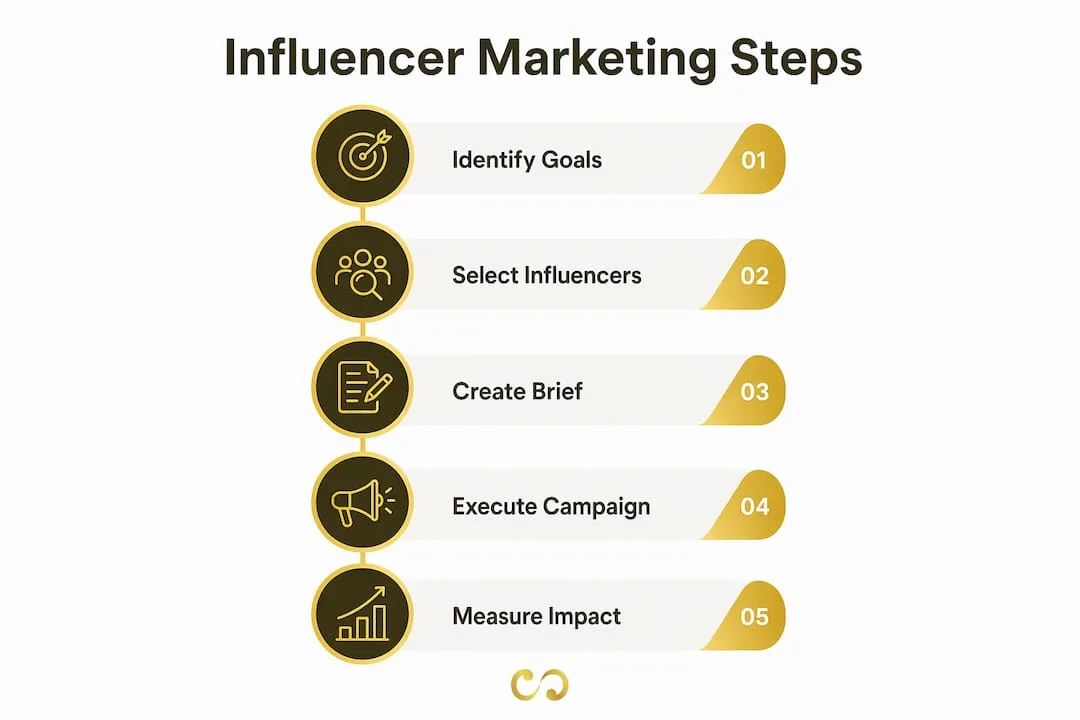
Follow these six stages to build a programme that scales:
- Discovery: define your campaign objective first. Awareness, product launches and direct conversions each need different creator profiles and content formats.
- Strategy: set your budget, choose platforms and decide on partnership types. Instagram and TikTok dominate for consumer brands. LinkedIn and YouTube work better for B2B and long-form education.
- Outreach: contact creators with a personal pitch that explains why their audience is the right fit. Generic mass outreach gets few replies and weaker partnerships.
- Collaboration: provide a clear creative brief covering brand guidelines, required disclosures, key messages and deadlines. Leave the creative execution to the creator.
- Measurement: track reach, engagement rate, click-through rate and conversions tied to unique links or promo codes. Connect campaign data to your wider marketing attribution.
- Optimisation: review performance after each campaign. Do more with the creators and formats that work. Drop what doesn't perform after a fair test.
Long-term partnerships build ongoing brand equity and keep returns coming, rather than one-off traffic spikes. Brands that treat creators as ongoing collaborators tend to outperform those that rotate creators every campaign. For a wider view of how this fits your overall approach, see these marketing strategy examples.
Common pitfalls to avoid:
- Choosing creators on follower count alone without checking engagement quality
- Skipping advertising disclosure rules (set by the ASA and CMA in the UK, and the FTC in the US), which creates legal and reputational risk
- Measuring only vanity metrics like likes without connecting them to revenue or pipeline
- Running a single campaign and deciding the channel doesn't work
Pro tip: Keep a simple performance scorecard for every influencer you work with. Track engagement rate, link clicks and conversion rate per post. After three campaigns you will have enough data to spot your top performers and move budget towards them.
Influencer marketing campaign examples worth studying
Real campaigns show the patterns that separate strong programmes from forgettable ones. The most effective share creator-audience fit, genuine storytelling, and a call to action that feels natural in the content.
- Glossier built its brand on seeding products with everyday customers and beauty enthusiasts, generating content that felt like genuine peer recommendations. It became a cult brand with very little traditional advertising.
- Gymshark grew from a small UK fitness apparel brand into a global name by partnering with fitness creators on YouTube and Instagram before influencer marketing was mainstream. Long-term ambassador relationships kept the brand visible inside highly engaged fitness communities.
The lesson from both is the same: creator-audience fit matters more than production quality or budget. A well-matched creator with 50,000 engaged followers will usually beat a mismatched one with 5 million passive followers. For more ideas, look at these standout marketing campaign examples across industries.
The brands that win treat creators as long-term partners, not media placements.
Key takeaways
Influencer marketing works when brands put niche fit, genuine content and sustained partnerships ahead of follower count and one-off placements.
| Point | Details |
|---|---|
| Returns can be strong | Mailchimp, citing Influencer Marketing Hub, puts the average at $5.78 earned per $1 spent. |
| Trust drives conversions | Hootsuite reports that 60% of consumers trust creators more than brands, so authenticity is the asset to protect. |
| Tier choice shapes outcomes | Match the tier to the goal: micro for engagement, macro for awareness, mega for mass reach. |
| Strategy beats tactics | A six-stage process from discovery to optimisation compounds in a way one-off posts can't. |
| Niche fit beats follower count | Audience relevance and engagement quality predict performance better than raw follower numbers. |
Why most brands get influencer marketing wrong
I have watched brands put serious budget into influencer programmes and walk away disappointed, almost always for the same reason. They optimised for the metric they could see (follower count) instead of the one that drives revenue (audience trust and relevance).
The friend factor is the real mechanism. When a creator recommends a product, their audience hears it the way they would hear a recommendation from a trusted friend. Traditional advertising can't replicate that, whatever the production budget. The moment a brand over-scripts a creator or forces an unnatural product placement, the friend factor disappears.
My view is that most brands should start smaller than they think. Work with three to five micro-influencers in your exact niche before you consider macro or mega partnerships. You will learn which messages resonate, which formats convert and what your real cost per acquisition is. That data is worth more than any single viral post.
The other mistake I see constantly is treating influencer marketing as a standalone channel. The brands that get the best results fold creator content into their wider social media marketing, reuse creator content in paid ads, and use influencer campaigns to feed their SEO and email. The channel multiplies when it connects to everything else you do.
Pawan
Ready to turn influencer reach into real brand growth?
A successful influencer campaign needs more than the right creator. Your brand needs a strong visual identity, a website that converts the traffic creators send, and content that stands up to scrutiny from a new audience.
LOOM Brand Designs builds the brand foundations that make influencer campaigns work harder. From brand identity and logo design to video content production and professional website development, we can put the digital groundwork in place for your campaigns. If you want a brand that creators are glad to partner with and audiences trust on first contact, we would love to talk.
FAQ
What is influencer marketing in simple terms?
Influencer marketing is when brands pay or partner with social media creators to promote products to the creators' audiences. It works because a creator's recommendation carries the trust of a personal recommendation rather than an advert.
How much does influencer marketing cost?
Costs range from gifted product for nano-influencers to five-figure fees for the biggest creators. Payment models include flat fees, commission, gifting and hybrid arrangements, depending on the creator's tier and platform.
What is a micro-influencer and why do they matter?
A micro-influencer usually has between 10,000 and 100,000 followers and often delivers higher engagement than larger creators. Research suggests smaller creators are especially effective for niche audience trust and cost-efficient engagement.
How do you measure influencer marketing ROI?
Track engagement rate, unique link clicks, promo code redemptions and conversions attributed to each creator, and connect that data to revenue. As a benchmark, Mailchimp, citing Influencer Marketing Hub, puts the average return at $5.78 per dollar spent.
What platforms work best for influencer marketing campaigns?
Instagram and TikTok dominate for consumer products, while YouTube suits long-form reviews and tutorials. LinkedIn is the strongest platform for B2B influencer programmes aimed at professional decision-makers.
The Hashtag Loom