

TL;DR:
- SEO in 2026 means being visible on every search surface, including AI Overviews and generative answer engines. Authority and clear, factual, well-structured content are what earn AI citations, which now matter as much as traditional rankings. Checking whether AI answers mention your brand, and describe it accurately, has become part of measuring SEO success.
SEO in 2026 is about visibility on every surface where search happens, from Google's classic blue links to AI Overviews, AI Mode, Maps, Shopping and generative answer engines. The goal has moved. Ranking first still matters, but being cited as a trusted source in an AI-generated answer now carries as much weight. If your brand does not appear in those answers, a growing share of searchers will never see you. The discipline now spans several platforms, several formats and a different relationship between content and search engines.
How has AI transformed traditional SEO practices?
Traditional SEO rested on three pillars: keywords, backlinks and technical health. They still stand, but AI search has added a fourth layer that many marketers are still working out.
Google's AI Overviews and AI Mode do not replace the core ranking system. Google's own guidance says foundational SEO best practice is the basis for visibility in its generative AI features, which depend on the same core ranking systems and spam protections as the rest of Search. Classic SEO is not obsolete. It is the entry ticket. Without solid crawlability, indexability and content quality, your site will not appear in AI answers however hard you try to optimise for them.
What has changed is the output. Search engines used to return a list of links. Now they combine facts, weigh credibility and give direct answers. AI search engines reward clear, factual content that is easy to extract, not keyword-stuffed paragraphs written to game an algorithm. The shift is from ranking pages to being cited in answers.
What are AI Overviews and AI Mode?
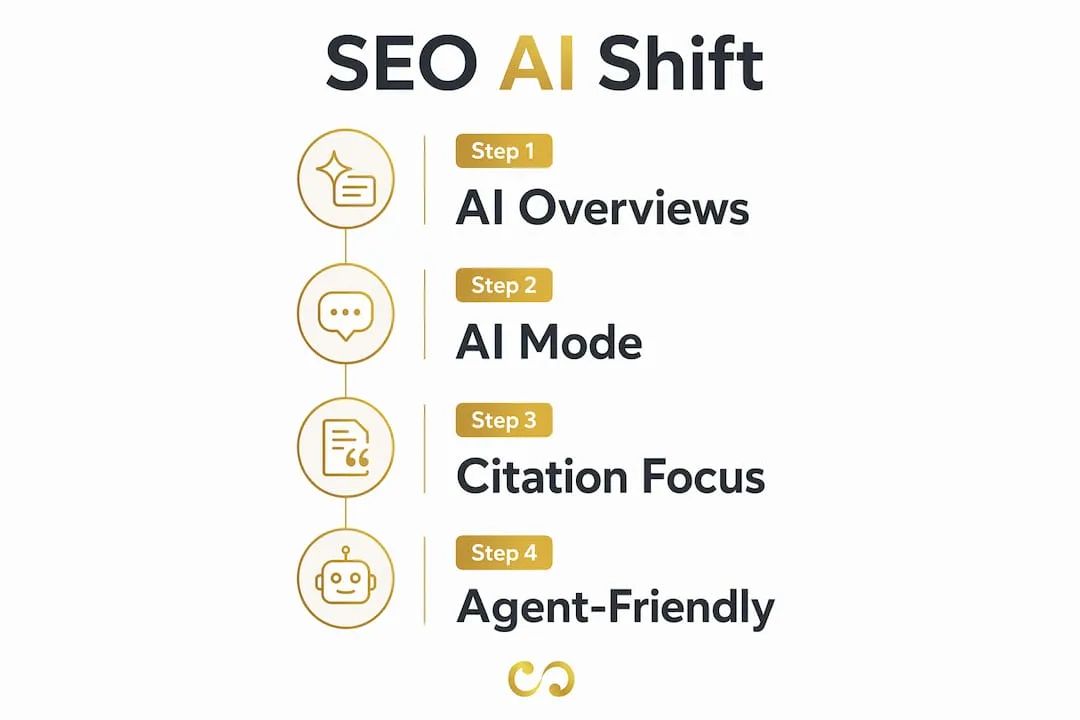
AI Overviews appear at the top of Google results and bring together answers from several sources. AI Mode goes further and works more like a conversational assistant that can handle multi-step questions. Both draw on sources that are authoritative, clear and well structured, so your content needs to answer questions directly and fully.
Pro tip: Open every major article with a clear one-paragraph summary. Putting your main point first helps readers and makes it easier for any system, human or machine, to see what the page is about.
Chris Green, writing in Search Engine Land, describes SEO in 2026 as a new layer on top of classic SEO hygiene, with added complexity around AI discovery and extractable content. That is a useful way to see it. You are not starting again. You are adding a new skill to an existing foundation.
What are the biggest SEO trends in 2026?
Three trends are shaping SEO this year: zero-click optimisation, entity citation and agent-friendly content. Each needs a different approach from what worked a few years ago.

Zero-click optimisation means writing content so search systems can pull out a direct answer without the user clicking through. HubSpot describes optimising for extractable answers as a core SEO goal rather than a side tactic. Clicks are not dead. Your content has to earn the citation first, and the click may follow.
Entity citation is about how AI systems recognise and reference authoritative sources. Google looks at whether your brand, your authors and your content are recognised as credible. E-E-A-T (Experience, Expertise, Authoritativeness, Trustworthiness) is the framework Google uses to describe this. Visible author credentials, original research and a consistent brand presence across the web all help.
Agent-friendly content is the newest requirement. Google's AI agents now work in the background to complete tasks and find information on users' behalf. Your content should be structured so an agent can read it, find the relevant fact and use it accurately.
How the three trends compare:
| Trend | Primary requirement | Measurement signal |
|---|---|---|
| Zero-click optimisation | Direct, extractable answers | How often you are cited in AI Overviews |
| Entity citation | E-E-A-T signals and author authority | Accuracy of brand mentions in AI answers |
| Agent-friendly content | Clear headings, lists and summaries | Whether AI agents retrieve and use your content |
Pro tip: Keep using structured data (schema.org) for articles, products and FAQs. Google says it is not required for its AI features and there is no special AI markup, but it remains good SEO practice and makes you eligible for rich results.
Clear headings, summaries and lists make content easier to extract. Put matching search intent and summarising well ahead of publishing more for the sake of volume.
How should you measure SEO performance in 2026?
Rank tracking and organic session reports are no longer enough on their own. They measure the old game.
SEO reporting now needs to track whether your brand is cited in AI answers, and whether those citations are accurate, alongside rankings and clicks. A brand can rank third for a keyword and still be missing from every AI Overview on that topic. Those are very different outcomes.
Adobe recommends measuring how often your brand is cited in AI answers, treating citation presence as a core visibility metric. That is a real change in how marketing teams should report to leadership.
Old and new SEO metrics compared:
| Old metric | New metric | Why it matters |
|---|---|---|
| Keyword rank position | AI citation frequency | Rank does not equal AI visibility |
| Organic click-through rate | Citation accuracy in AI answers | Wrong citations damage brand trust |
| Organic sessions | Share of AI answer appearances | Sessions miss zero-click impressions |
| Backlink count | Entity authority | AI systems judge credibility, not just links |
Google Search Console is still the place for crawl and index health. For AI citations, tools that track brand mentions in AI-generated answers are becoming a standard part of SEO dashboards. The role of SEO in marketing is widening to include managing how your brand appears inside AI systems, not only driving traffic.
What are the best SEO practices for 2026?
Good SEO in 2026 starts with the fundamentals that have always mattered, then adds AI-specific requirements. This order works:
-
Audit crawlability and indexability first. Google cannot cite what it cannot crawl. Use Google Search Console to find crawl errors, blocked pages and indexing gaps, and fix them before anything else.
-
Improve Core Web Vitals, especially LCP and INP. Largest Contentful Paint and Interaction to Next Paint shape how fast and responsive a page feels, and slow, laggy pages give both visitors and search engines a reason to look elsewhere.
-
Answer questions directly. Open every article, page and section with the answer, then add evidence and examples. AI systems favour the clearest, most direct response available.
-
Skip the llms.txt hype. Google says you do not need special AI text files or markup to appear in its generative AI features, and that Google Search ignores llms.txt. Time spent on them is better spent on what does make a difference.
-
Build visible author authority. Publish author bios with credentials, link to author profiles and write from first-hand experience. Trust signals attach to authors as well as to the domain.
-
Structure content clearly. Use H2 and H3 headings that match real questions. Add summaries at the top of long articles. Use numbered lists for processes and bullet points for comparisons. Content that is easy to read is easier to cite accurately.
Understanding how AI transforms digital marketing gives you the wider business context for these technical changes. SEO does not work in isolation from the rest of your marketing.
Key takeaways
SEO in 2026 means earning citations in AI answers across several search surfaces, as well as traditional rankings.
| Point | Details |
|---|---|
| SEO scope has expanded | Visibility now covers AI Overviews, AI Mode, Maps, Shopping and generative answer engines. |
| Fundamentals still decide AI eligibility | Google says crawlability, indexability and content quality underpin its AI features. |
| Citation presence is the new rank | Track how often, and how accurately, your brand appears in AI answers. |
| Structured content is easier to cite | Clear headings, summaries and lists help AI systems understand and cite your content. |
| Skip unproven AI-specific files | Google Search ignores llms.txt and similar files, so focus on core SEO health instead. |
The uncomfortable truth about SEO in 2026
I have spent years watching marketers chase the newest tactic and neglect the basics. In 2026 it is happening again, this time with AI-specific files, prompt engineering for search and elaborate "AI SEO" frameworks with no documented effect on citations.
What I have actually seen: the brands that keep appearing in AI Overviews are not the ones with elaborate AI optimisation strategies. They are the ones that wrote clear, factual, well-structured content years ago and kept their technical health in good order. Google's AI systems rely on the same quality signals as before. Brands that invested in genuine expertise, original research and clean site architecture are doing well in AI search without changing much at all.
That does not mean ignoring the changes. It means resisting the urge to drop what works for what sounds new. For most businesses, the digital marketing checklist for 2026 is shorter than they think: fix your technical health, write better content, build real authority, and measure citations alongside traditional metrics.
The marketers who will struggle are those who treat AI search as a separate discipline needing a separate strategy. It is the same discipline with higher standards and wider measurement. Update your reporting, raise your content quality and keep the fundamentals solid. That is the whole playbook.
Pawan
How LOOM Brand Designs can strengthen your SEO foundation
Your SEO is only as strong as the brand and website behind it. If your site is slow, visually inconsistent or built without search in mind, no amount of content work will close the gap.
LOOM Brand Designs builds websites designed for search and brand authority from the ground up. Every project brings technical SEO, Core Web Vitals performance and brand consistency together in one build. Whether you need a complete brand identity or a site built to earn AI citations, book a consultation to see how we can position your business for search in 2026.
FAQ
What is SEO in 2026 in simple terms?
It is the work of making your business visible across traditional search results, AI Overviews, AI Mode, Maps and other AI search surfaces. Being cited in AI-generated answers now matters as much as ranking in the classic blue links.
Do AI Overviews use different ranking signals than regular search?
No. Google says its generative AI features rely on the same core ranking and quality systems as the rest of Search. Crawlability, content quality and trustworthiness remain the main factors.
How do I track SEO performance in an AI search world?
Track how often your brand is cited in AI answers, and how accurately, alongside keyword rankings and organic sessions. Tools that monitor appearances in AI answers are becoming a standard part of SEO reporting.
Is llms.txt necessary for AI search optimisation?
Not for Google. Google's guidance says you do not need llms.txt or other special AI files to appear in its generative AI features, and that Google Search ignores them. Focus on crawl health and content quality instead.
What content format works best for AI citation?
Clear, question-based headings, a direct answer at the start, numbered lists and short summaries. Structured data is not required for Google's AI features but remains good practice for rich results.
The Hashtag Loom