

Standing out feels impossible when every competitor seems to offer something similar at a similar price. Many small businesses lose customers to larger brands with bigger budgets for exactly this reason. The answer is not to outspend them but to build clear brand positioning that makes your value obvious. This guide shows you how to define and put into practice a positioning strategy that attracts the right customers, improves profitability and lets you compete with businesses of any size.
Key takeaways
| Point | Details |
|---|---|
| Positioning drives profitability | Good positioning shapes lead quality, conversion and long-term revenue. |
| Specialisation wins | Trying to appeal to everyone dilutes your message and weakens your advantage in crowded markets. |
| Clarity creates conversions | Clear positioning makes the customer's decision easier because your value is obvious. |
| Small can beat big | Focused positioning lets small businesses outcompete larger rivals in the segments they choose. |
Understanding brand positioning and why it matters
Brand positioning is not a tagline, a logo or a slogan. It is a deliberate choice about what your business will be known for, and what you will not compete on. That choice shapes how customers see you compared with the alternatives. Done well, positioning becomes a mental shortcut that makes choosing you the obvious decision for your ideal customers.
Think of positioning as claiming a specific territory in your customer's mind. You cannot own every category or meet every need. Businesses that try to be everything to everyone end up meaning nothing to anyone. Good positioning means choosing a narrow focus where you can lead and deliver exceptional value. That might be a particular industry, a specific problem you solve better than anyone, or a defined customer group you understand deeply.
Look at it from the buyer's side. In almost every market there are too many options. Clear positioning cuts through by saying exactly who you serve, what problem you solve and why you are the best choice. That reduces friction in buying and attracts customers who value precisely what you offer. Our branding guide for small business owners explains how positioning fits into your wider brand strategy.
Small businesses have positioning advantages that larger competitors struggle to copy. You can change direction quickly, specialise deeply and build close relationships with niche audiences. A local accountancy positioned as the tax specialist for creative freelancers can lead that segment despite national competitors. A boutique agency working only with healthcare startups can charge more because of its focused expertise. Your size becomes an asset when your positioning is sharp and defensible.
Positioning fundamentals:
- Positioning defines your competitive advantage, not just your features
- Good positioning connects emotionally while delivering rational benefits
- Your position must be credible and backed by customer results
- Positioning guides every business decision, from pricing to partnerships
Positioning involves sacrifice. You have to be willing to give up certain customers, features and markets to own the territory that matters most. That willingness is often what separates businesses that thrive from those that merely survive.
Preparing to define your brand positioning
Before you write a positioning statement, you need groundwork. Rushing in produces generic claims that do not set you apart. Start with market research that shows both what competitors promise and which customer needs go unmet. Look at what similar businesses say, how they say it and where the gaps are. This is where differentiation opportunities appear.
Defining your ideal audience takes more than demographics. Age and income tell you little about why people buy. Describe your audience by their challenges, ambitions and decision criteria instead. A business targeting "small business owners" competes with thousands of others. A business targeting "solo consultants struggling to systemise client onboarding" owns a niche. The narrower the focus, the stronger the position.
Small businesses often struggle in crowded markets because they avoid specialising and try to appeal to everyone, usually out of fear of turning work away. In practice the opposite happens. Broad positioning attracts price-sensitive customers who see you as interchangeable. Focused positioning attracts customers who value your expertise and will pay for it. Revenue tends to grow when you serve fewer customer types exceptionally well rather than everyone adequately.

Clarifying your strengths needs an honest look at the business. What can you deliver better than anyone else in your market? It might be a proprietary process, rare expertise or a combination of services nobody else offers. Those strengths must match what your audience values most. Being the fastest only matters if speed is high on customers' list. Being the most thorough matters when quality drives the decision.
Have these ready before you settle on a position:
- A competitive analysis that shows positioning gaps
- Specific audience profiles that go beyond demographics
- Clear evidence of your capabilities and proof points
- An understanding of customer pain points and desired outcomes
- An honest view of what you will not compete on
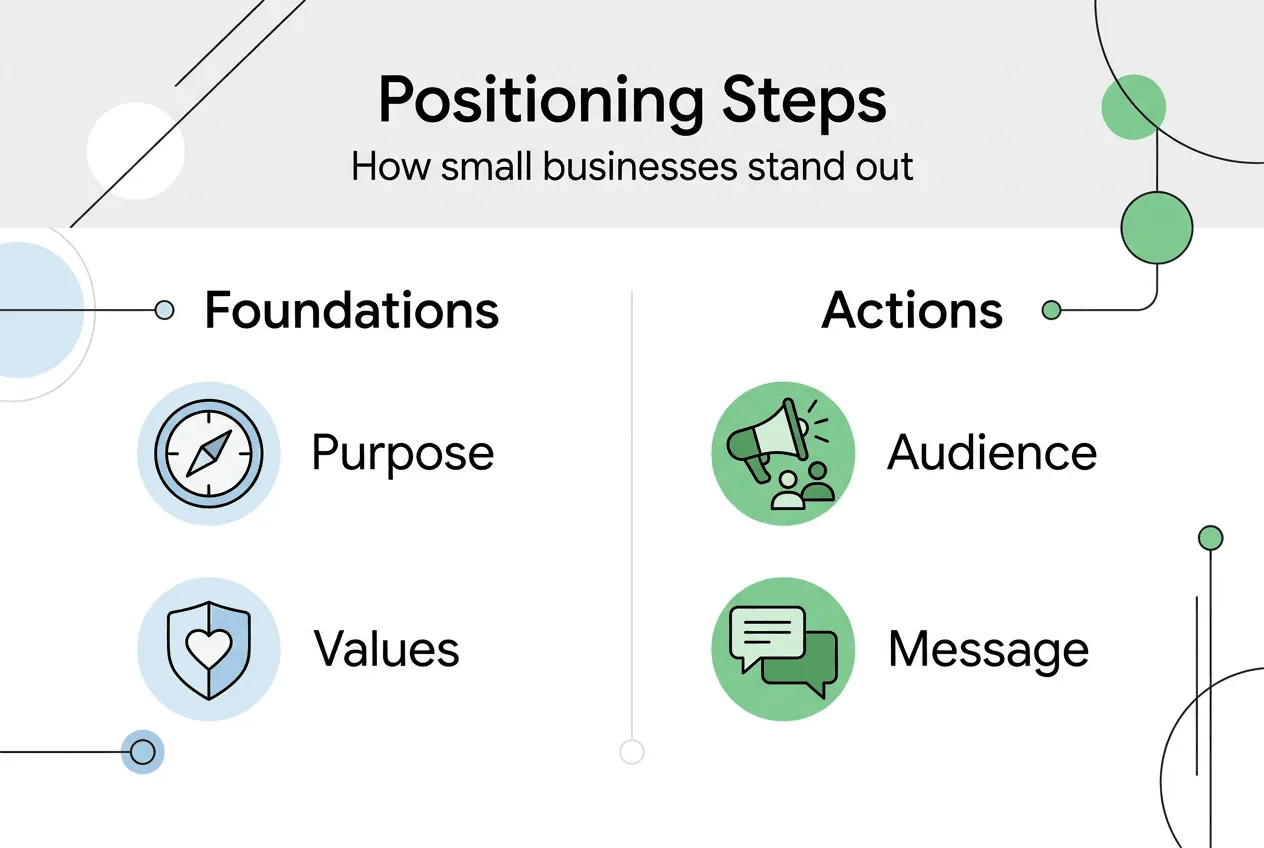
Your purpose and values give positioning its authenticity. Customers increasingly choose brands that reflect their own beliefs and priorities. Our branding strategy insights for 2026 show how to bring these into one framework. Decide what your business stands for beyond profit and let that guide your positioning choices. Authenticity builds trust, and trust turns prospects into loyal customers.
Step-by-step guide to creating your brand positioning
Good positioning follows a clear process that turns research into a strong market position:
-
Define your target market precisely. Move past broad categories to the specific segment where you can lead. Consider industry, company size, location or customer mindset, whichever fits your strengths.
-
Identify your unique value proposition. State the specific benefit customers get from choosing you. It must be meaningful, measurable and hard for competitors to copy. Focus on outcomes rather than features.
-
Choose how you will differentiate. Decide whether you will compete on specialist expertise, better service, a distinctive method or a unique mix of offerings. Your differentiation must matter to your audience and hold up over time.
-
Write your positioning statement. A short declaration of who you serve, what you deliver and why you are the best choice. It guides every marketing and business decision from here on.
-
Test the concept. Try your positioning with current customers and target prospects before rolling it out. Ask about clarity, relevance and how different it feels from competitors, then refine.
The difference between vague and focused positioning shows up in the kind of business you attract. Compare the two:
| Approach | Generic positioning | Focused positioning |
|---|---|---|
| Target audience | All small businesses | SaaS startups in healthcare |
| Value proposition | Quality web design services | HIPAA-compliant websites that convert |
| Differentiation | Great customer service | Healthcare regulatory expertise |
| Lead quality | Price-sensitive, quick to leave | Value-focused, long-term clients |
| Conversion | Harder, with more price objections | Easier, because the fit is obvious |
Your positioning statement should be memorable and usable. For example: "We help solo financial advisers automate client reporting so they can focus on relationships instead of spreadsheets." It names the audience (solo financial advisers), the benefit (automated reporting) and the outcome (more time for clients). Anyone reading it knows straight away whether the service is for them.
Pro Tip: Before you finalise your positioning, share it with five current customers and five target prospects. Ask them to explain in their own words what makes you different. If they cannot, the positioning needs work. Customers' own language often turns out to be the most persuasive way to describe your position.
Use the same positioning everywhere. Your website, proposals, social media and sales conversations must all reinforce it. Mixed messages confuse prospects and weaken your advantage. Our guide to branding strategies for small businesses helps keep channels aligned. Every customer interaction should strengthen the perception you are building.
Verifying and maintaining your brand positioning
To check whether positioning works, track how the market responds. Start with lead quality: how closely do new prospects match your ideal customer? Good leads understand your value before the first conversation and talk about fit rather than price. If most leads ask generic questions or go straight to negotiating on cost, your positioning may be unclear or aimed at the wrong audience.
Sales figures give direct feedback. Track conversion from first contact to closed deal. A rising rate suggests your positioning is landing with the right people. Measure average deal size and customer lifetime value too; strong positioning attracts customers who value expertise and invest accordingly. Falling numbers are a signal to revisit your position.
Customer feedback shows how the market actually sees you. Ask customers regularly why they chose you over the alternatives. Their answers should echo your intended positioning. If they give unrelated reasons, there is a gap between your message and how you are perceived. Use what you learn to sharpen the message or adjust the position itself.
Markets change, so review positioning regularly. New competitors arrive, priorities shift and technology changes how people buy. Look at the competitive picture each quarter and review your positioning in depth once a year. Clear positioning only makes the right choice obvious if it keeps up with reality.
Keep positioning consistent across:
- Website messaging and visual identity
- Sales presentations and proposals
- Marketing content and advertising
- Customer onboarding and service delivery
- Team training and internal communication
Your team has to understand and live the positioning. Everyone who speaks to customers should be able to describe your value the same way. Regular training with practical examples helps. When the whole organisation lives the positioning, customers get a consistent experience that builds trust and loyalty.
Pro Tip: When the market forces a change, adjust gradually rather than abandoning your position overnight. Test new elements with part of your audience before rolling them out widely. That keeps existing customers on side while you check the new direction works. Our brand refresh guide for 2026 explains how to evolve positioning without losing brand equity.
Strengthen your brand positioning with expert help
Strong positioning needs both strategic thinking and creative execution. LOOM Brand Designs helps small businesses define and communicate positioning that supports growth. Our basic branding package gives you the foundations: positioning strategy, visual identity and a messaging framework built around your ideal customers.
Our branding portfolio shows positioning work across a range of industries and how strategy becomes a distinctive brand experience. We pair positioning with website design services that bring your brand to life online, so every digital touchpoint reinforces your position and turns visitors into customers.
Frequently asked questions
What is brand positioning and why is it important?
Brand positioning defines what sets your business apart and why customers should choose you. Clear positioning improves lead quality and conversion and helps you compete whatever your size. It also simplifies marketing by giving every decision and message a consistent reference point.
How can I avoid the mistake of trying to appeal to everyone?
Pick a specific niche where you can deliver exceptional value. Focus on one customer type, or on solving one problem better than anyone else in your market. Specialisation attracts customers who value your expertise and will pay for it, while broad positioning turns your services into a commodity and invites price competition.
What steps should I take to create an effective positioning statement?
Identify your unique value proposition and the audience you serve best. Define the differentiators competitors cannot easily copy. Write a short statement that says who you help, what problem you solve and why you are the best choice. Test it with customers and prospects before using it across the business.
How do I know if my brand positioning is working?
Look at lead quality, conversion and customer feedback. Good leads understand your value before the first conversation and focus on fit rather than price. Check whether customers mention your intended differentiators when they explain why they chose you. Keep an eye on competitors and market trends, and adjust when the numbers fall or new opportunities appear.
The Hashtag Loom