

TL;DR:
- Content marketing builds trust and search visibility through helpful content focused on your audience.
- Consistent, good-quality content can outperform paid ads over time on a small budget.
- Authenticity and local expertise are what make you stand out now that AI content is everywhere.
Content marketing is one of the most misunderstood growth strategies. Many small business owners assume it needs a big budget, a full creative team or months before anything happens. That assumption keeps a lot of good local brands invisible online. In reality, a well-run content strategy built around your audience's real questions can outperform paid ads in the long run, for a fraction of the cost. This guide covers what content marketing is, why it matters more now than before, and how to build a practical plan that suits your size and budget.
Key takeaways
| Point | Details |
|---|---|
| Content builds trust | Content marketing establishes your brand as credible and authoritative in your field. |
| Consistency over quantity | Steady, valuable publishing, not mass output, drives long-term small business growth. |
| Originality is essential | Your own insights and local expertise make your content stand out in a crowded, AI-heavy market. |
| Strategy prevents pitfalls | A simple, written plan helps you avoid wasted effort and measure real outcomes. |
Understanding content marketing: what it is and what it isn't
Content marketing uses helpful, relevant material to attract your target audience and earn their trust over time. It is not advertising. Ads interrupt; content invites. When you write a blog post that answers the exact question your customer is searching for, you are solving their problem, not selling to them. That is what builds real authority.
What content marketing looks like for a small business:
- Blog posts and guides that answer common customer questions
- Email newsletters that keep your audience warm and informed
- Social media posts repurposed from longer content for wider reach
- Local SEO content that attracts nearby customers searching for your services
- Video and audio that put a face and voice to your brand
The biggest misconception is that you need to publish constantly. You do not. As the US Chamber of Commerce puts it, consistency matters more than intensity. For most small businesses, a steady rhythm of 1 to 4 pieces a month across a blog, an email newsletter and local SEO is enough to build authority and bring in leads on channels you own.
"Content marketing is not about how much you publish. It is about how much your audience actually finds useful."
The aim is steady, affordable publishing, not the output of a media company. Understanding the digital marketing essentials behind content strategy shows how it fits alongside SEO, social media and email as part of a wider system rather than a standalone tactic.
Consistency and relevance beat volume. One well-researched post a month will do more for you than ten shallow posts a week.
How content marketing fuels small business growth
The power of content marketing is that it compounds. Every good piece you publish keeps working long after it goes live. A blog post from six months ago can still bring in leads today, whereas paid ads stop the moment the budget runs out.
How content marketing drives growth for small businesses:
- Builds trust and credibility by consistently answering your audience's real questions
- Improves search visibility because search engines reward helpful, well-structured content
- Brings in qualified leads because people who find you through content are already interested
- Educates your audience so they arrive already convinced of your value
- Supports the whole funnel from awareness to decision without paying for every click
Pro Tip: Pick one topic cluster, such as "local [business name] tips" or "how to choose [your service]", and write 4 to 6 posts around it. Connected content tends to rank faster than isolated posts.
Picture a small plumbing firm that publishes one post a month answering the questions local customers actually search for: what to do about a burst pipe, how much a boiler service involves, when to call someone out. Each post keeps showing up in local searches, and over time the website becomes a steady source of enquiries without any ad spend.

| Content type | Cost | Lead quality | Time to results |
|---|---|---|---|
| Blog posts | Low | High | 3 to 6 months |
| Email newsletters | Very low | Very high | 1 to 3 months |
| Social repurposing | Low | Medium | 1 to 2 months |
| Paid ads | High | Medium | Immediate |
A sustainable small business digital strategy leans on content that keeps working. Paired with essential digital tactics such as local SEO and email marketing, content becomes your most reliable long-term source of growth.
Content marketing now: key trends and shifts for small brands
Content changed dramatically once AI writing tools went mainstream. The web is now full of generic, interchangeable material. That sounds like bad news, but for small businesses willing to show up as themselves, it is a big opportunity.
Where things stand:
- Generic how-to content is being commoditised by AI, which favours proprietary data, original research and first-person methods
- More searches end without a click, as answers appear directly on the results page, so brand recognition matters as much as keyword volume
- With so much "AI slop" around, distinctive, human-led creativity now wins where volume once did
- Local expertise, personal stories and niche authority are very hard for AI to copy
The context moat is what separates brands now. Instead of chasing keyword volume, successful small businesses build authority through original insight, real client stories and specific local knowledge that no algorithm can produce.
| Old SEO strategy | Current content strategy |
|---|---|
| High-volume keyword stuffing | Branded, contextual authority |
| Generic how-to articles | First-person methods and case studies |
| Quantity over quality | Consistency with originality |
| Traffic as the goal | Leads and conversions as the goal |
Understanding AI in digital marketing helps you use these tools well without becoming another source of forgettable content. AI marketing for SMBs looks at which uses genuinely add value without replacing your own voice. It is also worth thinking about who owns a brand's ideas and names when AI helps create them.

How to craft a simple content marketing strategy
A strategy does not need to be complicated. It needs to be written down and followed. Many small businesses never document theirs, which is a big reason so much content produces so little.
A simple framework you can start this week:
- Define your audience and their top 5 questions. What keeps your ideal customer up at night? Start there.
- Audit what you already have. What gaps are there between what you publish and what your audience needs?
- Build a simple content calendar. Plan 1 to 4 pieces a month and batch-produce them so you stay ahead.
- Put value and originality ahead of volume. One genuinely helpful post beats five thin ones.
- Measure real outcomes. Track leads, conversions and enquiries, not just page views or likes.
Pro Tip: Run a 90-day content sprint. Pick one audience problem, create 4 pieces tackling it from different angles, publish them on schedule, then see which one brought in the most enquiries. That tells you exactly what to do in the next sprint.
Avoid vanity metrics. A post with 500 views and no enquiries is worth less than one with 80 views that books 3 consultations. Real content marketing for branding tracks what moves the business forward, not what looks good on a dashboard.
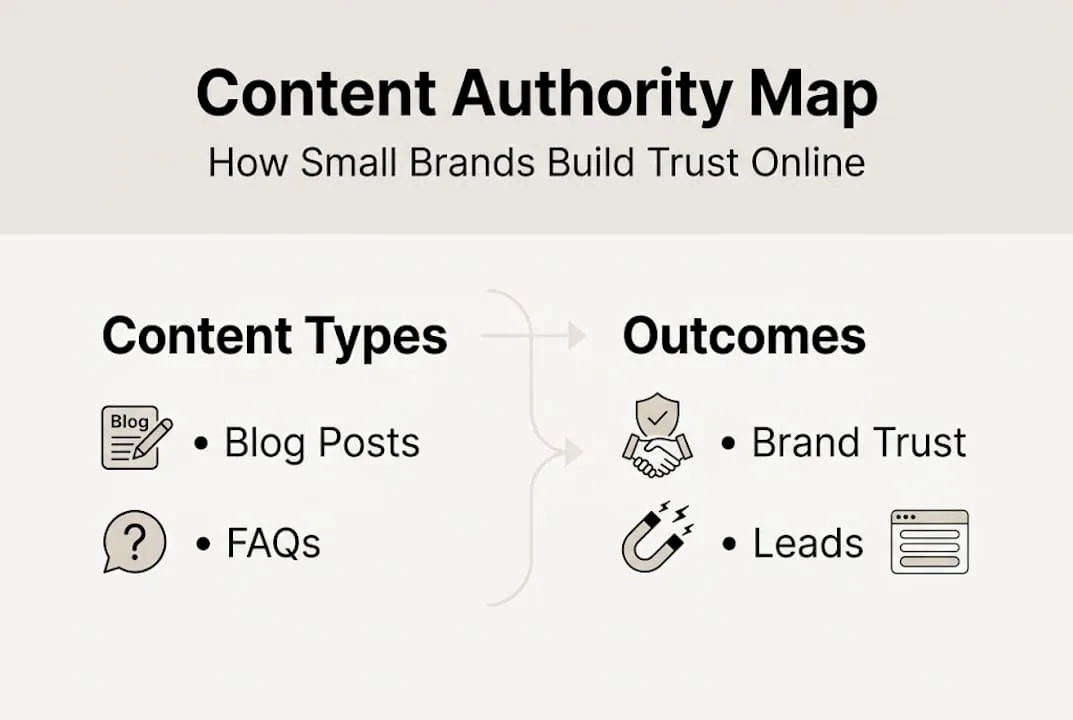
Why most small business content fails (and what nobody tells you)
Most small business content fails because of strategy, not writing. Brands copy big companies without understanding the context behind their tactics. They chase trending topics that have nothing to do with their audience. They publish because they feel they should, not because they have something useful to say.
AI tools have made this worse, because mediocre content is now effortless to produce at scale. But all that AI content has also raised the bar for what earns trust. Generic answers no longer build relationships. Your specific point of view, your real customer stories and the local knowledge a national brand or an AI cannot copy do.
The businesses doing well are not the ones publishing the most. They are the ones publishing work that is most recognisably theirs. A consistent voice, an honest perspective and content tied to real business outcomes are hard for any competitor to copy. Your branding strategy and the branding strategies for small businesses you choose should run alongside your content marketing, so every piece reinforces who you are and why customers should pick you.
Get expert help with your content marketing
Building a content strategy from scratch while running a business is hard. Knowing what to write, how to optimise it and how to make it look and feel on-brand takes time most owners do not have.
At LOOM Brand Designs, we help small businesses turn content marketing into a real source of growth rather than a box to tick. Whether you need a strong brand foundation through our affordable branding package or a professional online home through our website design services, we build the foundations that make your content work harder. Every strategy we develop is shaped around your audience, your goals and your budget.
Frequently asked questions
Why is content marketing important for small businesses?
Content marketing builds authority affordably by attracting leads through helpful content, which makes it one of the most cost-effective long-term growth tools a small business has.
How do I measure success in content marketing?
Focus on leads, conversions and customer actions. Tracking conversions and checking for content gaps gives you far more useful improvements than watching page views alone.
Is social media part of content marketing?
Yes. Repurposing content for social media is one of the most useful low-cost tactics for small businesses, because it extends the reach of work you have already done.
How can small businesses stand out with content marketing now?
Lead with your own insights and local expertise. Original, context-rich content outperforms generic AI-generated material because it offers what algorithms cannot produce.
The Hashtag Loom