

TL;DR:
- Online presence optimisation matters for small and medium-sized businesses because it decides whether customers find you or never see you.
- It brings your website, content, SEO, social media and email together as one system, measured against a few targeted metrics.
Online presence optimisation is the work of improving your visibility, engagement and authority on every channel where your customers search, browse and buy. For small and medium-sized businesses, it is not a luxury. It is the difference between being found and being invisible. This guide covers the groundwork, website and content strategy, social and email tactics, and the measurement you need to build a digital presence that keeps building on itself. Tools like Google Analytics, Semrush and Mailchimp are where you start, not where you finish.
What does an online presence optimisation guide actually cover?
It covers every layer of your digital footprint: your website, search rankings, social profiles, content, reviews and discovery through AI tools. Most business owners treat these as separate projects. The better approach treats them as one connected system in which each channel supports the others. That change in thinking is what separates businesses that grow online from those that spin their wheels.
Before you touch a single tactic, you need to know where you stand. A digital presence audit looks at your website's technical health, SEO performance, social media profiles, content gaps and how you compare with competitors. Skip it and you are optimising in the dark.
Your website is the centre of your digital presence. Every social post, ad and email should send people back to a site you own and control. Social platforms change their algorithms. Google updates its ranking criteria. Your website is the one asset that belongs entirely to you.

Choosing the right channels matters more than being everywhere. A strong presence comes from focused effort on a clear audience, not from spreading yourself thin across every platform. A local heating and air conditioning company in Texas will get more from Google Business Profile and YouTube tutorials than from Pinterest or TikTok.
Pro tip: Try a 3-3-3 rule when setting your digital strategy: three core messages, three main channels and three measurable outcomes. It stops the strategic sprawl that sinks a lot of small business marketing.
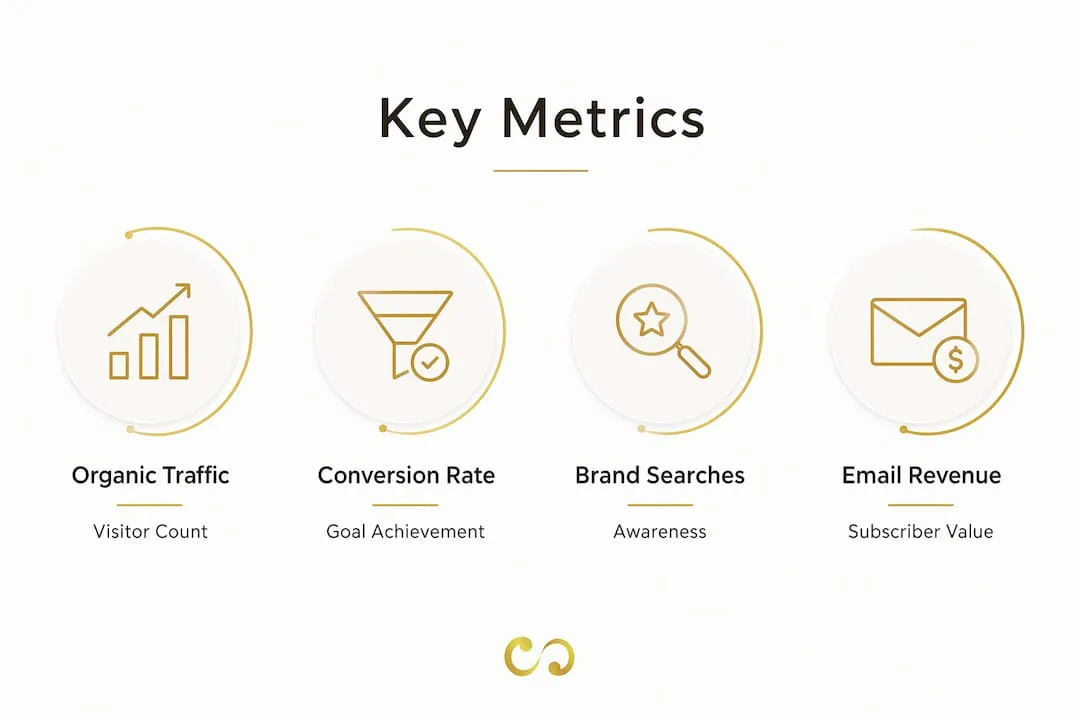
The metrics worth tracking from day one are organic search traffic, conversion rate by channel, branded search volume and customer acquisition cost. Follower counts and page views feel good but tell you very little about revenue.
How to optimise your website and content for search and AI discovery
Technical SEO is the foundation of any website advice that actually works. Google's Core Web Vitals measure loading speed, visual stability and responsiveness, and they form part of the page experience signals Google considers. Use Google Search Console and PageSpeed Insights to find and fix problems before you invest in content.
Your site has to work well on a phone. A lot of searching happens on mobile, and if your site loads slowly or looks broken on a small screen, you lose customers before they read a word.
Structured data, specifically Schema.org markup, is one of the most underused tools in small business SEO. Adding schema to your pages tells search engines and AI assistants exactly what your content means. Structured data and clear question-and-answer formatting help your content get picked up in AI-driven discovery and zero-click results. This matters because tools such as ChatGPT, Perplexity and Google's AI Overviews increasingly pull answers from well-structured, clearly labelled content.
Here is a practical content strategy framework for 2026:
- Choose your core topics. Pick three to five subjects where your business has genuine expertise. An accounting firm might focus on small business tax, bookkeeping software and cash flow.
- Build pillar pages. Create one long, authoritative page per core topic. It becomes your main resource on that subject.
- Add content clusters. Write supporting articles that answer specific questions related to each pillar, and link them back to the pillar page.
- Format for questions. Use H2 and H3 headings that mirror how people actually ask. "How do I reduce my quarterly tax bill?" works better as a heading than "Tax reduction strategies".
- Refresh regularly. Update pillar pages every six months with new examples and links. Fresh content signals relevance to both Google and AI systems.
| Content type | Main benefit | Update frequency |
|---|---|---|
| Pillar pages | Topical authority and organic rankings | Every 6 months |
| Blog posts and clusters | Long-tail traffic and internal linking | Every 12 months |
| FAQ sections with schema | AI and voice search visibility | Every 3 months |
| Case studies | Trust and conversion | As projects complete |
Pro tip: Without a working organic funnel, every new customer has to be bought through ads. Investing in content and SEO first reduces your dependence on paid ads and brings long-term acquisition costs down.
What social media and email tactics build lasting visibility?
Social media presence is not about posting volume. It is about turning up consistently in the right places for the right people, and picking the wrong platforms wastes time and budget. LinkedIn suits B2B service providers. Instagram and Facebook suit local consumer businesses. YouTube builds long-term authority for any business that can teach something on camera.
The most common mistake is overreach. Opening accounts on six platforms and posting now and then on all of them does worse than owning two platforms properly. Marketing tools such as Buffer, Hootsuite and Meta Business Suite handle scheduling and keep your posting consistent without daily manual effort.
Authentic content tends to do better than polished content on social platforms. Behind-the-scenes posts, customer stories and direct answers to common questions usually get more engagement than generic promotional graphics. These standout campaign examples show brands that found the balance between authenticity and strategy.
Email is one of the most valuable channels small businesses underuse. Automated emails triggered by behaviour, such as onboarding sequences, purchase history and engagement, convert far better than one-size-fits-all newsletters. A new subscriber who downloads your free guide should get a different sequence from a customer who has just made a second purchase.
Engagement metrics to track across social and email:
- Email open rate and click-through rate by campaign type and audience segment
- Social reach vs. engagement rate (engagement matters far more than reach)
- Follower growth compared with how often you post and what you post
- Direct messages and comments as signs of genuine interest
- Traffic from social to your website, tracked in Google Analytics by source and medium
Tie your social media goals to your wider business objectives so you are not optimising for likes instead of leads. Every social metric you track should connect to something close to revenue.
How do you measure success and fix what is not working?
Measurement is where most online presence work falls apart. Last-click attribution, which credits the final touchpoint before a conversion, consistently undervalues content, social media and brand awareness. Journeys now span several platforms and devices, so a customer who finds you through a blog post, follows you on Instagram and then buys through a Google search looks like a Google conversion in a last-click model.
Google Analytics 4 offers data-driven attribution and conversion path reports that spread credit across the touchpoints in a journey. That gives you a far more accurate picture of which channels are driving growth.
Branded search volume is one of the most reliable signs of a strong presence. When more people search for your business by name, awareness and trust are growing. Track it monthly in Google Search Console.
| Metric | What it tells you | Tool to use |
|---|---|---|
| Branded search volume | Growth in awareness and trust | Google Search Console |
| Conversion paths | Each channel's real contribution | Google Analytics 4 |
| Organic traffic by page | Content performance | Google Search Console |
| Email revenue per subscriber | Return from the email channel | Mailchimp, Klaviyo |
Quarterly audits stop your strategy drifting. Every three months, review your five best and five worst pages, your social engagement by platform and the health of your email list. Drop channels that keep underperforming. That kind of disciplined review is how you avoid chasing vanity metrics or spreading your budget too thin.
Pro tip: Keep to one main objective and one or two secondary goals over a six to twelve month period. If you are tracking more than three KPIs at once, you are measuring everything and improving nothing.
Pruning weak content matters as much as creating new content. Pages with no organic traffic after twelve months need either a full rewrite or merging into stronger pages. That lifts the authority of your site as a whole and keeps Google's attention on your best work.
Key takeaways
A focused presence across a few channels, built on technical SEO, structured content and behaviour-based email, produces visibility that keeps growing in a way paid advertising alone cannot.
| Point | Details |
|---|---|
| Start with a full audit | Review your website, SEO, social profiles and competitors before changing anything. |
| Apply the 3-3-3 rule | Limit focus to three messages, three channels and three measurable KPIs. |
| Use structured data | Schema.org markup helps visibility in AI-driven search and zero-click results. |
| Track metrics close to revenue | Branded search volume and conversion paths say more than follower counts. |
| Audit quarterly | Review and prune weak content and channels every three months. |
What I have learned from watching businesses get this wrong
Most small business owners I work with arrive having done everything the popular advice says. They have accounts on every platform, a blog with thirty posts and a Google Ads campaign running. Yet their digital marketing tactics bring less and less return, because the pieces are not connected.
The change that matters most is moving from broadcasting to orchestration. Broadcasting means pushing content out and hoping something lands. Orchestration means designing a system in which your website, content, email and social channels each have a specific job and feed one another. A blog post brings in organic traffic. An email opt-in captures that traffic. The email sequence nurtures the lead. The lead becomes a customer and then a case study. The case study feeds the next blog post. That loop is what builds over time.
I also see businesses resist pruning. They hold on to weak content and dead social accounts because they represent past effort. Letting go of what is not working is not failure. It is the discipline that separates businesses with a growing online presence from those with a cluttered, unfocused one.
Authenticity and technical optimisation are not opposites. The businesses doing well are the ones that manage to be genuinely useful and technically visible at the same time. Schema markup does not make your content robotic. It makes it findable. Write for people, structure for machines.
Finally, consistency beats intensity. A business that publishes one strong piece a week and sends one well-segmented email a month will usually do better than one that launches a huge campaign every quarter and goes quiet in between. Presence is built through repetition, not bursts.
Pawan
How LOOM Brand Designs can build your digital presence for you
LOOM Brand Designs works with small and medium-sized businesses that know they need a stronger online presence but do not have the time or the team to do it properly. From professional website design built for SEO and conversion to brand identity and content strategy, every service is designed to work as part of a connected system rather than as a one-off deliverable. If you are starting from scratch, the Basic Branding Package gives you a solid foundation. If you need more digital visibility tools and marketing assets, the Standard Branding Package covers the next level. Book a consultation to get a strategy built around your business goals.
FAQ
What is online presence optimisation?
It is the process of improving your visibility, credibility and engagement on every digital channel where customers search for and interact with your brand. It brings SEO, content strategy, social media management and reputation management together as one system.
How long does it take to see results from SEO and content?
As general guidance, organic SEO often shows measurable ranking gains for targeted keywords within three to six months, with traffic continuing to build over twelve to eighteen months. Paid channels such as Google Ads deliver results faster, but you keep paying for every visit.
Which social media platform should a small business prioritise?
It depends on your audience. B2B service businesses often do best on LinkedIn, while local consumer businesses usually do better on Facebook and Instagram. Choose one or two platforms and build depth before expanding.
What metrics actually matter for measuring online presence?
Branded search volume, organic traffic by page, conversion paths and email revenue per subscriber are the metrics most closely tied to business growth. Follower counts and page views are vanity metrics that rarely track revenue.
How often should I audit my digital presence?
Run a full digital presence audit every quarter, covering website performance, content effectiveness, social engagement by platform and email list health. Once a year is too infrequent to catch the slow drift that wears performance down.
The Hashtag Loom