

TL;DR:
- A marketing persona is a research-based profile of one segment of your ideal customer, focused on their motivations and behaviour. Building personas from customer interviews, validating them and updating them regularly improves marketing alignment, conversions and campaign returns. Treat personas as living documents so they stay accurate and keep guiding every customer-facing team.
A marketing persona is a research-based, semi-fictional profile of a specific segment of your ideal customer, built from real data about their motivations, behaviour, goals and pain points. The more common industry term is "buyer persona", and both describe the same tool. Personas turn generic marketing into meaningful communication because they address real challenges and expectations instead of assumed ones. For marketers and business owners, that is the difference between campaigns that convert and campaigns that waste budget.
What is a marketing persona and how does it differ from demographics?
A marketing persona goes much further than a demographic profile. Demographics tell you what a customer is: 34, female, a household income in a certain bracket, living in a particular city. A buyer persona tells you why she buys: she wants to grow her consulting business, she is wary of wasting money on tools that do not deliver, and she decides based on peer reviews and LinkedIn recommendations.

Mixing up personas and demographics is one of the most common mistakes in marketing. A demographic segment groups people by shared characteristics. A persona groups people by shared psychology, goals and decision-making patterns. They are different lenses.
A buyer persona is also different from an ideal customer profile (ICP). An ICP is about the company: the type of organisation most likely to buy from you, by industry, size, revenue and tech stack. A buyer persona is about the person: the individual inside that organisation who makes or influences the buying decision. You need both, but they answer different questions.
Assumptions and oversimplified demographics lead to poor targeting because they skip the "why". When you know a customer's triggers, barriers and decision criteria, you can write copy that speaks to their situation. When you only know their postcode and age bracket, you are guessing.
How do you create a marketing persona step by step?
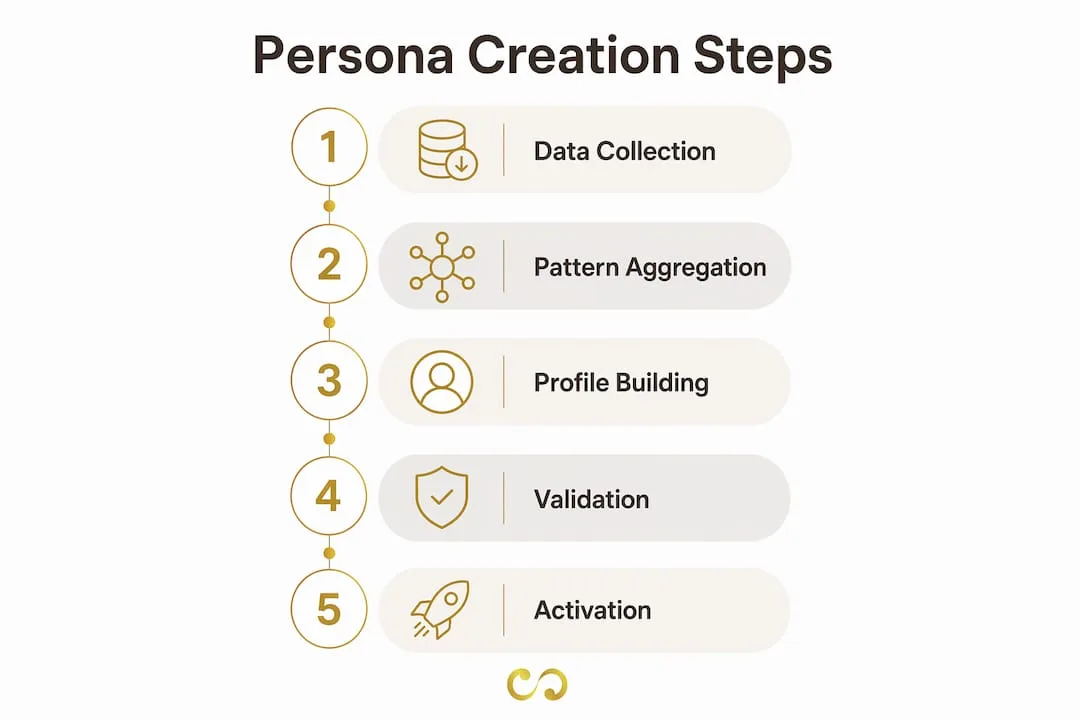
A reliable method for building validated personas has five phases: data collection, pattern aggregation and segment selection, profile building, validation and activation. Each builds on the last, and skipping one produces a persona that looks complete but fails in practice.
Phase 1: Data collection
Collect data from several sources. Customer interviews give the richest insight. Add CRM records, website analytics, social media behaviour, sales call notes and support tickets. The aim is evidence of real behaviour, not confirmation of what your team already believes.
Phase 2: Pattern aggregation and segment selection
Group the data by recurring themes: shared goals, shared frustrations and shared language. From those patterns, pick 2 to 4 distinct customer segments worth building personas around. Avoid building more than five at once, because too many personas blur your focus.
Phase 3: Profile building
A strong persona profile has seven core components: core mission or goal, deep motivations, behavioural triggers, barriers to purchase, objections, choice criteria and experience expectations. Demographics such as age, job title and location add context, but these seven elements drive the messaging.
Give each persona a name and a realistic photo. It sounds superficial, but it works. A team that can picture "Marcus, the operations manager who hates vendor complexity" writes better copy than a team staring at a spreadsheet of attributes.
Phase 4: Validation
Validate persona drafts with 8 to 12 people who match the target profile. Do not skip this. Internal teams tend to overestimate how well they understand customers. Validation interviews uncover gaps, wrong assumptions and mismatched language that would otherwise make it into live campaigns.
Phase 5: Activation
A persona that sits in a shared drive is decoration, not strategy. Activation means giving personas to every team that deals with customers: marketing, sales, product and customer success. Each team uses them differently, but they all need them.
Pro Tip: Build a one-page persona summary card that fits on one screen. Long persona documents get ignored. A tight, scannable card gets used every day.
Why do marketing personas matter for business results?
The business case is well documented. HubSpot reports that companies using personas are twice as likely to exceed their revenue goals. That reflects how much better marketing spend lines up with real customer needs when the customer is clearly defined.
Personalisation is what links personas to revenue. When your messaging matches the real motivations of the person reading it, people are more likely to buy and more likely to come back.
"Personas focus marketing on real people's motivations and behaviour patterns. Without them, personalisation is just guesswork dressed up as strategy."
Personas also cut wasted spend. Once you know which channels your persona uses, which objections they raise and which formats they prefer, you stop paying for campaigns that reach the wrong people with the wrong message. Every pound you move from a misaligned channel to a validated one improves your return without raising the budget.
The benefit reaches beyond marketing. When sales, marketing and product share the same persona definitions, they stop arguing about who the customer is and start working together on how to serve them. That shows up in faster deals, better product decisions and more consistent customer experiences.
How are personas applied across marketing channels and teams?
Personas are most valuable when they drive decisions in every customer-facing function. They give sales, marketing and product a shared language, which helps both lead generation and closing deals, but only if the persona is specific enough to guide real decisions.
How personas turn into action channel by channel:
- Content marketing: Persona goals and pain points decide your topics. If your persona fears picking the wrong supplier, create comparison guides, case studies and ROI calculators. If they are motivated by peer recognition, create thought leadership they can share.
- Paid advertising: Persona demographics and behavioural triggers inform audience targeting on Meta and Google. Objections shape the ad copy. Choice criteria shape the landing page.
- Email marketing: Triggers decide send timing and subject lines. Barriers decide the order of your nurture emails. A persona who needs social proof gets testimonials early; one who needs technical detail gets specs and documentation.
- Social media: Channel preferences decide where you publish. A B2B persona who lives on LinkedIn needs different content from a consumer persona scrolling Instagram. Posting the same thing everywhere ignores this.
- Web design: Experience expectations shape navigation, page hierarchy and calls to action. A persona-informed website reduces friction at every decision point.
Using personas across teams needs a structured handover. Marketing builds and validates them. Sales gets them with specific guidance on objections and triggers. Product gets them with guidance on feature priorities and experience expectations. Without that handover, personas stay in the marketing department and never reach their full value.
Personas also deepen brand identity by connecting brand archetypes to the emotional needs of real customer segments, which makes brand messaging feel authentic rather than manufactured.
Personas need to keep changing with real data and campaign results. Markets shift and customer priorities change, so a persona built a few years ago may not describe today's buyer. Set a review cycle: quarterly in fast-moving markets, every six months in stable ones. Update whenever campaign data contradicts the persona. An out-of-date persona is worse than none, because it gives teams false confidence.
| Persona application | Business function | Primary benefit |
|---|---|---|
| Content topic selection | Marketing | Higher relevance and engagement |
| Ad audience targeting | Paid media | Lower cost per acquisition |
| Objection handling scripts | Sales | Faster deal closure |
| Feature prioritisation | Product | Better product-market fit |
| Email nurture sequencing | Marketing automation | Higher conversion rates |
Key takeaways
A validated, regularly updated marketing persona is one of the most effective tools for lining up messaging, spend and team decisions with real customer behaviour.
| Point | Details |
|---|---|
| Personas go beyond demographics | They capture motivations, triggers and decision criteria, not just age and location. |
| Use the five-phase method | Collect data, find patterns and pick segments, build profiles, validate, then activate across teams. |
| Validate with real customers | Test persona drafts with 8 to 12 people from your target audience before using them in campaigns. |
| Personas pay off | HubSpot reports that companies using personas are twice as likely to exceed their revenue goals. |
| Treat personas as living documents | Update them when campaign data contradicts your assumptions. |
Personas are only as good as the process behind them
I have reviewed persona documents from dozens of businesses, and the pattern is consistent. The ones that fail were built in a meeting room by people who had not spoken to a customer that month. They are full of confident assumptions dressed up as research.
The ones that work were built differently. They started with customer interviews. They were checked against real people. They were specific enough to guide channel choices and message decisions, not just describe a vague archetype. A persona that cannot tell you which objection to tackle first on a sales call is not a strategic tool. It is a slide in a deck.
The other mistake I see all the time is treating personas as a one-off deliverable. A team spends three weeks building them, presents them to the whole company and never touches them again. A year later the market has moved, but the persona still describes last year's buyer, and the team is optimising for someone who no longer exists.
The businesses that get the most from personas treat them the way a good product team treats a roadmap: always current, always tied to real data and always open to revision. Aligning your branding and marketing around a living persona is what separates companies that grow steadily from those that run campaigns and hope.
Build the persona. Validate it. Share it. Then keep updating it. That is the whole discipline in four sentences.
Pawan
How LOOM Brand Designs helps you build a brand around your best customers
A validated persona is step one. Turning it into a brand identity, website and marketing system that actually reaches those people is where most businesses need professional help.
LOOM Brand Designs works with marketers and business owners to build brand strategies grounded in real customer insight. From the Basic Branding Package, which gives you a clear brand identity aligned to your persona, to full website design and development built around persona-informed user experience, every service connects your customer research to visible results. If your personas are ready and your brand needs to catch up, we would be glad to help.
FAQ
What is a marketing persona in simple terms?
A marketing persona is a detailed, semi-fictional profile of your ideal customer, built from real data. It captures their goals, motivations, behaviour and barriers to buying.
How is a buyer persona different from an ideal customer profile?
A buyer persona describes an individual person and their psychology. An ideal customer profile describes the type of company most likely to buy, using firmographic data such as industry and company size.
How many personas does a business need?
Most businesses need 2 to 4 personas. Building more than five at once dilutes focus and makes it harder to write specific, effective messaging for any one segment.
How do you validate a marketing persona?
Interview 8 to 12 people who match the target profile and ask how well the draft reflects them. This uncovers wrong assumptions and mismatched language before they reach live campaigns.
How often should marketing personas be updated?
Review personas quarterly in fast-moving markets and every six months in stable ones. Update them whenever campaign data contradicts the assumptions in the current profile.
The Hashtag Loom