

TL;DR:
- Data-driven marketing uses evidence, not gut instinct, to guide decisions.
- For small businesses, the benefits are precise targeting, better use of budget, measurable results and the ability to react quickly.
- Start with basic data, act quickly and keep learning rather than waiting for perfect information.
Collecting more data does not automatically make your marketing better. Many marketing managers at small and medium-sized businesses fall into this trap: they spend time and budget gathering mountains of information, then find their campaigns still underperform. The real shift comes when you move from collecting data to making decisions with it. This guide explains what data-driven marketing means, why it matters for businesses with limited resources and how to start using your data for better targeting, smarter budget allocation and measurable results.
Key takeaways
| Point | Details |
|---|---|
| Data fuels better decisions | The right data helps small businesses target, personalise and optimise their marketing. |
| Start small, stay practical | You do not need huge datasets. Basic tracking and steady improvement matter most. |
| Avoid vanity metrics | Focus on actionable KPIs like CAC and LTV rather than surface-level numbers. |
| Fix the basics before scaling | Break down data silos, connect your tools and centralise information before expanding. |
| Balance data and judgement | Combine analytics with marketing intuition to capture nuance and respond quickly. |
What is data-driven marketing?
Data-driven marketing means using real data analysis to guide marketing decisions, from audience targeting and channel choice to messaging and budget. It replaces gut instinct with evidence. Instead of assuming your audience responds to a certain type of ad, you test it, measure the response and optimise based on what the numbers show.
Traditional marketing leans on intuition, experience and broad audience assumptions. You might target "women aged 25 to 45" because it feels right for your product, but that broad brush wastes spend on people who will never buy. Data-driven marketing narrows the focus using actual behaviour, purchase history and engagement patterns.
For small businesses, this matters a great deal. You cannot absorb wasted ad spend the way large companies can, so every pound has to work harder. Any good digital marketing guide will tell you that strategy without data is just expensive guessing.
The most useful types of data for small marketing teams:
- Customer demographics: age, location, income bracket and job role help you build realistic audience profiles.
- Website analytics: page visits, bounce rates and session duration show where you are losing potential customers.
- Campaign performance: click-through rates, cost per click and conversion rates show which creative and channels work.
- Sales trends: seasonal patterns and product-level revenue connect your marketing to real business outcomes.
- Customer feedback: reviews, support tickets and survey responses add the qualitative layer numbers miss.
Pro Tip: Actionable KPIs like customer acquisition cost (CAC) and lifetime value (LTV) will always tell you more than vanity metrics like total impressions or follower counts. Prioritise metrics that connect directly to revenue.
Google Analytics, your email platform's built-in reporting and even a basic CRM dashboard can get you started without an enterprise budget. The point is not perfect data. It is building the habit of asking "what does the data say?" before you decide. AI marketing examples show that even small teams can use intelligent analysis to punch above their weight.
Key benefits of data-driven marketing for small businesses
Here is how those principles turn into business benefits.
Precision targeting is usually the most immediate win. Instead of broadcasting to a wide, unqualified audience, data lets you reach the people most likely to buy. You stop paying to reach the wrong crowd.

Budget efficiency follows from precision. Businesses that cannot trace which channels drive conversions end up funding channels that do nothing for them. When you know what is working, you stop paying for what is not.
Measurability changes how you justify marketing spend internally. Every campaign ties back to a trackable outcome, which makes reporting to leadership easier and strengthens the case for more resources.
| Approach | Targeting method | Spend visibility | Optimisation speed |
|---|---|---|---|
| Traditional marketing | Broad assumptions | Low | Slow (after the campaign) |
| Data-driven marketing | Behavioural signals | High | Fast (real time) |
Adaptability gives you an edge in volatile markets. A live dashboard lets you pause a failing campaign on Tuesday instead of finding the problem in your monthly review. That agility is often the difference between a campaign that recovers and one that burns through the quarter's budget.
"The businesses winning at data-driven marketing are not necessarily those with the biggest datasets. They are the ones making faster, smarter decisions with the data they already have."
What a data-driven approach makes possible for small businesses:
- Find your highest-value customer segments and focus on acquiring more of them.
- Cut spend on channels with poor returns and invest more in proven performers.
- Personalise messaging based on where customers are in their buying journey.
- Forecast demand more accurately and line campaigns up with real sales cycles.
A focused marketing strategy for SMBs built on real data creates a compounding advantage. Each campaign teaches you something that makes the next one better.

Common challenges and pitfalls (and how to solve them)
The advantages are real, but getting there has its challenges, especially for smaller businesses. Limited data, siloed systems and vanity metrics are the three most common barriers. Here is how to deal with each.
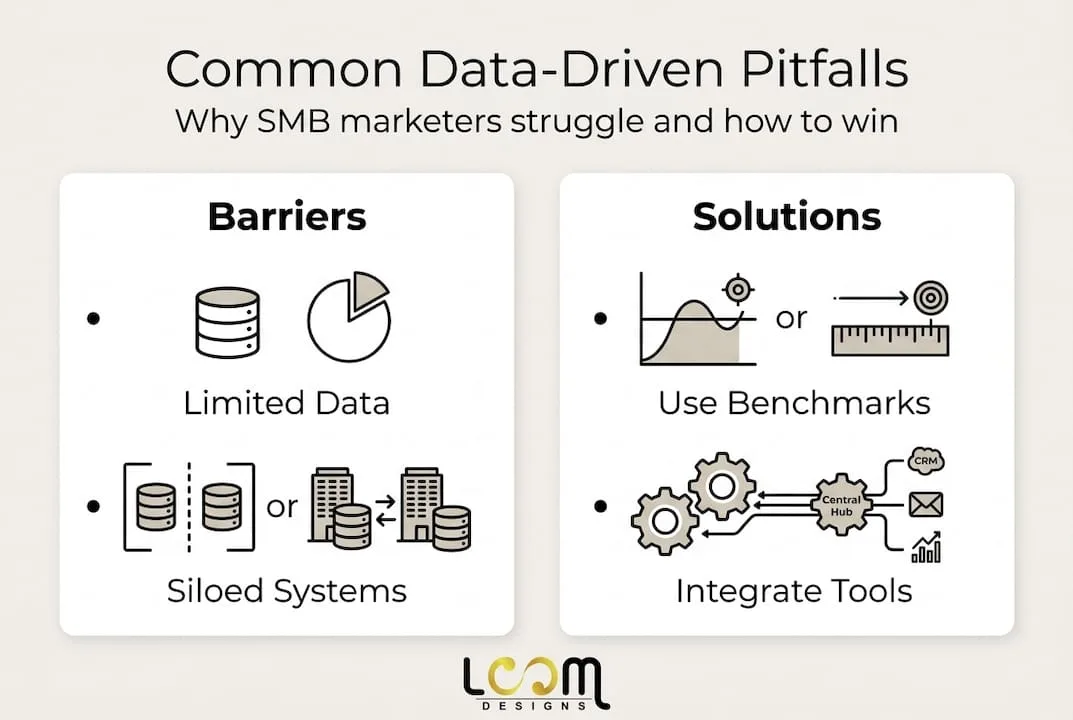
When you do not have enough data, resist the urge to wait until you do. Use industry benchmarks as stand-ins. If you know roughly what it costs to win a customer in your sector, say £45, that is a useful starting point before you have a clean dataset of your own. Bayesian reasoning, which simply means updating your assumptions as new information arrives, is a practical way to think about it.
Data silos happen when your email platform, CRM, ad accounts and website analytics never talk to each other. You end up with fragmented views that contradict one another. A centralised CRM fixes this by pulling every customer touchpoint into one place. These marketing automation tips can also help you connect systems without manual effort.
Vanity metrics feel good but change nothing. Total page views, social likes and raw email open rates say very little about revenue. Replace them with metrics that matter:
- Customer acquisition cost (CAC): how much does it cost to win one new customer?
- Lifetime value (LTV): how much revenue does a customer bring over the whole relationship?
- Conversion rate by channel: which sources are actually driving sales?
- Return on ad spend (ROAS): are your paid campaigns earning more than they cost?
- Churn rate: are you keeping the customers you worked hard to win?
Analysis paralysis is a real risk when data becomes overwhelming. If you find yourself building dashboards instead of running campaigns, you have crossed a line. Set a review rhythm, weekly or fortnightly, and commit to acting on the top two or three insights from each review.
Pro Tip: Start with one question, not a hundred. Pick your most important marketing challenge and the one metric that best measures it. Build from there.
Steps to build a data-driven marketing process
Here is how to build data into the way your business markets, starting today.
- Audit your current data. Map where your marketing data lives: email platform, CRM, ad accounts, website analytics. Find the gaps. What customer behaviour are you not tracking that would change your decisions if you knew it?
- Set clear business goals and KPIs. Tie every marketing metric to a business outcome. "Increase brand awareness" is not a KPI. "Reduce CAC from £60 to £45 by Q3" is.
- Centralise your data. Bring your key sources into one place. Even a spreadsheet that pulls from three sources beats three disconnected dashboards.
- Look for patterns and anomalies. Find what is working unexpectedly well and what is quietly draining budget. Anomalies, not just trends, often point to your best opportunities.
- Run short test cycles. Two to four week experiments with a single variable let you learn fast without big risk. Change one thing at a time so you know what caused the result.
- Combine data with human judgement. Numbers explain what happened. Your team explains why. Balance quantitative and qualitative data to catch what raw metrics miss, such as the tone of customer feedback or the reason behind a sudden traffic spike.
A practical digital marketing checklist helps you make sure you are covering all of this as you build your process.
Pro Tip: Bring your sales team into your KPI reviews. They hear objections, ask customers questions and pick up signals your analytics will never capture. That context makes your data far more useful.
Real talk: what most small businesses get wrong about data-driven marketing
We see it again and again: marketing managers at smaller businesses stall because they believe they need perfect data, a large budget or sophisticated tools before they can be data-driven. That belief is the problem, not the data.
The businesses that move fastest are not the ones with the cleanest databases. They are the ones willing to act on imperfect information, learn from the result and adjust. A small experiment with a £200 ad budget and a clear hypothesis teaches you more than a £5,000 campaign with no measurement plan.
Avoiding paralysis is one of the most underrated skills in marketing. Data without action is just storage. The goal is not perfect knowledge before you move. It is a loop where you act, measure, learn and improve.
Small businesses actually have a structural advantage here. Decisions move faster. You can test an idea this week, not next quarter. Use that speed deliberately, with even basic AI marketing tools layered on your existing data, and you can out-learn competitors still waiting for perfect conditions.
The edge in data-driven marketing does not belong to whoever has the most data. It belongs to whoever learns fastest.
Next steps: take your marketing further with expert support
A data-driven approach is more within reach than most small businesses realise, and the right expertise makes faster results much easier.
At LOOM Brand Designs, we help marketing managers at growing businesses build strategies grounded in real performance data, not assumptions. Whether you need a solid brand foundation through our branding essentials for SMEs, deeper intelligence through AI marketing insights or steady organic visibility through our SEO services, our services are built for businesses ready to grow with intention. Start simple, scale sensibly and let data guide each next step.
Frequently asked questions
What exactly does data-driven marketing mean for small businesses?
It means basing marketing decisions on real, actionable data rather than intuition or guesswork, so every pound in a campaign has a clear purpose.
What data should I track to get started?
Prioritise CAC, LTV and sales metrics first. They connect directly to revenue and show clearly whether your marketing is working.
How can I overcome a lack of data in my small business?
Use proxies and industry benchmarks while you build your own dataset. Start making decisions with what you have, and your own data will grow from there.
Is there a risk of focusing too much on data?
Yes. Collecting without acting wastes time and money. Aim for a steady rhythm of analysis followed by action, not endless reporting.
Do I need expensive tools or a large team to be data-driven?
No. Basic methods and affordable tools are enough to start. Process and consistency matter far more than platform sophistication in the early stages.
The Hashtag Loom