

TL;DR:
- Off-page SEO covers the actions outside your website that build authority, trust and visibility for better search rankings.
- It includes earning backlinks, brand mentions and local reviews, all of which shape how Google judges your site's credibility.
Off-page SEO is everything you do outside your website to build authority, credibility and visibility in search results. As Moz explains, off-page SEO covers actions such as earning backlinks, gaining brand mentions and building local visibility signals that tell search engines your site deserves to rank. Moz, Semrush and Yoast have long treated off-page optimisation as the external half of a complete SEO strategy. On-page SEO controls what your site says. Off-page SEO reflects what the rest of the internet says about you. Neither works well without the other.
What is off-page SEO and why does it matter for rankings?
Off-page SEO is the practice of building the external signals search engines use to judge your site's trustworthiness and authority. Search Engine Land notes that Google weighs experience, expertise, authoritativeness and trustworthiness when it assesses content. These qualities, known as E-E-A-T, are largely shaped by what happens away from your website. A site with strong content but weak external signals will often lose out to a competitor with a better reputation.

The case for off-page SEO comes down to one idea: search engines cannot fully trust what you say about yourself. They trust what others say about you. A backlink from a respected publication, a brand mention in a niche forum or a run of five-star Google reviews all send the same message: real people and real organisations think your site is worth referencing.
Off-page SEO also shapes how your brand appears across the web, not just in Google Search. Social shares, podcast mentions and directory listings all add to a wider digital footprint. Yoast points out that this footprint feeds AI-driven search visibility as well as traditional rankings. Off-page SEO has grown well beyond link building, and marketers who treat it purely as link acquisition are leaving authority signals on the table.
What are the main components of off-page SEO?
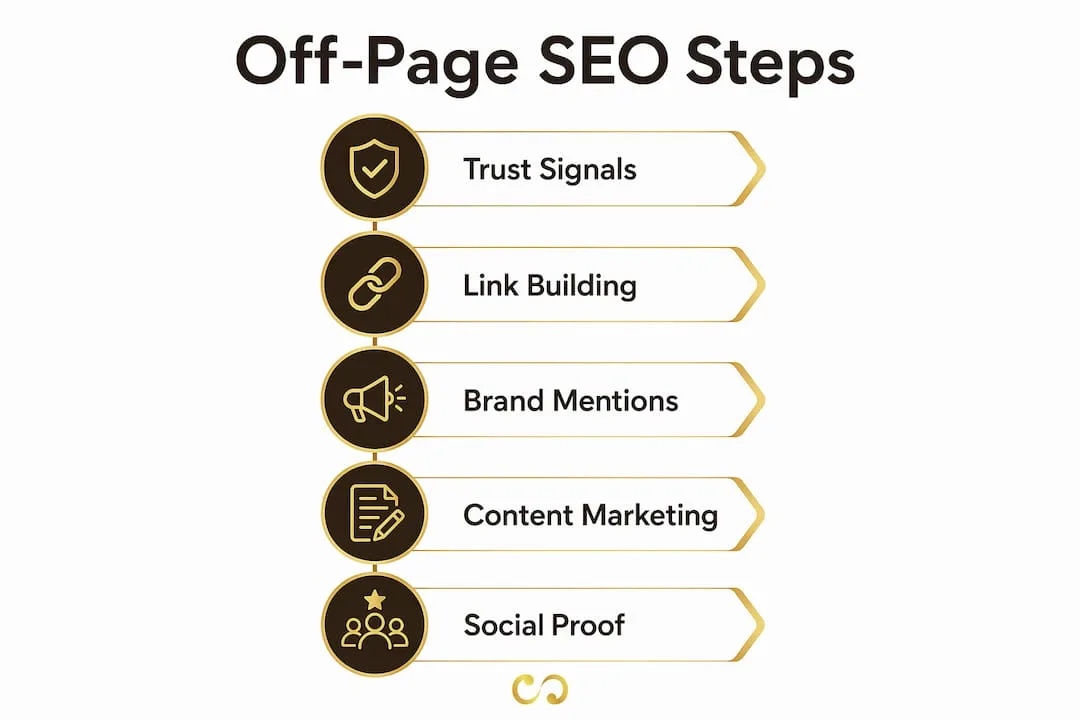
Off-page signals fall into four categories, each contributing differently to how search engines assess your authority.
- Backlinks. A backlink is a link from another website to yours. Search engines treat backlinks as votes of confidence, and the more authoritative and relevant the linking site, the more that vote counts. Backlinks remain the most direct and measurable off-page signal.
- Brand mentions and citations. Search engines notice unlinked brand mentions as well as linked ones. A mention of your business in a news article, even without a link, adds to your reputation. For local businesses, consistent NAP data (name, address, phone number) across directories works as a citation signal.
- Social signals. Social media does not directly affect rankings, but it drives discovery and sharing that can lead to links and brand familiarity. A piece of content that spreads on LinkedIn or X can earn backlinks from writers who find it in their feeds.
- Local SEO signals. Reviews on Google Business Profile, Yelp and industry directories send trust signals specific to local search. Consistent listings and a strong map presence reinforce local authority.
E-E-A-T sits above all of these. It is not a single score but a way of judging whether a site's external reputation backs up what it claims. Strong off-page SEO builds that external evidence. Without it, even technically perfect content struggles to rank for competitive terms.
Pro Tip: Track unlinked brand mentions with Google Alerts or Semrush's Brand Monitoring tool, then ask the author for a link. Turning existing mentions into backlinks is one of the quickest ways to strengthen your off-page profile without creating new content.
How does link quality affect your off-page SEO strategy?
Not all backlinks are equal. Quality comes from editorial placement, source authority, topic relevance and natural anchor text. One link from a respected industry publication outweighs dozens from low-authority directories. Google's spam policies treat manipulative and paid link schemes as link spam, and sites that rely on them risk losing rankings.
Good backlinks tend to share these traits:
- They sit within the body of an article, not in footers or sidebars.
- The linking site covers topics closely related to yours.
- The anchor text reads naturally and describes the linked page accurately.
- The linking page is indexed and gets real organic traffic.
- The link was placed editorially, meaning the author chose to include it without payment or pressure.
Low-quality links carry real risk. Links from private blog networks, link farms or irrelevant foreign directories can lead to manual actions or algorithmic suppression. The safest rule: if a link would embarrass you if Google looked at it, do not pursue it.
Pro Tip: Run a competitor backlink gap analysis in Semrush or Ahrefs. Export the domains linking to your top three competitors but not to you. That list is your priority outreach target, because those sites have already shown they will link to content in your niche.
Link building is a long-term investment, not a one-off task. Sites that keep earning editorial links over months and years build compounding authority that competitors find very hard to copy quickly.
What modern off-page SEO strategies go beyond link building?
Good off-page SEO works like a campaign that combines link building, brand building, influencer work and reputation management. Treating it as a checklist of link requests misses the bigger picture. The goal is a reputation that search engines and people both recognise as authoritative.
These are the off-page strategies worth prioritising in 2026:
- Earn brand mentions through PR and content. Publish original research, data studies or expert commentary that journalists and bloggers want to cite. One well-placed feature in a trade publication can bring several backlinks and many brand mentions.
- Build influencer and partner collaborations. Co-create content with recognised voices in your industry. Guest posts, podcast appearances and co-authored reports all generate links and mentions while growing your audience.
- Take part in niche communities. Contribute properly to forums, Reddit communities, LinkedIn groups and industry Slack channels. Consistent, helpful participation builds familiarity and sometimes earns direct links when members reference your content.
- Manage your online reputation actively. Respond to reviews, deal with negative mentions and watch what appears on the first page of results for your brand name. Online reputation management feeds directly into the trust signals search engines look for.
- Distribute content through social media. Share content consistently on LinkedIn, X and industry-specific platforms. Wider distribution raises the chance that writers and researchers come across your work and link to it.
- Audit and build your backlink profile systematically. Semrush's off-page SEO checklist stresses auditing existing backlinks, identifying toxic links, analysing competitor link profiles and running targeted outreach. This structure stops wasted effort and focuses you on links that actually move rankings.
The role of SEO in marketing now includes brand building as a core function. Off-page SEO and content marketing go hand in hand. Every piece of content you publish is a potential link asset, and every relationship with another brand or creator is a potential source of authority.
Pro Tip: Create a "linkable asset" designed to earn backlinks. Original data, free tools, in-depth guides and visual content such as infographics attract links over time without constant outreach. One strong linkable asset can earn more links in a year than a pile of outreach emails.
How does off-page SEO connect to local SEO and AI search?
Local off-page SEO relies on consistent NAP data, directory listings, reviews and map presence. For businesses serving a specific area, these signals often matter more than general backlinks. A restaurant with consistent listings everywhere and a steady stream of Google reviews can outrank a competitor that has stronger backlinks but weak local signals.
Key local off-page actions:
- Claim and complete your Google Business Profile with accurate hours, photos and categories.
- Build consistent citations on directories such as Yelp, Bing Places, Apple Maps and industry-specific platforms.
- Ask satisfied customers for reviews and respond to every review, positive or negative.
- Earn local backlinks from community organisations, local news outlets and regional business associations.
AI search tools are changing how off-page signals get used. Yoast and Search Engine Land both highlight off-page SEO's role in AI search visibility beyond classic rankings. Google's AI Overviews and Perplexity draw on sources they consider authoritative. The same signals that help traditional rankings (strong backlinks, consistent citations, positive brand mentions) also influence which sources AI tools choose to feature.
| Off-page signal | Effect on traditional SEO | Effect on AI search |
|---|---|---|
| High-authority backlinks | Direct ranking boost | Signals source credibility |
| Brand mentions | Builds E-E-A-T | Raises the chance of being cited |
| Consistent NAP citations | Strengthens local rankings | Confirms the business is real |
| Online reviews | Improves local pack visibility | Feeds trust evaluation |
The overlap between traditional off-page SEO and AI search is growing. A strong off-page profile now pays off across every search format, not just the ten blue links.
Key takeaways
Off-page SEO builds the external authority and trust that search engines and AI tools use to rank and feature your website.
| Point | Details |
|---|---|
| Off-page SEO defined | Actions outside your website that build authority through backlinks, mentions and local signals. |
| Link quality over quantity | One editorial link from a relevant, authoritative site outweighs dozens of low-quality directory links. |
| E-E-A-T shapes rankings | Google's experience, expertise, authoritativeness and trustworthiness framework leans heavily on off-page signals. |
| Modern strategy is broader | Good off-page SEO includes PR, influencer partnerships, community participation and reputation management. |
| Local and AI search overlap | Consistent citations and reviews help both local rankings and visibility in AI-generated answers. |
Why I think most businesses still get off-page SEO wrong
Most businesses treat off-page SEO as a task to finish rather than a reputation to build. They run a link building campaign for three months, see modest gains and stop. Six months later, competitors who kept going have pulled ahead. Off-page SEO compounds. The businesses that win treat it as a long-term relationship with the web, not a short project.
The biggest mistake I see is chasing link volume instead of relevance. A business owner gets excited about landing 50 backlinks from a link exchange network and wonders why rankings do not move. Meanwhile, one mention in an industry trade publication or a feature in a respected regional news outlet makes a visible difference. Endorsements that show trust and relevance matter more than link counts, and that principle has held since Google's earliest days.
The other shift worth watching is AI search. Generative search tools pull from sources they trust, and that trust rests on the same signals that have always defined off-page SEO. Brands that have invested in real authority, through earned backlinks, consistent citations and strong reputations, are the ones showing up in AI Overviews and Perplexity answers. Brands that cut corners are invisible in both. The lesson has not changed: build credibility the right way and the results follow across every channel.
Pawan
How LOOM Brand Designs can strengthen your off-page SEO
A strong off-page profile takes more than a list of tactics. It needs a coordinated approach that connects your brand identity, website authority and content strategy into one consistent signal.
LOOM Brand Designs works with marketers and business owners to build that foundation. From website design and development that gives you a technically sound site worth linking to, to digital strategy consultation that maps out your off-page campaign, our team can help move your authority in the right direction. If you are ready to build a brand that earns links, mentions and trust, we would be glad to talk.
FAQ
What is off-page SEO in simple terms?
Off-page SEO is everything you do outside your own website to improve your search rankings. It includes earning backlinks, building brand mentions and managing your reputation across directories and social platforms.
What are backlinks and why do they matter?
Backlinks are links from other websites to yours. Search engines treat them as votes of confidence, and links from authoritative, relevant sites carry the most weight.
How is off-page SEO different from on-page SEO?
On-page SEO covers what you control on your own site, including content, titles and technical structure. Off-page SEO covers external signals such as backlinks, brand mentions and reviews that other sites and platforms generate about you.
How long does off-page SEO take to show results?
As a rule of thumb, expect three to six months before you see clear ranking improvements, depending on how competitive your niche is and the quality of the signals you earn. It compounds over time, so steady effort beats short campaigns.
Does social media count as off-page SEO?
Social media does not directly affect rankings, but it drives discovery and sharing that can lead to backlinks and stronger brand signals. It is an indirect but valuable part of any off-page strategy.
The Hashtag Loom