
TL;DR:
- Online reputation management means continuously monitoring and shaping how a business appears online, and it matters for customer trust and growth. It covers review sites, social media, search results, news and forums, and uses sentiment analysis to spot risks early. It takes consistent effort over months, built on proactive content, engagement and well-kept profiles on every platform.
Online reputation management (ORM) is the practice of monitoring, shaping and maintaining how your business appears across every digital channel. Think of it as your brand's public record, the one customers check before they call you or walk through your door. Research from Harvard Business School, summarised by Brandwatch, found that a one-star improvement in a business's Yelp rating can lift revenue by 5% to 9%. That alone explains why ORM matters to any owner who wants to grow.
What is online reputation management and what does it cover?
ORM is the continuous work of tracking, influencing and improving how your business is seen across search engines, review platforms, social media, news sites and forums. It covers far more than replying to bad reviews. Done well, it brings reviews, listings, social platforms and customer engagement together into one system for building trust.

ORM sits where public relations, customer service and digital marketing meet. A negative news story, a run of one-star reviews or a social media complaint that spreads can all damage a brand within hours. ORM gives you the processes to catch those signals early and respond before they grow.
For small and mid-sized businesses, reputation carries a lot of weight. Many customers treat online reviews much as they would a recommendation from someone they know. Your Google Business Profile, review pages and LinkedIn presence are often the first things a prospect sees, and if they tell a bad story, many prospects never reach your website.
What are the key channels in reputation management?
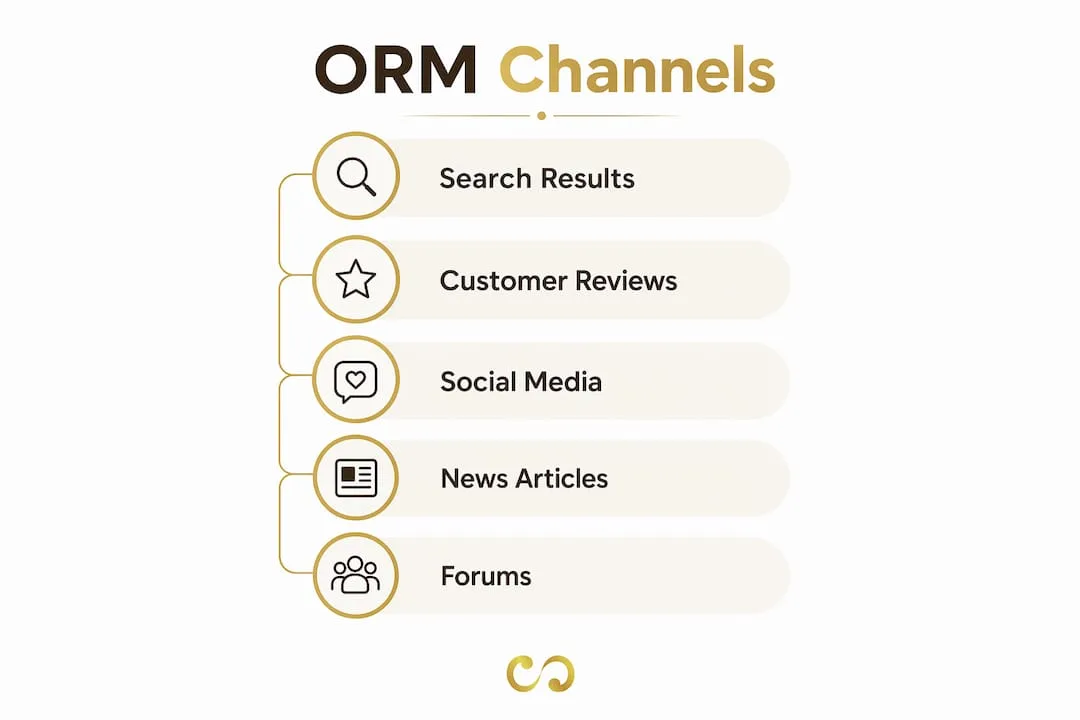
ORM works across five main channels, each with its own monitoring focus and response.
| Channel | Monitoring focus | Key action |
|---|---|---|
| Search engine results | Branded keyword rankings | Publish positive content to control page one |
| Review sites (Google, Yelp) | Star ratings, review volume | Respond to every review within 24 hours |
| Social media | Mentions, comments, sentiment | Engage consistently and address complaints publicly |
| News and media | Brand mentions in articles | Issue responses or press releases when needed |
| Forums and communities | Reddit threads, niche boards | Monitor and take part where appropriate |
Sentiment analysis drives modern ORM. Brandwatch says its Consumer Research platform tracks mentions across more than 100 million online sources in real time, turning loose conversation into structured reputation data. Scale matters because a single mention on a niche forum can surface in Google results within days.
You cannot manage what you cannot see, so monitoring all five channels is the foundation of any serious ORM programme. Google Alerts covers the basics for free, while platforms such as Brandwatch and Birdeye offer deeper sentiment tracking for businesses that need more detail.
How does ORM differ from SEO, and why do both matter?
ORM and SEO share many techniques but aim at different things. Traditional SEO targets non-branded keywords to bring in new audiences. ORM targets branded search results: everything that appears when someone searches your business name.
In practice:
- SEO focuses on ranking one property (your website) for competitive keywords.
- ORM focuses on the many properties (your site, social profiles, review pages, press mentions) that appear for your brand name.
- ORM borrows SEO tools such as keyword research, link building and content optimisation, but applies them to reputation rather than traffic.
- Each strengthens the other. Strong SEO authority makes it easier to rank positive content above negative results.
Understanding SEO's role in marketing shows why the two should never run in separate silos. A business with strong SEO and no ORM is exposed the moment a negative result reaches page one for its name. A business with strong ORM and weak SEO struggles to push positive content high enough to matter.
Pro tip: Search your business name now and count how many of the top ten results you control. If it is fewer than seven, your ORM has a gap worth closing.
What are effective online reputation strategies for business owners?
Building your reputation before a crisis is cheaper and more effective than managing one afterwards. This do-it-yourself timeline suits most small businesses:
-
Weeks 1 and 2: Audit and claim. Search your business name and note every result on page one. Claim your Google Business Profile, Yelp listing, LinkedIn page, Facebook page and any industry directories. Unclaimed profiles are gaps in your reputation.
-
Weeks 3 and 4: Optimise. Complete every profile with accurate contact details, photos and a consistent brand description. Half-finished profiles look neglected to customers and search engines alike.
-
Month 2: Publish content. Start or refresh your blog, post on social media consistently and consider guest articles for industry publications. Building content authority gives you more assets that can rank above negative results.
-
Month 3 onwards: Maintain and monitor. Set up alerts, reply to every review and publish regularly. As a rough guide, expect consistent effort to show in search results after 3 to 6 months.
With negative reviews the rule is simple: reply publicly, stay professional and offer to sort the issue out offline. A thoughtful reply to a bad review often impresses potential customers more than the review itself puts them off.
Pro tip: Never pay for fake reviews or use review gating to filter out unhappy customers. Both break Google's policies and can get your listing penalised or removed.
For negative results that will not go away, the best long-term approach is not to fight them head on. Good positive content across your website, active social profiles and industry bylines gradually pushes them down. Volume and variety of positive assets win over time.
Cross-platform brand consistency matters here too. Every platform where you keep an active, complete presence is one more chance to rank well when someone searches your name, and one less slot for negative content.
How do monitoring technologies and sentiment analysis work?
Modern ORM platforms do more than collect mentions. They classify them. Sentiment analysis reads the tone of each mention and flags it as positive, negative or neutral, so you can prioritise replies and spot patterns before they become crises.
The big shift in recent years has been from reacting to crises towards spotting reputation risks early. Tools like Brandwatch pick up early warning signs through sentiment analysis, giving businesses time to respond before a complaint spreads. That is a very different position from waiting for a crisis to land in your inbox.
Useful outputs from these platforms include:
- Sentiment trend lines showing whether perception of the brand is improving or declining over weeks and months.
- Source breakdowns showing which platforms generate the most negative mentions.
- Competitor comparisons showing how your reputation compares with direct rivals.
- Spike alerts when mention volume suddenly rises, which often means a story is developing.
If enterprise platforms are out of reach, Google Alerts and the insights in Google Business Profile cover the basics. Tools such as Birdeye and Reputation.com offer mid-market options with review management and sentiment tracking built in.
How can you measure and improve your ORM results?
Measuring ORM means tracking the right metrics over the right timeframe. Reputation does not improve overnight. It builds over months of steady effort.
| Milestone | Timeline | What to measure |
|---|---|---|
| Profile audit complete | Week 2 | Number of claimed and optimised profiles |
| Content published | Month 2 | New blog posts, social posts and bylines live |
| Search ranking shifts | Months 3 to 4 | Position of branded results on page one |
| Review rating improvement | Months 4 to 6 | Average star rating across Google, Yelp and others |
| Sentiment trend positive | Month 6 onwards | Net sentiment trending upwards in monitoring tools |
Watch trends rather than single negative reviews. One bad review from an unreasonable customer is noise. An average rating that falls for three months is a sign that something in the business needs fixing.
Read systematically, customer feedback is a tool for improving the business. If five reviewers mention slow replies, that is not a reputation problem. It is an operations problem showing up in your reputation. Fix the cause and the reviews follow.
Pro tip: Set a reminder to run a full branded search audit every 90 days and screenshot page one each time. Comparing the screenshots over six months shows exactly where you are gaining or losing ground.
Key takeaways
Good reputation management needs consistent monitoring, proactive content and direct engagement wherever customers talk about your business.
| Point | Details |
|---|---|
| ORM covers five channels | Search, reviews, social media, news and forums all need monitoring and response. |
| Proactive beats reactive | Building positive content before a crisis is cheaper and more effective than damage control after one. |
| Sentiment analysis drives insight | Platforms such as Brandwatch flag reputation risks early by tracking sentiment across many sources. |
| Results take months | Expect consistent effort to show in search results after roughly 3 to 6 months. |
| Trends matter more than incidents | Declining sentiment over time signals a real problem; one bad review rarely calls for a change of strategy. |
Why patience is the most underrated ORM skill
Many owners I work with expect ORM to behave like paid advertising: spend money, see results straight away. It does not. Reputation is built from accumulated trust, and trust takes time.
The businesses that struggle most treat ORM as a one-off fix. They respond to a crisis, tidy up their profiles and then go quiet for six months. When the next issue appears, they start from scratch. The ones that do well treat ORM as a standing part of running the business, like accounts or customer service.
I also see owners focus entirely on negative reviews and ignore the positive ones. Thanking a happy customer publicly is as valuable as calming an angry one. It shows every reader that you are paying attention and proud of your work.
AI is playing a growing part in ORM. Platforms are getting better at predicting risks before they surface publicly, and the gap between businesses that use these tools and those that do not is likely to widen. If you manage your reputation by hand today, look at social media and SEO tools that can automate the monitoring. That leaves you free for the human side of reputation: genuine engagement, real replies and consistent brand storytelling.
Pawan
How LOOM Brand Designs helps you build a reputation worth protecting
Your reputation is only as strong as the brand behind it. If your website looks dated, your logo varies from platform to platform or your social profiles feel disconnected, customers notice before they read a single review.
LOOM Brand Designs builds the visual and digital foundation that makes reputation work count. From a professional website built to rank and convert to a branding package that gives you one consistent identity everywhere, we connect brand design to business credibility. A polished, consistent brand makes every positive review more believable and every piece of content more authoritative. Get in touch to build the brand your reputation deserves.
FAQ
What is digital reputation and how is it different from ORM?
Digital reputation is the overall impression of your brand online, based on everything people can find. ORM is the active work of managing and improving that impression through monitoring, content and engagement.
How long does online reputation management take to show results?
As a guide, most businesses see search results start to improve after 3 to 6 months of consistent work on profiles, content and reviews.
What are the best online reputation tools for small businesses?
Google Alerts and Google Business Profile insights cover basic monitoring for free. Paid platforms such as Birdeye and Brandwatch add sentiment analysis and review management across several channels.
How should I handle negative reviews as a business owner?
Reply publicly within 24 hours, stay professional and offer to resolve the issue privately. A calm, constructive reply often reassures potential customers more than the negative review puts them off.
Is it ethical to create content to push down negative search results?
Publishing genuine, good-quality content on your website, social profiles and industry publications is standard, ethical practice. Buying fake reviews or publishing misleading content breaks platform rules and can lead to penalties.
The Hashtag Loom