
TL;DR:
- Pay-per-click advertising charges only when someone clicks your ad, so you can track the return on every pound. Good campaigns rely on targeted keywords, strong landing pages, conversion tracking and steady optimisation. Most underperforming campaigns fail because of weak landing pages and scaling too early, which is why patient data collection and a consistent brand matter so much.
Pay-per-click (PPC) advertising is a performance-based model where advertisers pay only when someone clicks their ad. With traditional advertising, you pay for exposure whatever the result. PPC charges you for real engagement. Ads appear on search engines such as Google and Bing, social platforms such as Meta and LinkedIn, and thousands of partner websites. For business owners and marketers, PPC is one of the most direct routes to measurable growth, because every pound spent ties to a user action.
What is PPC advertising and how does it work?
PPC runs on an auction. Every time someone searches a keyword or loads a page where ads can appear, an automated auction decides which ads show and in what order. Advertisers bid on keywords, and the platform weighs each bid alongside a Quality Score to decide placement.

Quality Score reflects three things: expected click-through rate (CTR), how relevant the ad is to the keyword, and landing page experience. A higher Quality Score can lower your cost per click (CPC) and lift your ad position. So a well-written ad pointing to a strong landing page can outrank a competitor who bids more but offers a poor experience.
What happens in a typical auction:
- Someone types a search query into Google.
- Google runs an instant auction among the advertisers bidding on that keyword.
- Each advertiser's Ad Rank is worked out from their bid, the quality of the ad and landing page, and other factors such as the expected impact of ad assets.
- The highest Ad Rank wins the top position.
- The advertiser pays only when the user clicks.
Pro Tip: Improving your Quality Score is often cheaper than raising your bid. Better ad relevance and a better landing page can bring your CPC down without any increase in budget.
What are the common types of PPC campaigns?
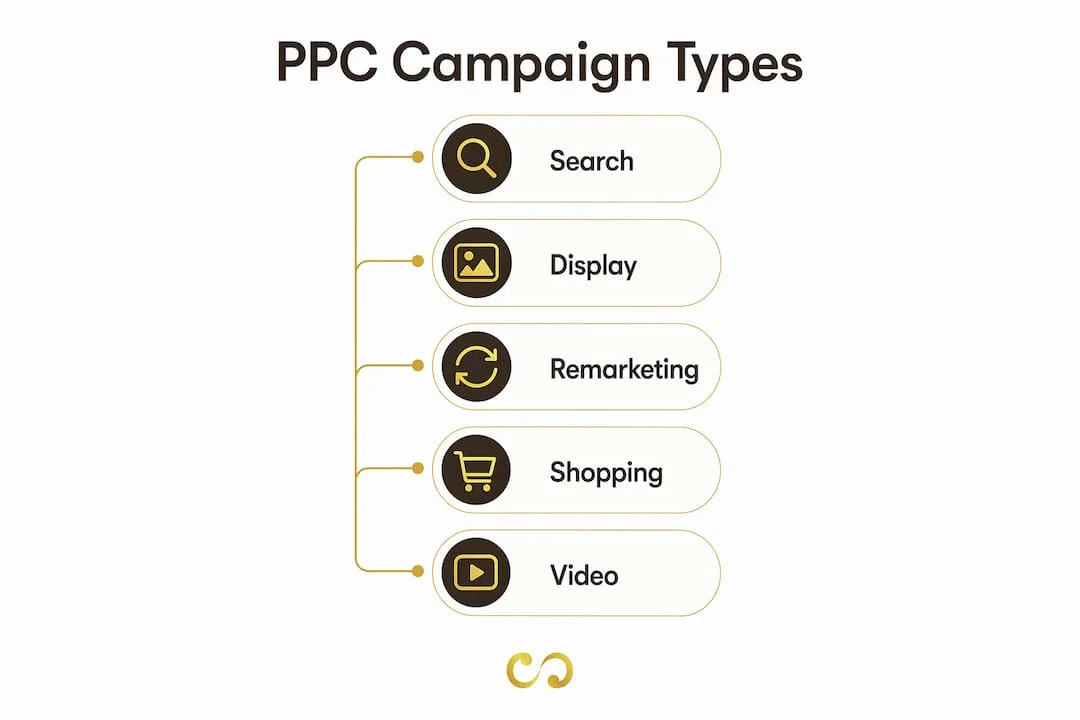
There are several PPC ad types, each suited to a different goal. The right one depends on where your audience is in the buying process and what you want them to do.
| Ad type | Best use |
|---|---|
| Search ads | Capturing high-intent users actively searching for your product |
| Display ads | Building brand awareness across websites and apps |
| Social media ads | Reaching audiences by interest, behaviour or demographics |
| Shopping ads | Promoting physical products with images and prices |
| Video ads | Engaging users on platforms like YouTube with visual storytelling |
| Remarketing ads | Re-engaging visitors who left your site without converting |
Search ads are the most direct format. They appear at the top of Google or Bing results when someone types a relevant query. Display ads work differently: they appear as banners or images on sites across the Google Display Network, reaching people who may not be searching but fit your audience profile.
Remarketing deserves special attention. It targets people who have already visited your site, which tends to make it one of the best-converting ad types. A visitor who browsed your pricing page is far more likely to convert than a cold audience. Our retargeting performance guide covers the mechanics in detail.
How to plan and run effective PPC campaigns
Good PPC management starts before you write a single ad. As Salesforce notes, successful campaigns need clear goals, continuous tracking and steady optimisation. Skipping the planning stage is the most common reason campaigns waste budget.
Step 1: Set a specific goal
Define success before you spend a penny. A lead generation campaign measures cost per lead. An e-commerce campaign measures return on ad spend (ROAS). Without a defined goal, you cannot tell whether the campaign is working.
Step 2: Research and select keywords
Keywords decide who sees your ads. Use broad match to discover new queries and exact match to control costs on high-value terms. Negative keywords matter just as much: they stop your ads showing on irrelevant searches, which cuts wasted spend straight away.
Step 3: Write ad copy that earns the click
Your headline must match the searcher's intent. If someone searches "affordable web design for small business", your headline should reflect that language. Include a clear call to action in every ad. Specific phrases such as "Get a Free Quote" or "Book a Consultation Today" tend to beat vague copy like "Learn More".
Step 4: Build landing pages that convert
The landing page is where clicks become customers. A mismatch between what your ad promises and what the page shows will sink your conversion rate. If the ad promotes a specific service, the landing page must deliver exactly that, not a generic homepage.
Step 5: Choose a bid strategy
Google Ads offers several automated bid strategies. Target CPA bidding sets bids automatically to get as many conversions as possible at your target cost per acquisition. Set the target unrealistically low and you limit exposure and lose conversions. Start with a realistic CPA based on your historical data, then tighten it as performance improves.
Pro Tip: Use manual CPC bidding when you first launch a campaign. It gives you direct control while you gather data. Move to automated strategies like Target CPA once you have at least 30 days of conversion history.
How to measure and optimise PPC performance
Clicks alone do not tell you whether a campaign is profitable. Conversion tracking is the foundation of accurate measurement. Set it up in your ad platform and on your website to track sign-ups, purchases, phone calls or whatever goal matters to your business.
The four metrics every marketer should watch:
- CTR (click-through rate): the percentage of people who see your ad and click it. A low CTR points to weak copy or poor keyword targeting.
- Conversion rate: the percentage of clicks that complete your goal. A low rate usually means a landing page problem.
- CPA (cost per acquisition): what you pay for each conversion. This is the clearest measure of efficiency.
- Quality Score: Google's rating of your ad relevance and landing page experience. A low score raises your CPC and lowers your position.
A/B testing is the most reliable way to improve these numbers. Test one variable at a time: headline, call to action, landing page layout or offer. A common rule of thumb, set out in Channable's PPC best practices, is to wait for around 100 conversions per variation before drawing conclusions. Scale spend before then and you are making decisions on noise, not data.
Let performance data guide your budget. Move money towards the campaigns and ad groups with the lowest CPA and highest conversion rate. Pause or cut underperformers rather than waiting for them to recover. For a wider view of the metrics that matter, our marketing metrics guide covers tracking frameworks that apply directly to PPC.
Key takeaways
PPC delivers measurable results only when ad relevance, landing page quality and conversion tracking work together.
| Point | Details |
|---|---|
| PPC charges per click | You pay only when someone clicks your ad, so every pound traces to a real action. |
| Quality Score controls costs | Better ad relevance and landing pages lower your CPC without raising your bid. |
| Match campaign type to goal | Search ads capture intent; remarketing and display build awareness and re-engage visitors. |
| Conversion tracking is non-negotiable | Without it, you cannot measure CPA or make informed budget decisions. |
| Test before you scale | Wait for enough conversions per variation, often around 100, before drawing conclusions or raising spend. |
Why most PPC campaigns underperform before they even launch
I have reviewed a lot of PPC campaigns over the years, and the pattern is almost always the same. Business owners build the ads carefully, set a budget, then point everything at the homepage. The ads run. The clicks come in. The conversions do not.
The problem is not the ad. PPC is a funnel challenge, not an ad-writing challenge. Weak landing pages quietly inflate your costs even when the ads are strong. Every pound spent on clicks that land on a mismatched or slow page is wasted, and your Quality Score drops as a result.
The second mistake I see constantly is scaling too fast. A campaign with 15 conversions does not have enough data to tell you anything reliable. Marketers get impatient, see a low CPA for a week and double the budget. Then the CPA spikes and they blame the platform. The platform did not change. The data was just too thin to trust.
My honest advice: treat your first 60 days as data collection, not growth. Fix the landing page first. Get conversion tracking right. Let each ad variation gather enough conversions before you touch the bids. The marketers who do this consistently do better than those chasing short-term numbers.
Pawan
How LOOM Brand Designs supports your PPC strategy
Running PPC without strong brand assets is like building a house on sand. Your ads can drive traffic, but if your landing pages look inconsistent or your brand identity is unclear, conversion suffers.
LOOM Brand Designs builds the brand foundation that makes PPC work harder. From logo and identity design to full website design and development, every asset is built to convert. If you are starting out, the Basic Branding Package gives you a professional identity that holds up across ad creative and landing pages. For businesses ready to scale, the Standard Branding Package delivers cohesive messaging across every channel. Book a consultation to see how the right brand foundation changes your PPC results.
FAQ
What is PPC advertising in simple terms?
PPC is a paid digital model where you pay only when someone clicks your ad. Ads appear on search engines, social platforms and websites based on keyword bids and audience targeting.
What are the best PPC advertising platforms?
Google Ads and Meta Ads are the most widely used. Google captures high-intent search traffic, while Meta reaches audiences by interest and behaviour across Facebook and Instagram.
How much does PPC advertising cost?
Costs vary by industry, keyword competition and Quality Score. You set your own budget and pay per click, so costs scale with the traffic you receive.
How do I run a PPC campaign for the first time?
Define a single goal, research keywords, write focused ad copy and build a dedicated landing page. Set up conversion tracking before your first ad goes live so you can measure real results from day one.
What is Quality Score and why does it matter?
Quality Score is Google's rating of your ad relevance and landing page experience. A higher score lowers your cost per click and improves your ad position, which makes it one of the most cost-efficient levers in PPC.
The Hashtag Loom