

TL;DR:
- Search engine optimisation improves a website's position in unpaid search results, bringing in more organic traffic.
- It rests on crawling, indexing and ranking, with content quality, technical health and authority all playing a part.
- In 2026, steady SEO work is still essential for visibility, credibility and long-term growth.
SEO, or search engine optimisation, is the practice of improving a website so it ranks higher in organic search results and attracts more unpaid traffic from search engines such as Google. For most businesses, search is one of the main ways new customers find them. As Search Engine Land puts it, good SEO brings visibility, credibility and trust when people search for relevant topics. For founders and small business owners, learning the basics is one of the most cost-effective ways to compete online without a large advertising budget.
What is SEO and how does it work?
SEO works through three processes: crawling, indexing and ranking. Each happens automatically inside the search engine, but your site's structure and content shape the outcome.

Crawling is how search engines discover your content. Automated programs called bots follow links across the web and visit pages on your site. If your site has broken links, heavy JavaScript that gets in the bots' way, or pages blocked in your robots.txt file, they may never find your content.
Indexing happens after a bot visits a page. The search engine stores the page in a huge database and categorises it by topic, keywords and quality signals. A page that is not indexed cannot appear in results, however good it is.
Ranking is the final step. Algorithms weigh a great many signals, including keyword relevance, content quality, page speed and the number of credible sites linking to yours, to decide where your page appears. Most clicks go to results on the first page, so ranking on page two is close to not ranking at all.
Keywords and user intent sit at the centre of ranking. A keyword is the phrase someone types into a search engine. Intent is the reason behind the search. Someone typing "best running shoes for flat feet" wants a recommendation, not a history of athletic footwear. Matching your content to intent is what separates pages that rank from pages that vanish.
- Crawling: bots discover pages by following links
- Indexing: content is stored and categorised in the search engine's database
- Ranking: algorithms score pages on relevance, authority and technical health
- Keywords: the bridge between what people search and what your page covers
- User intent: the real goal behind a search
Pro Tip: Submit a sitemap in Google Search Console. It tells Google which pages exist on your site and helps it crawl and index them.
What are the key components of SEO?
SEO has three main pillars: technical SEO, on-page SEO and off-page SEO. Each deals with a different layer of how search engines judge your site.
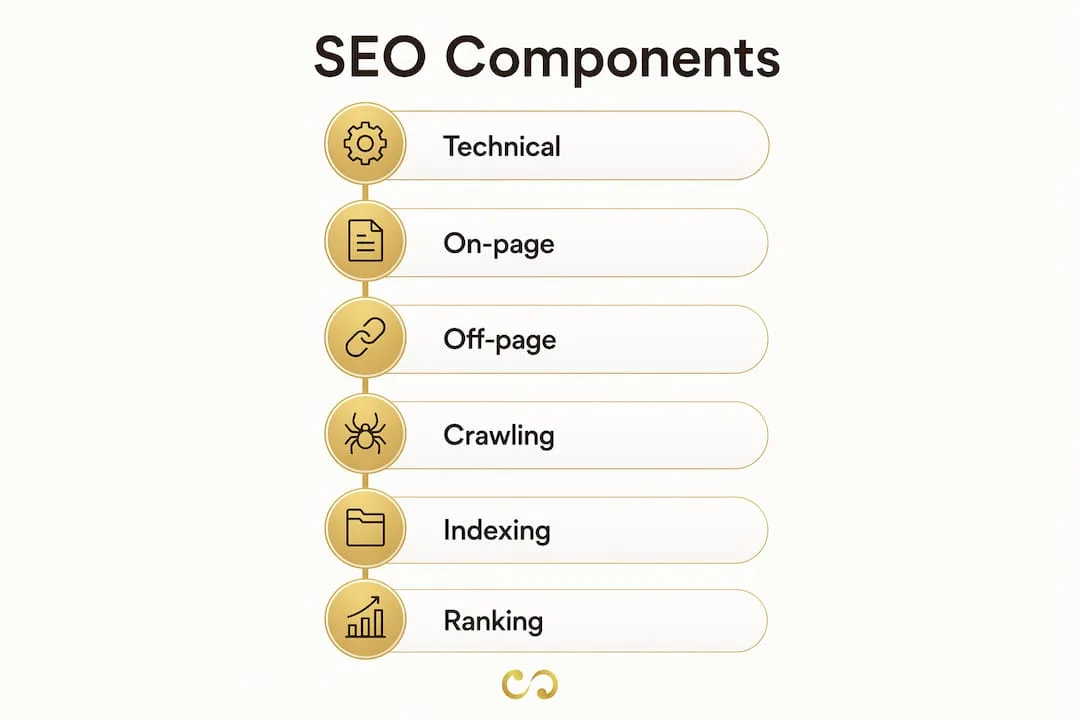
Technical SEO
Technical SEO covers your website's infrastructure: site speed, mobile-friendliness, secure HTTPS, fixing crawl errors and structured data. Technical problems such as slow load times and crawl errors hold back your visibility in Google and in AI-driven search tools. A site that loads slowly on a phone loses rankings and visitors at the same time.
On-page SEO
On-page SEO deals with the content and HTML of each page. That includes putting your target keywords in title tags, meta descriptions, headings and body text. Quality matters as much as placement. A page that answers a question fully, in clear language, with sensible headings, will consistently beat thin, keyword-stuffed content.
Off-page SEO
Off-page SEO builds your site's authority through signals from elsewhere. Backlinks, links from other websites to yours, are the strongest of these. A link from a respected news outlet or industry publication tells Google your content is credible. Brand mentions and online reviews add to your reputation too.
| Component | Focus area | Main goal |
|---|---|---|
| Technical SEO | Site infrastructure and speed | Make the site crawlable and fast |
| On-page SEO | Content, keywords and metadata | Match intent and signal relevance |
| Off-page SEO | Backlinks and external reputation | Build authority and trust |
All three work together. Strong content on a technically weak site will not rank. A fast site with no backlinks will struggle in competitive markets. Our digital marketing checklist for small businesses shows how to tackle all three in a practical order.
Pro Tip: Fix technical SEO first. No amount of great content makes up for a site Google cannot crawl and index properly.
Why does SEO matter for business growth in 2026?
SEO is one of the best-value digital marketing channels available to small businesses because organic traffic compounds. A page that ranks well keeps attracting visitors for months or years without extra spend, while paid traffic stops when the budget does.
SEO now also covers visibility in AI-driven discovery tools. Businesses that treat it as a one-off task tend to fall behind those that treat it as an ongoing investment.
AI-powered features such as AI Overviews and answer engines have changed how results look, but they have not reduced the value of SEO. Sites with strong technical health, authoritative content and clear structure are the ones AI systems draw on when they generate answers. Weak SEO means weak visibility in both traditional and AI-driven results.
For small business owners the lesson is simple. Paid ads stop the moment you stop paying; SEO builds an asset. A blog post that ranks for a relevant search in your industry can bring in enquiries every day without ongoing cost. The role of SEO in marketing goes well beyond rankings: it builds credibility, brings in qualified visitors and supports every other channel you run.
How can small business owners get started with SEO?
Good SEO is a continuous effort covering keyword research, content quality and link building. The good news is that beginners can make real progress by following a clear order.
-
Do some keyword research. Use free tools such as Google Search Console or Google's autocomplete to find the phrases your customers actually type. Choose keywords with clear intent and realistic competition for a new or small site.
-
Create content that matches intent. Write pages and posts that directly answer your audience's questions. Put depth and clarity ahead of word count: a 600-word page that fully answers a question beats a 2,000-word page that circles it.
-
Sort out your technical foundation. Run a free check with Google PageSpeed Insights to find speed problems. Aim for pages that load quickly on mobile, and fix broken links or pages returning errors.
-
Earn backlinks honestly. Approach local business directories, industry blogs and community organisations about linking to your site. Guest articles on relevant websites are a dependable way to build authority early.
-
Monitor results and adjust. Connect your site to Google Search Console and Google Analytics. Check which pages bring in traffic, which searches you appear for and where visitors leave. Improve weak pages with better content or sharper keyword focus.
Pro Tip: The most common beginner mistake is chasing keywords that are far too competitive. A local bakery will see results much sooner for "best sourdough in [your town]" than for "best bread in the UK".
Our Brand Foundation SEO Starter is designed for businesses at this stage and covers the foundations beginners most often miss.
Key takeaways
SEO is one of the most cost-effective ways for a small business to build lasting online visibility, provided the work is consistent.
| Point | Details |
|---|---|
| SEO definition | SEO improves a site's organic search visibility through technical, content and authority signals. |
| Three core pillars | Technical, on-page and off-page SEO each deal with a different layer of search performance. |
| First-page visibility | Most clicks go to first-page results, so ranking position has a direct business effect. |
| Long-term value | Rankings keep bringing visitors without ongoing spend, unlike paid ads. |
| AI and SEO in 2026 | Strong technical SEO now affects visibility in both traditional and AI-driven search. |
SEO in 2026 is not optional. Here is why I am certain
I hear the same question all the time: "Does SEO still matter now that AI answers everything?" Yes, and the reasoning is simple.
AI search tools do not create information. They retrieve it from websites that are well structured, authoritative and technically sound. When a site has crawl errors, slow load times or thin content, it is less likely to be picked up by Google's index or by AI tools that draw on the web. That is not a coincidence. It is the same logic applied to a new interface.
What I have seen consistently is that businesses treating SEO as a one-off box to tick get left behind. Those that treat it as an ongoing discipline, updating content, fixing technical issues and building real authority, keep growing their visibility year after year. AI has not changed that. If anything, it has raised the bar for content quality and technical health.
My honest recommendation: start with the fundamentals. Fix your technical foundation, write content that genuinely helps your audience and build links through real relationships. That approach worked in 2016, it works in 2026 and it will work in whatever comes next.
Pawan
How LOOM Brand Designs can help you build your SEO foundation
A strong online presence starts with a website search engines can find and people trust. LOOM Brand Designs offers website design and development with SEO good practice built in from the start, so your site is fast, mobile-ready and technically sound before you publish a single page.
For small businesses starting from scratch, the basic branding package combines brand identity with the digital foundations you need to compete in search. We work with founders and small business owners to build credible, well-structured online presences that people and search engines both reward. If you are ready to go from invisible to findable, we are ready to help.
FAQ
What is SEO in simple terms?
SEO, or search engine optimisation, is the process of improving your website so it appears higher in unpaid search results. Higher rankings mean more people find your business without you paying for ads.
How long does SEO take to show results?
SEO usually takes three to six months to show noticeable results, and competitive markets can take longer. The timeline depends on your site's technical health, content quality and backlink profile.
What does SEO do for a small business?
SEO brings organic visitors to your website, builds credibility with potential customers and reduces your reliance on paid advertising. A well-ranked page can keep generating enquiries without ongoing ad spend.
What is the difference between on-page and off-page SEO?
On-page SEO covers what you control on your own site, such as content, keywords and metadata. Off-page SEO covers external signals, such as backlinks from other websites, that build your site's authority.
Is SEO still relevant with AI search in 2026?
Yes. AI search tools draw on technically sound, authoritative websites, so strong SEO supports your visibility in both traditional and AI-driven results.
The Hashtag Loom