

TL;DR:
- Real brand loyalty is about trust, preference and advocacy, not just repeat purchases.
- Customer experience shapes loyalty at first contact, at the point of purchase and after the sale.
- Lasting loyalty takes consistent effort across the whole company, built on experiences that feel genuine.
Many business owners assume that if customers keep coming back, the brand must be doing something right. That assumption can hold back growth. Retention and brand loyalty are not the same thing, and confusing the two leads to marketing decisions built on a shaky foundation. A customer who stays because switching feels like a hassle is very different from one who stays because they trust your brand. This article explains what real brand loyalty looks like, why it matters beyond any retention metric, and how small and mid-sized businesses can build it deliberately.
Key takeaways
| Point | Details |
|---|---|
| Loyalty vs. retention | Brand loyalty runs deeper than customer retention and supports lasting growth. |
| Experience drives loyalty | Good customer experiences turn buyers into advocates. |
| Measure loyalty properly | Track retention, but also emotional connection and willingness to refer. |
| Loyalty supports profit | Loyal customers tend to spend more, refer others and lower your marketing costs. |
| Mindset over programmes | Lasting loyalty comes from a company-wide commitment, not quick-fix tactics. |
What is brand loyalty and why does it matter?
Brand loyalty is a customer's consistent preference for your brand over competitors, even when other options are available and sometimes cheaper. It is more than a repeat transaction. A loyal customer actively chooses you, recommends you, and forgives the occasional mistake because they value the relationship.
The distinction matters for SMEs. Misread the loyalty signals and you end up investing in retention tactics that patch the surface while the foundation cracks. Loyal customers do things that repeat buyers often don't:
- They spend more per transaction over time
- They refer friends and colleagues without being asked
- They give honest feedback that helps you improve
- They are far less likely to leave when a competitor runs a promotion
- They defend your brand publicly when it faces criticism
Customer experience research from Harvard Business School Online puts experience quality at the centre of loyalty: how well you manage the customer journey, and the link between service, satisfaction and profit, shapes satisfaction, loyalty, retention and growth.
The financial stakes are real. Winning a new customer usually costs more than keeping an existing one, and loyal customers tend to contribute a larger share of profit. For an SME on a limited marketing budget, a base of genuinely loyal customers is one of the most efficient growth assets there is.
Customer experience: the engine behind real loyalty
If brand loyalty is the destination, customer experience is the road. Every interaction, from the first ad someone sees to the follow-up email after they buy, shapes their view of you and whether they come back with enthusiasm or out of habit.
Better customer experience goes hand in hand with higher satisfaction and stronger long-term loyalty. So the product alone is rarely enough. Customers judge you on the whole experience, and small moments of friction or delight carry more weight than most business owners realise. Treat building better brand experiences as an ongoing process, not a one-off project.
Three touchpoints every SME should get right:
- First impression. Whether a prospect finds you through Google, a social post or a referral, the first interaction sets the tone. A confusing website, a slow reply or a mismatched message can end the relationship before it starts. Review your first-contact experience at least once a quarter.
- Purchase or service delivery. This is where the promise meets reality. Delays, poor communication, or a product that falls short of its marketing all open a gap between expectation and experience, and that gap is where loyalty dies. Train your team to over-communicate during this phase, especially when things go wrong.
- After the sale. Many SMEs go quiet once the sale is made, and that silence reads as indifference. A well-timed check-in, a personal thank-you, or a useful resource that helps the customer get more from their purchase turns a transaction into a relationship.
Common habits that erode trust even among repeat buyers include inconsistent messaging across channels, slow responses to complaints, and the sense that you only care about the sale, not the outcome.
Pro tip: set up a simple quarterly feedback loop with a two-question survey: "How satisfied were you with your experience?" and "What is one thing we could do better?" Track the answers over time, not just one by one. The patterns will show you where loyalty is being built or quietly lost.
Retention vs. loyalty: diagnosing the real drivers
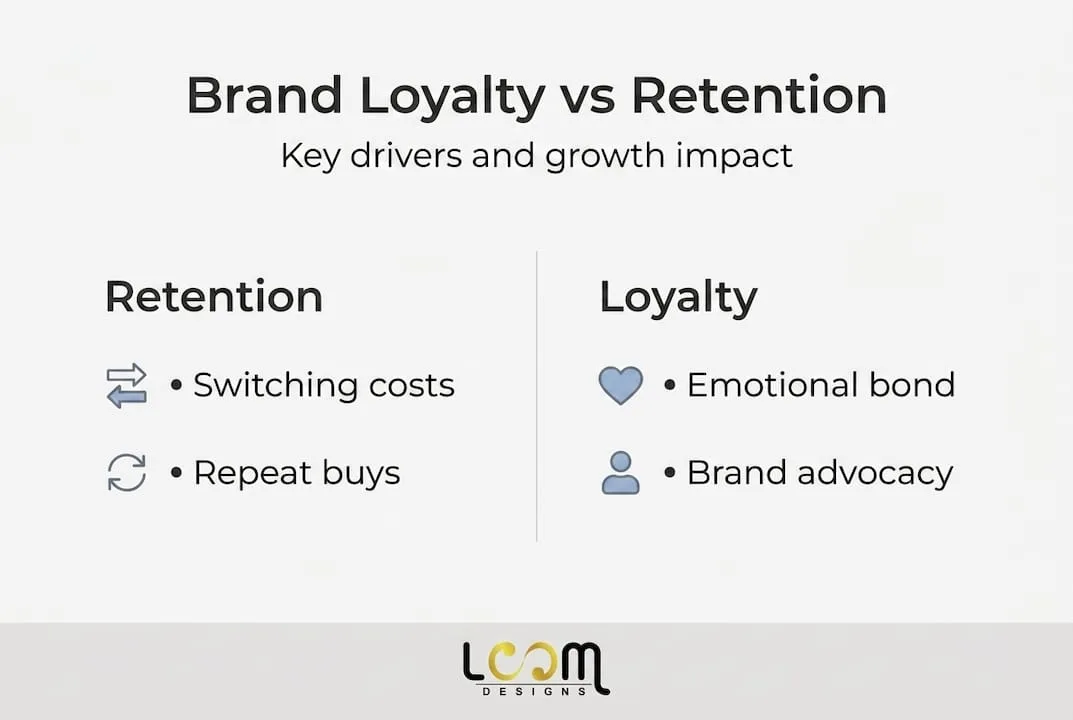
Retention and loyalty look alike on a spreadsheet but behave very differently in a competitive market. A business can report high retention while sitting on a customer base that is one good competitor promotion away from leaving.
Customers can stay because of inertia or switching costs even when they are not especially satisfied, so raw retention figures can mislead you unless you understand why people stay. It's an uncomfortable reality of customer data: the number that looks like success may be hiding a slow-building weakness.
| Factor | Inertia-based retention | Relationship-driven loyalty |
|---|---|---|
| Main driver | Inconvenience of switching | Genuine preference and trust |
| Price sensitivity | High, will leave for a better deal | Low, willing to pay a premium |
| Referral behaviour | Rare, passive | Frequent, enthusiastic |
| Response to a bad experience | Quick to leave | Likely to give a second chance |
| Long-term value to the brand | Fragile and unpredictable | Stable and compounding |
| Engagement level | Minimal | Active and invested |
The table shows why building brand trust has to be an active strategy, not a by-product of a low churn rate.
Pro tip: to find out whether your customers are loyal or just stuck, send a short survey that asks: "If a competitor offered the same product at a 10 percent discount, how likely would you be to switch?" Customers who say they wouldn't switch are showing loyalty. Those who would switch easily are retained but at risk, and that tells you where to focus your relationship-building.
How loyalty fuels growth and resilience
Brand loyalty is one of the most underrated growth drivers in business. It protects your revenue and also brings in more of it, with less effort and at lower cost.
Better customer experience leads to higher satisfaction and loyalty, which in turn lead to more retention, repeat business and referrals. Referrals matter especially for SMEs, because word of mouth from a loyal customer carries more weight than almost any paid channel. It is specific, credible and trusted by the person who hears it.
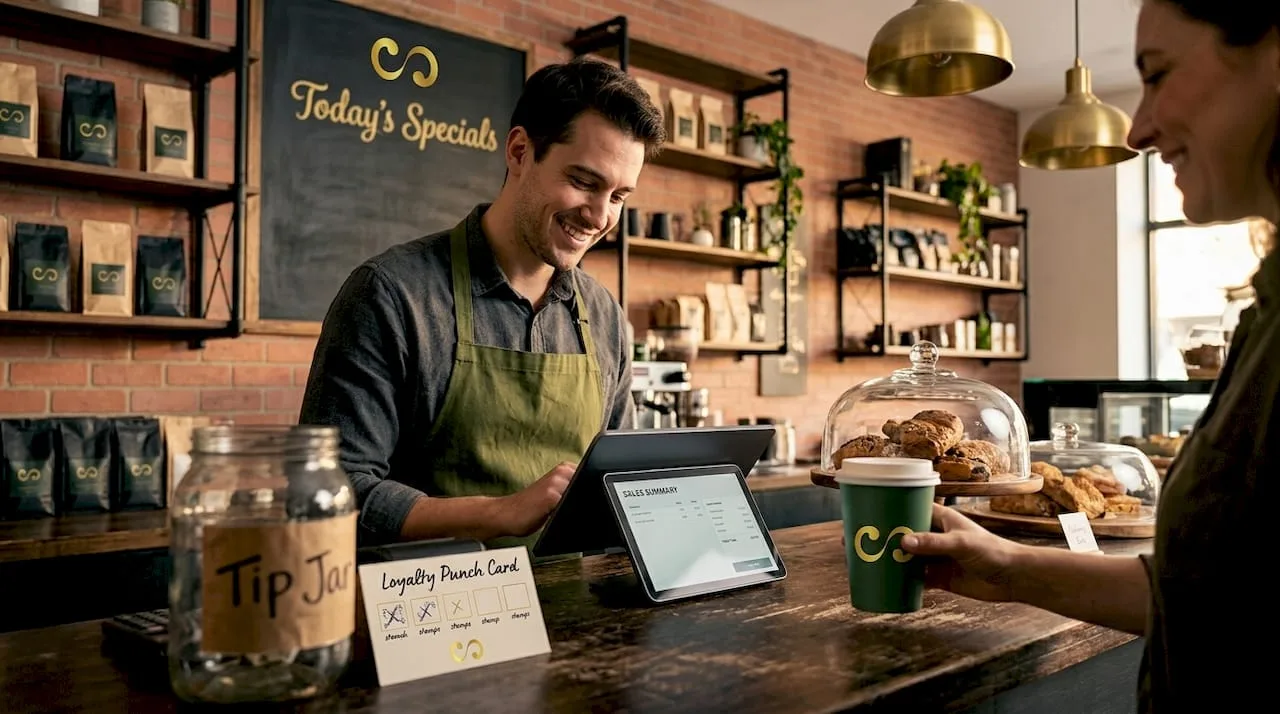
Loyal customers also act as a buffer in downturns and market disruption. When budgets tighten, people cut spending first with brands they feel neutral about. Brands they feel connected to often keep their business, because the relationship has value beyond price. Brands that invest consistently in genuine engagement build emotional equity that protects them from competing on price alone.
| Business metric | Low loyalty base | High loyalty base |
|---|---|---|
| Customer acquisition cost | High, ongoing | Lower over time thanks to referrals |
| Annual revenue per customer | Moderate, mostly transactional | Higher, includes upsells and referrals |
| Price sensitivity | High | Much lower |
| Recovery from service failure | Slow, often ends in churn | Faster, customers give the benefit of the doubt |
| Word-of-mouth volume | Low | High and steady |
Other ways loyalty protects your business when the market shifts:
- Loyal customers are more likely to try new products or services you launch, which lowers the risk of new revenue ideas
- They provide social proof through reviews and recommendations, so you depend less on paid marketing
- They are more forgiving of price rises when the relationship is strong and your communication is honest
- They create a stable revenue base that makes financial planning more predictable
This compounding effect is why growth strategy for SMEs should always track loyalty alongside customer acquisition.
Building real loyalty: practical approaches for SMEs
Knowing why loyalty matters is half the job. The other half is building it through consistent actions that add up to a strong relationship over time.
A practical sequence for turning satisfied customers into loyal promoters:
- Personalise every touchpoint you can. Use your CRM data to send birthday messages, mark purchase anniversaries and tailor recommendations to past behaviour. Personalisation shows you see the customer as a person, not an order number.
- Invest in after-sale support. The purchase is the start of the relationship. Follow up with onboarding help, usage tips or a simple check-in. This step on its own often separates businesses that retain customers from those that build loyalty.
- Reward advocacy in a human way. Generic points programmes are table stakes. Thank customers who refer others personally, with an exclusive offer or early access to something new. Recognition that feels human lands far better than an automated discount code.
- Show that feedback matters. When a customer gives feedback and later sees a change you made because of it, they feel ownership and belonging. Tell them: "We heard you, and here's what we changed."
- Keep the experience consistent across every channel. Your social voice, website design, email tone and in-person service should all feel like they come from the same business. Gaps create doubt. A thoughtful brand design process keeps your identity coherent at every interaction.
Poor internal service quality lowers satisfaction, loyalty and retention, so loyalty-building can't stop at customer-facing tactics. It has to run through your operations, team culture and internal standards. Your employees are part of the brand experience.
Common pitfalls to avoid:
- Treating a loyalty programme as a substitute for a real relationship
- Ignoring negative reviews or brushing off difficult feedback
- Delivering a great first experience and then letting quality slip after the second or third purchase
- Leaning on discounts to keep customers, which trains them to expect lower prices instead of building attachment
Work on your emotional brand connection to put your brand's values and personality into words that resonate more deeply than any reward points ever could.
A different view of brand loyalty for small businesses
Here is the part most marketing content skips: loyalty programmes, as most businesses run them, are a workaround for a problem that should have been solved upstream. They treat the symptom and leave the cause alone.
If your customers only stay because of a points balance or a discount tier, you haven't built loyalty. You've built a slightly more expensive switching cost. The moment a competitor offers a better scheme, or yours lapses, the relationship disappears.
Real brand loyalty is the result of many positive experiences across every touchpoint over time. A campaign can't manufacture it. It is earned through thousands of small moments where your brand showed up consistently, communicated honestly and delivered more than expected.
For SMEs, that means loyalty has to be a company-wide mindset, not a marketing department project. Operations, customer service, design and delivery partners all build or erode loyalty with every action. One frustrating exchange with an indifferent service rep can undo months of good marketing.
We believe the most durable advantage an SME can build is a reputation for making customers feel valued at every stage. A loyalty app can't buy that. It has to be lived through your culture and expressed through the branding tips you apply consistently over time.
The businesses we see growing fastest are rarely the ones with the flashiest loyalty schemes. They are the ones that have made excellent, consistent experiences a non-negotiable standard across the whole organisation.
Ready to build lasting loyalty for your brand?
Understanding what drives loyalty is the first step. Turning that into a brand customers genuinely connect with is where the real work, and the real reward, begins.
At LOOM Brand Designs, we help SMEs build brands that earn loyalty at every touchpoint. Whether you need a strong foundation with our basic branding package, a digital presence built to convert through our website design services, or consistent materials through our graphic design services, we create the building blocks that turn satisfied customers into advocates. Get in touch and let's build a brand experience your customers come back to because they want to, not because they have to.
Frequently asked questions
How can small businesses measure brand loyalty effectively?
Track repeat purchase rates, referral frequency and direct feedback to see loyalty beyond simple retention figures. Look for both qualitative and quantitative signs of emotional connection, not just purchase behaviour.
Can customer retention be high even if loyalty is low?
Yes. High retention can come from inertia or switching costs rather than genuine satisfaction or loyalty. Retention on its own can mislead you unless you find out why customers are staying.
What is the relationship between customer experience and loyalty?
A strong customer experience leads to higher satisfaction, which builds the lasting emotional attachment that defines loyalty. Better experience is consistently linked to stronger long-term loyalty.
What are common mistakes SMEs make when trying to build loyalty?
The most common are using rewards programmes as a substitute for consistently good experiences, and neglecting the internal service quality customers feel at every touchpoint. Loyalty is built through good operations and honest relationships, not just promotions.
The Hashtag Loom