


How Copywriting Shapes Brand Identity for Maximum Impact
- Pawan Samarakoon
- 7 days ago
- 9 min read

TL;DR:
Copywriting shapes brand identity, trust, and emotional connection more than visuals alone.
Principles of emotional ideas, focus, and structured persuasion drive memorable branding.
Consistent messaging and testing optimize brand recognition across all customer touchpoints.
Most marketing managers assume a polished logo and a consistent color palette are enough to build a recognizable brand. They’re not. While visuals create a first impression, it’s your words that determine whether someone trusts you, remembers you, and chooses you over a competitor. Copywriting is the architecture beneath every brand touchpoint, from your homepage headline to your email subject lines. The core principles of great brand copy include an Emotionally Compelling Idea, the Rule of One, and the Architecture of Persuasion. This guide walks you through each of these principles with practical frameworks, real comparisons, and actionable steps your team can use right now.
Table of Contents
Key Takeaways
Point | Details |
Copywriting builds trust | Consistent, persuasive messages make your brand identity memorable and reliable for customers. |
Emotion drives connection | Emotionally compelling copy motivates action and deepens loyalty far beyond functional details. |
Testing makes perfect | A/B testing and data analysis lead to continuous improvement in brand messaging effectiveness. |
Consistency matters | Unified tone and messaging across all channels reinforce your brand’s personality and values. |
Why copywriting is the backbone of brand identity
There’s a persistent myth in SME marketing: if the design looks professional, the brand feels professional. But design without copy is a billboard with no message. Your words define what your brand stands for, who it’s for, and why anyone should care. Copy is where personality lives.
When your copy is consistent, emotionally resonant, and strategically crafted, it aligns what your audience feels about your brand with what you intend them to feel. That alignment is brand identity. Without it, even the most beautiful visual system falls flat because there’s no story holding it together.
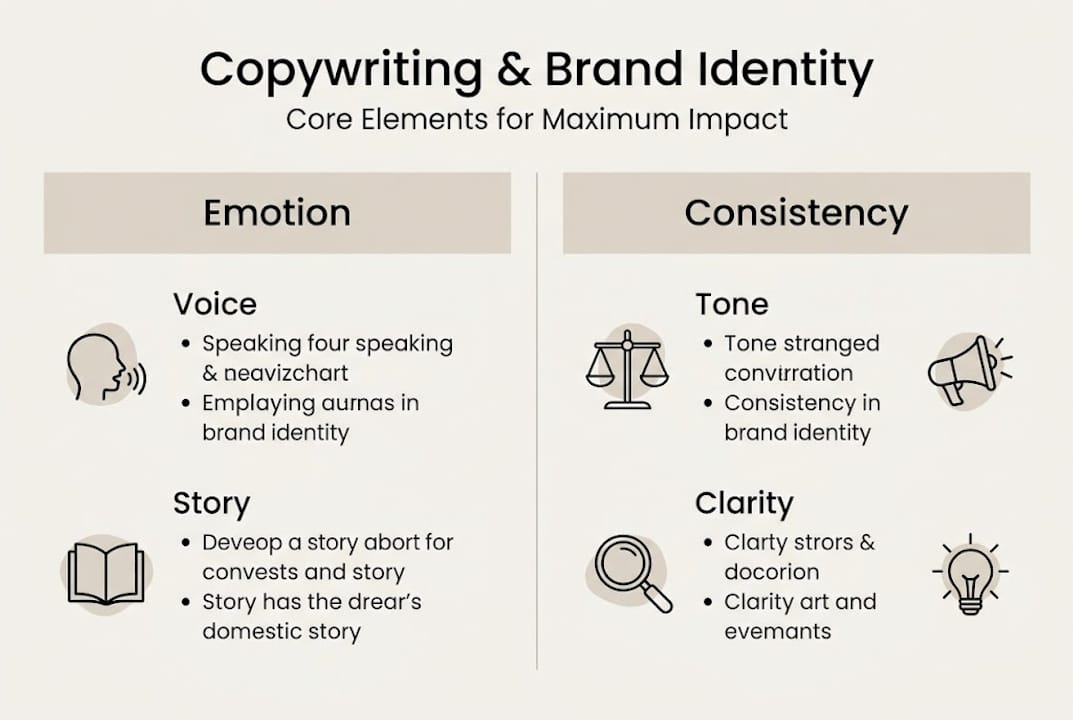
For SMEs, this is actually good news. You don’t need a massive design budget to compete with larger players. What you need is sharp, purposeful copy that stakes out a clear position in your market. Think of copy as a niche-positioning permission system. It signals to the right audience, “This brand is exactly for you,” while quietly filtering out everyone else. That kind of clarity is more powerful than any logo redesign.
A strong brand strategy for SMEs always starts with language before it starts with visuals. The words you choose shape the brief your designer works from, the tone your social team adopts, and the expectations your customers bring to every interaction.
The business case is compelling too. Persuasive copy boosts win rates in professional services by 87%, and it actively de-risks innovation by helping new offerings land with clarity rather than confusion. That’s not a marginal improvement. That’s a strategic advantage.
“Words are the operating system of your brand. Design is the interface, but copy is the code running underneath everything.”
Here’s what well-crafted brand copy actually does for your SME:
Crystallizes your brand personality so customers recognize your voice instantly
Builds emotional trust by speaking directly to your audience’s real concerns
Differentiates your positioning in crowded markets where products look similar
Guides audience perception toward the identity you’ve intentionally designed
Supports branding strategies for small businesses by giving every campaign a unified narrative thread
Exploring personal branding strategies can also reveal how individual voice translates into organizational brand equity, especially for founder-led SMEs. Your brand positioning guide should treat copy as a primary asset, not a finishing touch.
Core principles: Emotion, focus, and persuasion in copy
Once you accept that copy drives brand identity, the next question is: what makes copy work? There are three principles that separate forgettable messaging from brand-defining communication.
1. The Emotionally Compelling Idea Every piece of brand copy should be rooted in one emotional truth your audience already feels. Not what you want them to feel. What they already feel about their problem, their aspiration, or their frustration. When your copy mirrors that emotion back to them, it creates an instant sense of recognition and trust.
2. The Rule of One This is the most violated principle in SME copywriting. The Rule of One means each piece of copy focuses on a single idea, a single audience, and a single desired action. The moment you try to say three things at once, you say nothing. Great brand copy leverages a single, emotionally compelling idea and the Architecture of Persuasion to move readers forward.
3. The Architecture of Persuasion This is the structural flow of your copy: Problem, Agitation, Solution. You name the reader’s pain, intensify why it matters, then present your brand as the clear answer. It’s not manipulation. It’s empathy made visible through structure.
The role of storytelling in branding is directly tied to these principles. Stories are the natural container for emotional ideas, and storytelling for brands consistently outperforms feature-led messaging in recall and conversion. Understanding brand archetypes and emotional connection can help you choose the emotional register that fits your brand naturally.
Approach | Emotional resonance | Clarity | Audience retention |
Traditional (feature-led) | Low | Medium | Short-term |
Principles-led (Rule of One) | High | High | Long-term |
Inconsistent mixed messaging | None | Low | Minimal |
Here’s a quick framework for applying these principles to any brand asset:
Identify the single emotion your audience feels before they find you
Write one headline that names that emotion or its cause
Follow with a short paragraph that agitates the problem
Introduce your brand as the bridge to relief or aspiration
Close with one clear, specific call to action
Pro Tip: Before writing any brand copy, write a one-sentence “emotion brief” that captures exactly what your audience feels right now. Every word you write should connect back to that brief.
Data and testing: Turning creative intuition into brand wins
Even the most skilled copywriter is guessing until the data says otherwise. Intuition is a starting point, not a strategy. For SMEs with limited budgets, this matters even more because every campaign needs to pull its weight.
Good copy taps into beliefs and agency, and A/B testing is essential for SMEs to discover which messages actually resonate versus which ones only sound good in a brainstorm. The gap between those two categories is often surprising.
A/B testing for brand copy doesn’t require enterprise tools or a data science team. You can start with two versions of a homepage headline, a subject line, or a call-to-action button. Run them against each other for two weeks with equal traffic. The winner becomes your new baseline, and you test again.
Copywriting success is strengthened by data-driven iteration, not just intuition. The brands with the most memorable taglines didn’t stumble onto them by accident. They tested variations, measured engagement, and refined until the language clicked.
“Your audience will always tell you what works. The only question is whether you’re listening to the data or just your own preferences.”
Here are the metrics that matter most for brand copy performance:
Metric | What it reveals | Ideal tool |
Click-through rate | Headline and CTA effectiveness | Google Analytics, email platforms |
Bounce rate | Whether copy matches audience intent | Google Analytics |
Conversion rate | End-to-end message persuasiveness | Heatmaps, CRM data |
Time on page | Depth of engagement with copy | Google Analytics |
Open rate | Subject line and preview text strength | Email marketing platforms |
Pro Tip: Don’t test everything at once. Isolate one variable per test, whether that’s the headline, the CTA, or the opening sentence. Testing multiple changes simultaneously makes it impossible to know what actually moved the needle.
Strong content marketing for branding builds a feedback loop between your copy and your audience. Pair that with intentional graphic design engagement and you create brand assets that improve over time. Exploring brand engagement techniques can also reveal which channels amplify your tested copy most effectively.
From copy to identity: Consistency, voice, and storytelling
You’ve built the principles. You’ve tested the messages. Now comes the part most SMEs skip: making sure every single customer touchpoint speaks in the same voice. Consistency is what transforms good copy into a recognizable brand identity.

Think about the brands you trust most. You can probably predict how they’d phrase an apology email, a product launch announcement, or a social media reply. That predictability is not boring. It’s reassuring. It signals that the brand knows exactly who it is, and that stability builds loyalty over time.
Brand identity as a capstone means treating it as a dynamic advantage rather than a static assumption. Markets shift. Audiences evolve. Your copy needs to evolve with them while keeping the core voice intact. That balance between consistency and adaptability is where the real skill lies.
Here’s a practical checklist for auditing your brand voice across touchpoints:
Website headlines and subheadings: Do they share the same tone and vocabulary?
Email subject lines: Do they sound like the same person who wrote your homepage?
Social media captions: Is the personality consistent even when the format changes?
Customer service scripts: Does your support team use language that reflects your brand values?
Product descriptions: Are they written for your specific audience, not a generic buyer?
Error messages and button labels: Even microcopy should carry your brand’s personality
The strategic role of logos is to anchor visual identity, but copy is what gives that visual anchor meaning. Your brand archetypes in identity should directly inform your word choices, sentence rhythm, and emotional register across every channel.
Great storytelling techniques can help you structure brand narratives that feel cohesive across long-form content, ads, and even packaging copy.
Pro Tip: Infuse microcopy with personality. Instead of a generic “Submit” button, write “Send my free quote” or “Start building my brand.” These small moments of specificity add up to a brand experience that feels intentional and human.
What most experts miss about copywriting and branding
Here’s the uncomfortable truth most brand consultants won’t say out loud: SMEs don’t underinvest in copywriting because they don’t value it. They underinvest because they misunderstand what it actually does. They think of copy as content, as words that fill space. But copy is positioning. It’s the mechanism through which your brand claims territory in a customer’s mind.
The real leverage isn’t in writing one perfect tagline. It’s in treating every campaign as a storytelling lab where you test assumptions, gather signals, and refine your positioning based on what your audience actually responds to. That iterative process is what separates brands that grow from brands that plateau.
Brand identity is not a “set and forget” asset. It’s a living dialogue between your copy and your audience, shaped by every message you send and every response you receive. The brands that win long-term are the ones that stay curious about that dialogue.
For SMEs serious about brand positioning for small businesses, the most powerful move is to stop treating copywriting as a task and start treating it as a strategic discipline with its own feedback loops, metrics, and iteration cycles.
Elevate your brand with powerful copy and design
The principles in this article only create results when they’re applied consistently and strategically across every brand asset you build.
At LOOM Brand Designs, we combine data-driven copywriting with intentional visual design to help SMEs build brand identities that actually stick. Whether you’re starting from scratch or refining an existing identity, our basic branding package and standard branding package are built to translate these principles into real results for your business. Our graphic design services ensure your visual identity matches the strength of your messaging. Ready to turn your brand copy into a competitive advantage? Let’s build something worth remembering.
Frequently asked questions
How does copywriting directly influence brand recognition?
Copywriting shapes your brand’s voice, evokes emotion, and delivers messages that audiences remember and associate with your identity. Consistent, personality-driven copy builds the mental associations that make a brand instantly recognizable.
What is the ‘Rule of One’ in copywriting for branding?
The Rule of One means each piece of copy focuses on a single compelling idea, a single audience, and a single action. Focusing on one idea increases clarity and makes your message far more persuasive than trying to cover multiple points at once.
Why should SMEs use A/B testing for their brand copy?
A/B testing removes guesswork by showing you which messages your specific audience actually responds to. Testing is essential for SMEs because it turns creative decisions into evidence-backed choices that improve over time.
How can small businesses maintain a consistent brand voice across channels?
Create a brand voice guide with tone descriptors, vocabulary preferences, and example phrases, then audit your messaging regularly against it. Repeatable tone frameworks and periodic content reviews keep every channel aligned without requiring constant oversight.
Recommended
Comments