

TL;DR:
- Engaging content triggers an emotional or curiosity response within the first one or two seconds.
- Choosing the right format for each platform, such as video with visuals layered behind the speaker, gives viewers more reason to stay and share.
Engaging content is any post, video or article that gets enough of an emotional or social response to stop someone scrolling and make them act. Knowing how to create it is what separates marketers who build loyal audiences from those who publish into silence. Tools like Grammarly, Later and Hootsuite have made the technical side easier. The real challenge is the strategy behind the content. This guide gives you a practical process for posts and videos that people actually stop to read, watch and share.
What do you need before creating engaging content?
Strong content starts with understanding your audience. You need to know the exact words your readers use to describe their problems, not the polished language you use internally. Read comment sections, Reddit threads and customer reviews in your niche. When you write the way your audience thinks, you talk with them rather than at them.

Content pillars come next. Batching content around three to five well-defined pillars keeps you consistent and makes ideas easier to find. Each pillar should sit where your expertise, your audience's needs and your business goals meet. A social media agency, for example, might build pillars around platform strategy, content creation, analytics, brand voice and client results.
Your tools matter too. For writing and editing, Grammarly catches errors and improves clarity. For visuals, Canva covers graphics and basic video. For scheduling, Later and Hootsuite both offer analytics alongside publishing. Pick one tool per job and learn it well before adding more.
Pro tip: Buffer suggests scheduling no more than about a week ahead so your posts stay relevant and your ideas stay fresh. Scheduling too far ahead locks you into ideas that may feel stale by the time they go out.
| Tool | Best for |
|---|---|
| Grammarly | Writing clarity and error correction |
| Canva | Graphics and short video creation |
| Later | Visual scheduling and Instagram analytics |
| Hootsuite | Multi-platform management and reporting |
| Buffer | Content calendar and engagement tracking |
How do you craft hooks that stop the scroll?
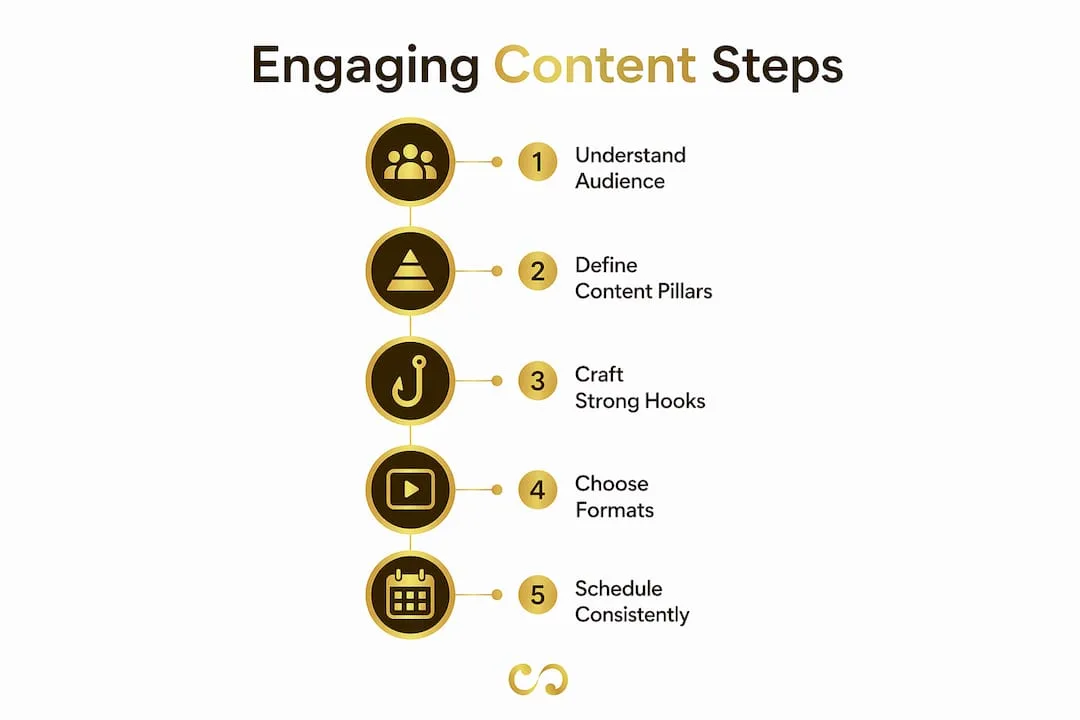
Scroll-stopping content depends on hooks that work within the first second or two. On social video, your opening frame and first spoken words must give people an immediate reason to keep watching. On text posts, the first line carries all the weight. There's no warm-up.
Five hook types reliably beat generic openers:
- Curiosity gap: "The one thing most marketers skip before posting."
- Contrarian opinion: "Posting daily is hurting your engagement."
- Mid-action story: "I was about to delete my account when I saw the analytics."
- How-to with a specific promise: "How to write a caption in under 3 minutes."
- Social proof: "This exact framework got our client [result] in [timeframe]." (Only use real results.)
A proof-led hook is one of the most underused formats. It opens with a specific, genuine result, like a screenshot of your analytics or a before-and-after. These posts tend to get saved because readers want to come back to the evidence later.
Emotion drives every effective hook. Frustration, empathy and indignation often get a faster reaction than aspirational or hopeful tones. That doesn't mean manufacturing negativity. It means framing your content around real frustrations your audience already feels.
Naming your reader's identity sharpens hooks too. "If you run a one-person marketing team..." speaks directly to a specific reader. Generic hooks speak to no one. The more precisely you describe your reader's situation, the faster they recognise themselves in your content.
Pro tip: Use an AI writing tool like ChatGPT to generate ten hook variations for one topic, then test two or three across platforms. It can turn an hour of staring at a blank page into a few minutes of choosing and refining.
Which content formats get the most engagement across platforms?
Format has a direct effect on reach. Videos where you appear in front of a background image, screenshot or clip (often called greenscreen style) give viewers more to look at than a plain talking head, which helps hold their attention. Plain talking-head videos still work, but they need a stronger hook and a tighter script to compete.
Video length is another lever many creators misuse. For short-form platforms like TikTok, Instagram Reels and YouTube Shorts, 60 to 90 seconds is a good balance of watch time and substance. Much shorter can feel incomplete; much longer can lose viewers before the payoff.
Captions and on-screen text reach people watching without sound, which is common on phones. Emoji and special characters can lift engagement when used with purpose. One or two relevant emoji per caption add personality without cluttering the message.
For written posts, shorter captions usually work harder than most marketers expect. Cutting a caption right back forces you to lead with your most compelling point.
Calls to action deserve attention too. A soft, implied call to action, such as "Save this for your next content session", often feels more natural than "Follow me for more tips". The difference is subtle, so test both with your own audience.
| Platform | Ideal format | Caption length |
|---|---|---|
| TikTok | Greenscreen-style or talking-head video, 60 to 90 sec | Short |
| Instagram Reels | Greenscreen-style or B-roll, 60 to 90 sec | Short |
| Text post or short video | Short to medium | |
| X (Twitter) | Text with image or short clip | Very short |
| Threads | Conversational text | Short |
How to produce and schedule content without burning out
Batch production is how professionals keep quality up and avoid burnout. Instead of making one piece of content a day, you set aside time once or twice a week to produce several at once. That keeps your creative energy focused and your publishing schedule steady.
A repeatable workflow:
- Define your pillars. Choose three to five topics that match your expertise and your audience's needs. These become your content categories.
- Develop your angles. For each pillar, brainstorm five to ten specific angles. An angle is a particular point of view on a broader topic.
- Write your hooks first. Draft the opening line or frame before anything else. If the hook is weak, the rest won't save it.
- Produce in format batches. Record all your videos in one session and write all your captions in another. Separating tasks cuts down on context-switching.
- Adapt for each platform. A 90-second TikTok becomes a LinkedIn text post, an X thread and a Threads conversation. One idea, four formats.
- Schedule within a seven-day window. This keeps your calendar flexible enough to respond to trends or audience feedback.
Engagement doesn't end when you publish. Replying to comments keeps conversations going, which platforms tend to reward with more distribution. It also tells you directly what your audience wants next.
Common pitfalls include skipping pillar planning and jumping straight into production. Without pillars, you run out of ideas quickly and your content feels scattered. Ignoring analytics is the other big mistake. Check which posts get saves, shares and comments, not just likes. Those show you what your audience finds genuinely useful.
Pro tip: Repurpose your best posts every 90 days with a fresh hook and updated information. Most of your audience hasn't seen your older content, and our content marketing examples show how well evergreen topics hold up when they're repackaged.
What I've learned from years of creating marketing content
The biggest shift I made was treating content as a conversation rather than a broadcast. Early on, I published and moved on. Once I started replying to every comment within the first hour, my reach changed noticeably. Algorithms reward conversation, and so do real people.
The second lesson was that breaking the pattern matters more than follower count. Posts from small accounts can easily outperform content from accounts many times their size. The difference is usually the hook and the format. A visually layered video with a strong curiosity hook will usually beat a plain talking head with a soft opener, whatever the audience size.
Small language changes make a big difference. Changing "Here are some tips" to "Here is the exact process I used" turns a generic post into a specific promise. Specificity builds trust. Vague language loses readers in the first sentence.
The last thing I'd tell any content creator is to test more and assume less. You can't predict which hook will land. You can only publish, measure and adjust. The creators who grow fastest aren't the most talented. They're the most willing to design marketing materials, test ideas quickly, learn from the data and improve without ego.
Pawan
LOOM Brand Designs can help your content stand out visually
Strong strategy only goes so far without strong visuals behind it. LOOM Brand Designs specialises in graphic design, video editing and brand identity work that makes content instantly recognisable and worth stopping for.
If you're building your content presence from the ground up, the Basic Branding Package gives you a professional visual foundation, including logo design and brand identity assets, so every post looks consistent and credible. If you need polished video, we offer professional video editing that turns raw footage into strong short-form content. Pair good strategy with good design and your content works harder on every platform.
FAQ
What makes content engaging on social media?
Engaging content triggers an emotional or curiosity response within the first second or two. The strongest posts use specific hooks, natural calls to action and formats that give viewers plenty to look at.
How long should social media captions be?
Usually shorter than you think. Lead with your strongest point and cut everything that doesn't add to the core message, then test length with your own audience.
What is the best video format for more views?
Formats that layer visuals behind the speaker, such as greenscreen-style videos, tend to hold attention better than plain talking heads because there's more to take in. A strong hook matters whichever format you choose.
How often should I post to build engagement?
Consistency matters more than frequency. Batch producing content around three to five clear pillars and scheduling within a seven-day window keeps your output steady without losing quality or relevance.
Does replying to comments actually increase reach?
Replying keeps the conversation going, and platforms tend to show content with active discussions to more people. Replying soon after you publish, while the post is still fresh, is especially worthwhile.
Key takeaways
Engaging content is built on precise hooks, the right format for each platform and a repeatable production system that keeps quality consistent.
| Point | Details |
|---|---|
| Hook within a second or two | Your opening line or frame must give people an immediate reason to keep watching or reading. |
| Choose visually rich formats | Videos that layer visuals behind the speaker give viewers more to engage with than a plain talking head. |
| Keep captions short | Short captions force you to lead with your strongest point. |
| Batch content around pillars | Producing content in batches around three to five pillars prevents burnout and keeps ideas flowing. |
| Reply to every comment | Replies keep conversations going and show you what your audience wants next. |
The Hashtag Loom