

Small business owners and digital marketers face the same problem again and again: too many marketing tasks, not enough time, and scattered effort that does not deliver. Without a structure, hours go on repetitive work while chances to reach customers slip by. A well-designed digital marketing workflow puts your operations in order, removes waste and sets the business up for steady growth. This guide walks through building a workflow, informed by AI where it helps, that saves time and gives you results you can measure.
Key takeaways
| Point | Details |
|---|---|
| Phased workflows improve focus | Foundation, growth and scaling phases keep marketing manageable for small businesses. |
| AI automation saves time | AI tools take over repetitive work, freeing people for strategy and creative decisions. |
| Integrated channels work harder | Email, SEO and paid advertising perform better when they are planned together. |
| Document before automating | Map manual processes fully before adding automation, to avoid confusion and wasted effort. |
| Human oversight stays essential | AI amplifies strategy, but human judgement prevents costly mistakes in changing markets. |
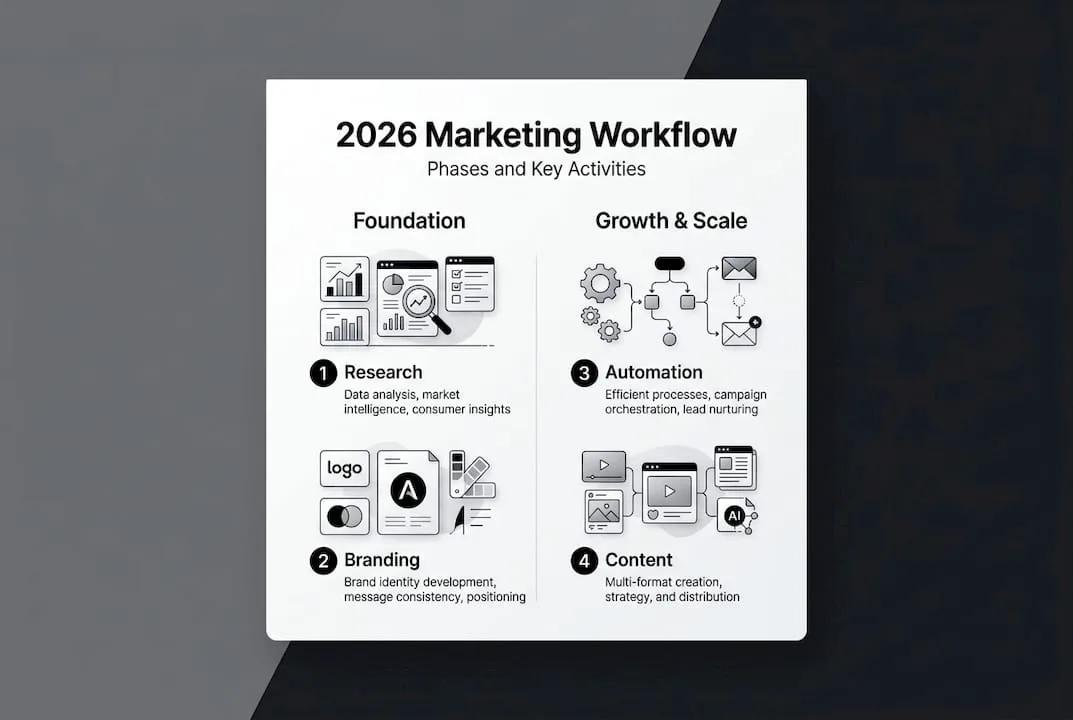
The foundation phase: research, branding and your website
Your marketing workflow starts with a solid foundation. Most small business workflows follow a phased approach, beginning with audience research, branding and the website. Skip this groundwork and campaigns miss the mark while budgets disappear.
Start by identifying your ideal customer. Research their pain points, preferred channels and buying behaviour. What you learn shapes every later decision, from messaging to platform choice. Next, set clear brand guidelines that define your voice, visual identity and value proposition. A strong branding strategy builds recognition and trust before you spend anything on advertising.
Your website is the hub for all your marketing. Make it fast, mobile-friendly and clear about the next step a visitor should take. Every campaign will send traffic there, so it has to turn visitors into customers. A slow or confusing site undermines even the best marketing.

Document your foundational processes. Create checklists for audience research, brand asset creation and website audits. These become your operating playbook, keeping things consistent as you grow and making it easier to delegate or bring new people on board.
A phased approach keeps the work manageable for small teams. Get the foundation right before moving into growth tactics. That discipline prevents the overwhelm that comes from running too many projects at once. Our guide to digital marketing essentials for small businesses helps you decide which foundational work to do first.
Key foundation phase tasks:
- Research detailed customer personas, covering demographics and motivations
- Write brand guidelines that cover voice, visuals and messaging
- Audit the website for speed, mobile experience and conversion paths
- Document the processes behind every foundational marketing activity
- Set up analytics so you can measure a baseline before campaigns launch
Pro tip: Spend at least two weeks on foundation work before launching paid campaigns. The patience pays off, because your marketing set-up will be able to support growth without breaking.
Running the growth and scaling phases with AI automation
Once the foundation is solid, move into the growth phase. This stage is about content marketing, social media and email campaigns that build relationships with your audience. The workflows here focus on consistent output and on nurturing prospects through the buying journey.
Content becomes your main activity. Write blog posts, social updates and email sequences that answer customer questions and show your expertise. Consistency matters more than perfection at this stage, so set a publishing calendar you can keep up.
Email marketing is valuable in the growth phase because you own the list. Build it through website sign-ups and lead magnets. Segment subscribers by interest and behaviour, then send targeted campaigns that move people towards a purchase. Our email marketing set-up takes some work up front but keeps paying back.
Social media extends your reach and builds community. Choose the platforms where your audience spends time rather than spreading yourself across every network. Post consistently, reply to people and use social listening to understand how customers feel.
The scaling phase brings in paid advertising and more advanced optimisation. This is where AI automation changes the picture. AI tools handle repetitive work such as first drafts, A/B tests and bid adjustments, which frees hours every week for the work that needs a person.
Introduce AI automation in this order:
- Use AI writing tools like ChatGPT for first drafts of blogs, emails and social posts
- Use AI-driven ad formats like Google Performance Max to adjust bids and targeting automatically
- Add personalisation that tailors website content and emails to user behaviour
- Set up automated A/B testing for headlines, images and calls to action
- Connect AI analytics tools that spot patterns and suggest adjustments
- Add an AI chatbot to answer common customer questions around the clock
- Review every AI output with human judgement to check quality and strategic fit
Pro tip: Start your automation with email marketing. Email is a closed loop, so results are easy to measure and the time savings show up straight away. Once email automation runs well, move on to social media and paid advertising.
AI automation for small business marketing brings several tools into one workflow. Connecting content creation, distribution and analytics removes manual data transfers and reduces errors.
Balance matters. AI is good at execution and optimisation but has no strategic judgement. Let automation handle volume and speed while you focus on creative direction, planning and relationships. The best workflows combine AI efficiency with human creativity and oversight.
Avoiding pitfalls: complexity and human oversight
Many marketers undermine themselves by building workflows that are too complicated. As MarTech has reported, too many workflows create confusion, raise error rates and push time into maintenance instead of execution. Complexity is the enemy of effectiveness.
Document each step before you automate anything. Write out the manual process, mark the decision points and map how data flows. This shows the duplication and gaps you need to deal with. Skip it and you get automated chaos, with systems that conflict and data that goes missing.
Keep a person in charge of every AI-driven decision. AI can amplify a poor strategy as easily as a good one. In fast-moving markets, human judgement catches nuances that algorithms miss. Check AI-generated content for accuracy, tone and strategic fit before it goes out.
Avoid siloed channels. When email, social media and paid ads run separately, you lose sight of what is driving results and customers get an inconsistent experience. Joined-up data and attribution across channels show which combinations work and where to put more money.
Keep operational workflows separate from campaign logic. Operational workflows cover recurring tasks such as posting schedules or monthly reports. Campaign workflows run specific projects with a start and end date. Mixing them causes confusion about what should continue and what should stop.
Common workflow mistakes:
- Building automation before the manual process is fully documented
- Creating separate workflows for tasks that belong together
- Leaving workflows without a clear owner
- Skipping the regular audits that catch outdated or broken automation
- Trusting AI output without human review
Pro tip: Hold a quarterly workflow audit and review every automated process. Remove steps that no longer serve your goals, merge duplicate workflows and update the documentation. This regular maintenance stops complexity creeping back in.
The most successful marketing operations balance automation with human control of strategy. AI handles volume and speed; people bring the creative insight and market understanding that make a campaign stand out.
Our digital marketing checklist helps you decide which processes to automate and which need ongoing human attention. Not everything should be automated, and knowing the difference protects your results.
Measuring success and improving your workflow
Good workflows need ongoing measurement and adjustment. Track the indicators that show whether your marketing creates real business value. Vanity metrics such as follower counts or page views feel good but rarely track revenue.
Focus on conversion rates across every channel. What share of website visitors join your email list? How many subscribers become customers? What return do you get from paid advertising? These numbers connect marketing activity directly to business outcomes.
Each channel plays a different role. Email tends to pay back quickly because you are talking to people who already know you. Paid search reaches people with intent right away. SEO takes longer but builds value as your content library grows.
Set your own benchmarks from your first few months of data, and compare yourself with similar businesses rather than generic averages. If your spend on a channel looks out of line, make sure you understand why and that it serves your goals.
| Channel | Main role | Typical time to see results |
|---|---|---|
| Email marketing | Turning existing contacts into customers and repeat buyers | 1 to 3 months |
| SEO | Building organic traffic that keeps growing | 4 to 12 months |
| Google Ads | Reaching people actively searching right now | 1 to 2 months |
| Social media ads | Building awareness and retargeting visitors | 1 to 2 months |
Adjust your workflows based on the data. If email campaigns consistently beat social media, move resources to email. When certain topics drive more engagement, create more content on them. Let your own numbers guide how the strategy changes.
Pro tip: Put email first for the quickest return, then add SEO for long-term organic growth and paid advertising for immediate reach. That mix covers short, medium and long time frames.
Review performance monthly for tactical changes and quarterly for strategic ones. Monthly reviews catch weak campaigns early. Quarterly reviews show the longer trends that should guide budget and channel decisions.
Our guide to social media marketing helps you set realistic expectations and notice when performance falls short. Results vary a lot by industry and business model.
Metrics to track consistently:
- Cost per lead and cost per customer acquired, by channel
- Return on ad spend for paid campaigns, with a monthly trend
- Email list growth and engagement, such as open and click rates
- Website conversion rates for key actions like form submissions and purchases
- Customer lifetime value, to judge long-term marketing effectiveness
Continuous improvement is what separates good marketing operations from great ones. Build experiments into your workflow: test new messages, try different formats and explore new channels. Keep a small share of the budget, say 10 to 20%, for experiments and put the rest behind what already works.
Improve your digital marketing with LOOM Brand Designs
Effective marketing workflows take expertise, time and the right tools. LOOM Brand Designs helps small businesses build strong foundations and run efficient campaigns.
Our basic branding package creates the visual identity and messaging framework your marketing needs, with brand guidelines that keep every channel consistent. Our website design and development service builds the hub where your campaigns turn visitors into customers.
Our email marketing set-up service configures your platform, builds automated sequences and puts the workflows in place. We handle the technical side so you can focus on running the business. Talk to LOOM Brand Designs about streamlining your digital marketing.
Frequently asked questions
How do I start building a digital marketing workflow?
Start by researching your target audience and listing your current marketing tasks. Set clear goals, then map the steps needed to reach them. Do the foundational work, such as branding and website improvements, before expanding into campaigns. Our guide to digital marketing essentials for small businesses can help you decide what to tackle first.
What should I automate first in my marketing workflow?
Start with email marketing, because results are easy to measure and the workflow is simple. Set up a welcome sequence for new subscribers and campaigns triggered by specific actions. Once email automation runs smoothly, move on to social media scheduling and then paid advertising. Taking it in stages avoids overwhelm while you build your automation skills.
How do I measure success in my digital marketing workflow?
Track metrics that connect directly to revenue, including cost per lead, customer acquisition cost and return on ad spend. Compare results with your own past performance and with similar businesses. Review monthly for tactical changes and quarterly for strategic ones, and focus on business value rather than vanity numbers like follower counts.
What AI tools are best for automating a digital marketing workflow?
Tools like ChatGPT and Google Performance Max help with content creation and ad optimisation, and chatbots can handle routine customer questions. CRM platforms with built-in automation, such as Agile CRM or HubSpot, offer drag-and-drop workflow builders. Combining these in one connected system reduces complexity.
How do I measure ROI from my digital marketing workflow?
Work out cost per customer by dividing total marketing spend by the number of customers acquired. Track return on ad spend by comparing the revenue a campaign brings in with what it cost. Compare each channel against your own earlier results to see where money works hardest, and use our social media marketing guide for channel-specific pointers.
How do I avoid overcomplicating my marketing workflows?
Document every process manually before automating it. Review workflows quarterly to remove outdated or duplicate steps. Keep operational workflows separate from campaign workflows. Balance automation with human oversight, start simple, and add complexity only when the benefit clearly justifies the extra maintenance.
The Hashtag Loom