

TL;DR:
- A structured workflow with the right tools and clear ownership makes a small content team far more efficient. AI can speed up ideation, drafting and distribution, but a person still has to check the output. Regular measurement and small, steady improvements keep the process working.
Talented marketing teams still end up buried under missed deadlines, endless revision rounds and Slack threads that go nowhere. When a content workflow runs on habit instead of structure, hours vanish and results stall. A deliberate, repeatable process wins that time back, cuts rework and lets the team produce more without burning out. This guide sets out a step-by-step plan for marketing managers and content strategists at small and medium-sized businesses who want a workflow that actually performs.
Key takeaways
| Point | Details |
|---|---|
| Define roles and tools | Clear ownership and the right tools are the foundation of a streamlined workflow. |
| Follow a step-by-step process | A sequenced workflow, from setting goals to reviewing results, prevents chaos and missed deadlines. |
| Use AI carefully | Treat AI as an accelerator and always pair it with human review for quality and brand consistency. |
| Audit, measure, improve | Review your workflow and performance metrics regularly to find bottlenecks and keep improving. |
What you need to streamline your content marketing workflow
Before you redesign anything, take stock of what you have and what is missing. A workflow overhaul built on shaky foundations only moves the bottlenecks around. Getting the tools, the people and the attitude right first is what separates a lasting change from a short-lived experiment.
Good workflow streamlining strategies start with a baseline audit. Map every step your content goes through from idea to publication, note where it slows down, and ask your team honestly why. Most small teams find the same culprits: no shared editorial calendar, review duties that shift depending on who is free that week, and assets scattered across email threads, Google Drive folders and personal desktops.
Essential tools for a small content team
| Tool category | Example options | Purpose |
|---|---|---|
| Editorial calendar | Notion, CoSchedule, Airtable | Keep scheduling and deadlines in one place |
| Project management | Asana, Monday.com, Trello | Assign tasks, track progress, flag blockers |
| Content repository | Google Drive, Confluence, SharePoint | Single source of truth for all assets |
| AI writing and ideation | ChatGPT, Jasper, Gemini | Speed up drafts, research and brainstorming |
| Analytics | Google Analytics 4, Semrush | Measure performance and guide improvements |
Beyond tools, you need people in defined roles. Your content strategist owns the editorial vision and the calendar. Your subject matter expert brings the specialist knowledge that keeps content credible. Your reviewers (a legal contact, a department head or a senior editor) need review time blocked into their diaries, not an open invitation to comment whenever they like.
Mindset matters as much. If people see the new workflow as extra admin rather than time saved, adoption stalls quickly. Before you change anything, hold a short kick-off to explain the reasons in plain terms: fewer last-minute scrambles, clearer ownership and content that lands on time.
Pro tip: Run a 15-minute workflow gap audit with a simple checklist. Do we have a shared calendar? Does every piece of content have a single owner? Are review deadlines set in advance? Every "no" shows you where to start.
A structured content marketing workflow follows a logical arc: goals, audience, audit, topics and clusters, calendar, creation (with expert input), review and approval, distribution, then measurement and improvement. Use that arc as a checklist and you will cover the gaps that usually cause teams to drop the ball.

Step-by-step content marketing workflow for small teams
With the essentials in place, here is the workflow broken into practical steps. Think of it as a production line: each stage feeds the next, and skipping one causes problems further down.
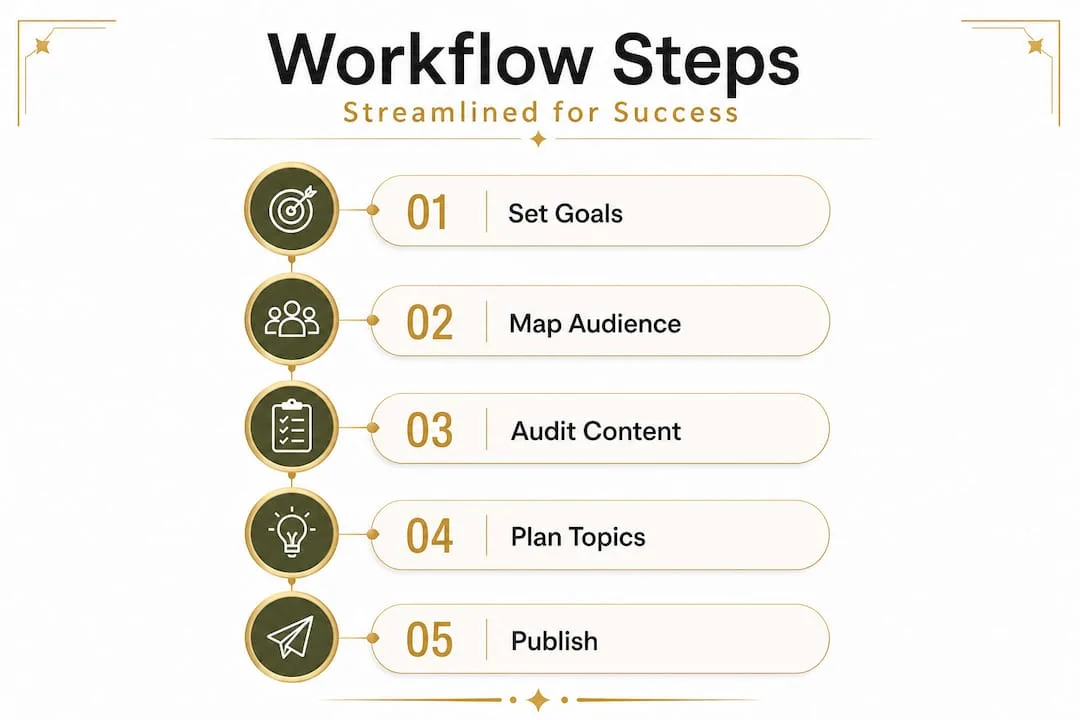
- Define your goals. Decide whether you are driving awareness, lead generation, retention or a mix. Specific goals decide the content types, the channels and the metrics you will care about.
- Identify your audience. Build or update your personas. Who are these people, what problems keep them up at night, and where do they spend time online? Everything you create should answer a real question they are asking.
- Audit existing content. Catalogue what you have, grade each piece for performance and accuracy, and flag anything that needs updating before you create something new. This step alone saves a lot of time and budget.
- Map topics and clusters. Group ideas into pillar topics and supporting clusters. The structure helps SEO and gives writers a coherent plan instead of a random list.
- Build your publishing schedule. Assign deadlines, owners and channels in the editorial calendar. Realistic scheduling prevents the late-night scrambles that wreck morale and quality.
- Create with expert input. Writers draft and subject matter experts check for accuracy and a distinctive angle. This is what separates content that builds authority from generic filler.
- Review and approve. Run a staged review: editor first, then the expert for a fact check, then final sign-off. Each stage has a fixed deadline, not an open window.
- Distribute. Send content to the right channels, whether blog, email, LinkedIn or paid promotion, as planned in step five.
- Measure and improve. Track the metrics that match your goals. Use marketing metrics tracking to see what is working and feed what you learn back into step one.
Because the process is sequential and easy to audit, everyone on the team knows where a piece of content stands at any moment.
Workflow stage summary
| Stage | Key tools | Owner | Output |
|---|---|---|---|
| Goals and audience | Strategy docs, persona templates | Content strategist | Documented goals and personas |
| Audit and topic mapping | Semrush, spreadsheet | Strategist plus expert | Content audit report, topic clusters |
| Calendar and scheduling | Airtable, CoSchedule | Content manager | Published editorial calendar |
| Creation | AI tools, writing platform | Writer plus expert | First draft |
| Review and approval | Asana, email | Editor, legal, stakeholder | Approved final draft |
| Distribution | CMS, email platform, social scheduler | Content manager | Published and promoted content |
| Measurement | GA4, Semrush | Strategist | Performance report |
Pro tip: Bring your subject matter expert into topic mapping, not only creation. When experts help choose what to write about, the content is more accurate, more distinctive and far easier to get approved, because the expert already believes in the angle.
Using AI for efficiency and consistency
Once the core workflow is in place, the right technology makes it faster. AI is not a shortcut around quality. Used well, it lets a lean team produce at a scale that used to need more people.
This is where AI helps most in a content workflow:
- Ideation: AI tools can analyse search trends, competitor content and audience behaviour to suggest topics your team might have missed.
- First drafts: A well-prompted tool can produce a working draft in minutes. It still needs human shaping, but it removes the blank page that slows many writers down.
- Visual assets: AI image tools can produce social graphics, blog headers and infographic concepts faster than a traditional design briefing.
- Automated distribution: Tools like Make (formerly Integromat) or Zapier connect your CMS to your email platform and social scheduler, so publishing triggers distribution automatically.
- Repurposing: AI can turn a long blog post into newsletter copy, LinkedIn carousels and short video scripts without starting from scratch each time.
A sensible sequence is ideation, AI draft, human editing, visuals and automated distribution. The human editing stage is not optional. It is what keeps your brand voice intact and your facts right.
The time savings come from cutting repetitive research, shortening drafting and automating routine distribution tasks. Guardrails matter just as much. Defined templates, a written brand voice guide and tools that draw on your own approved company information keep AI output accurate and reduce the rework that eats up editing time.
The smarter way to think about AI in marketing is as infrastructure rather than a novelty. When you build AI into specific stages instead of experimenting at random, the gains add up. AI-powered personalisation can, for example, route the right content to the right email list based on your audience segments.
"AI is your co-pilot, not your autopilot. It accelerates the execution; your team still has to set the destination and keep a hand on the controls."
The most useful thing automation in marketing does is take over the manual, low-judgement tasks, so your strategists can spend more time on the decisions that move results.
Pro tip: Before you give any AI tool a brief, write it a brand voice guide. Include your tone words, a list of words you never use, a sample paragraph in your ideal voice and your audience's usual vocabulary. Five minutes of setup prevents dozens of generic drafts that sound like every other company in your sector.
Avoiding common workflow pitfalls
Even well-designed workflows need attention. A process that ran smoothly in January can quietly slip by March if nobody is watching the process itself as well as the output.
Common workflow problems
- Slow approvals: Reviewers treat content as low priority when deadlines are vague and ownership is unclear.
- Skipped audits: Teams keep producing new content while outdated posts quietly undermine their SEO and credibility.
- Unclear ownership: When everyone is responsible, nobody is. Pieces stall because each contributor assumes someone else is moving them on.
- Review bottlenecks: Sending everything through one senior person creates a single point of failure that stops output whenever that person is busy.
- No measurement: Teams publish consistently but never feed performance data back into planning, so they repeat the same mistakes.
How to fix each problem
- Slow approvals: Agree a 48-hour turnaround for each review stage and set it as a hard deadline in your project management tool.
- Skipped audits: Make the content audit a recurring quarterly task owned by your content strategist, with a set output format so it never becomes a vague project.
- Unclear ownership: Every piece of content in your project tool gets exactly one primary owner, not a shared team tag.
- Review bottlenecks: Use tiered reviews. Routine blog posts get an editor-only review; high-stakes content goes through the full chain. The queue keeps moving without losing quality where it counts.
- No measurement: Book a monthly analytics session and require each one to produce at least one documented change to the upcoming content plan.
The workflow is only as strong as its measurement stage. Treat that last step as the input to your next planning cycle, not a report card. The teams that improve fastest work on their process with the same discipline they apply to their content.
Pro tip: Appoint a workflow owner whose job includes watching the process, not just the content. This person runs the monthly workflow review, flags recurring bottlenecks and makes small improvements. Without the role, even good workflows drift back into chaos.
What most marketers get wrong about streamlining workflows
Most teams that struggle with workflow efficiency do not have a tool problem. They have a clarity problem. They buy a new project management platform, spend two weeks onboarding everyone, then watch the same bottlenecks reappear inside the new system. Moving clutter into a better filing cabinet does not get rid of it.
AI speeds up execution, but it does not replace the strategic thinking and human judgement that make content valuable. The teams that gain most are not the ones with the most tools. They are the ones that have decided who owns each handoff and what "done" means at every stage.
The pattern is a common one. A team adopts an AI platform and starts producing twice as many drafts. If the approval process has not changed, the bottleneck simply moves: now twice as many drafts sit in the queue for the same overworked senior editor. Volume without process is just more mess.
The real lever is a few change champions. These are the people who understand both the old process and the new one well enough to bridge them. They answer questions, sort out adoption problems and keep momentum going between leadership announcements. Without them, even a well-designed workflow stalls during rollout.
The teams with the most consistent content rarely made one huge overhaul. They made small, frequent changes, tested them, kept what worked and dropped what did not.
Pro tip: Instead of planning a sweeping redesign, pick the single most painful bottleneck your team has right now and fix only that. Run the fix for four weeks, measure the effect, then move to the next problem. Small wins build the trust that makes bigger changes possible later.
Take the next step with expert support
A structured content workflow takes clarity, the right tools and some experienced guidance to get right. If this guide has shown you that the gap between your current workflow and where it needs to be is bigger than your team can close alone, that is where outside support helps.
At LOOM Brand Designs, we work with small marketing teams on the systems, assets and strategy behind consistent, good-quality content. Whether you need a branding strategy that gives your content a coherent identity, professional graphic design that turns ideas into visuals people stop for, or a website that fits neatly into your publishing process, we can help you move faster with the resources you already have. Get in touch to talk through what a tailored workflow could look like for your team.
Frequently asked questions
What are the most important stages in a content marketing workflow?
The core stages are goal setting, audience identification, content audit, topic planning, creation with expert input, staged review, distribution and measurement. Skipping any one of them creates problems further down the line.
How does AI really speed up the content workflow?
AI shortens ideation, drafting and distribution by taking over research, first drafts and routine scheduling. It only works well when human review stays built into the editing stage to protect accuracy and brand voice.
What is the best way to prevent bottlenecks in the approval process?
Give every piece of content a single primary owner and set a fixed review deadline for each stage. Tiered reviews also help, so routine content does not sit in the same queue as high-stakes pieces.
Can AI handle the entire content workflow for small businesses?
No. AI works best as a co-pilot that speeds up execution. Strategic direction, brand judgement and an understanding of your audience still need a person at every important decision point.
The Hashtag Loom