

TL;DR:
- Small businesses already have marketing funnels, but they are often accidental rather than designed.
- Modern customer journeys are non-linear, spanning several channels and "dark funnel" activity you cannot track.
- Start simple, measure regularly and improve one stage at a time.
Many small business owners assume marketing funnels belong to big companies with large budgets and dedicated teams. That assumption costs them money. A funnel is simply a map of how a stranger becomes a paying customer, and you already have one whether you designed it or not. The question is whether yours is intentional or accidental. This guide explains what a marketing funnel is, how customer behaviour has changed, and what you can do now to build one that drives sales.
Key takeaways
| Point | Details |
|---|---|
| Funnels map customer journeys | A funnel shows how potential customers move from discovery to purchase and beyond. |
| Non-linear paths are normal | Buyers skip steps or arrive mid-way, so your funnel needs to be flexible. |
| Simple funnels work best | Start with three core stages and basic tools rather than an elaborate system. |
| Keep improving | Track results and adjust using data, personalisation and automation. |
What is a marketing funnel?
A marketing funnel describes the path a potential customer takes from first hearing about your business to buying from you, and ideally telling others. Picture a wide opening at the top where many people enter and a narrow exit at the bottom where fewer complete a purchase.
The classic model has three main stages:
- Awareness: The customer discovers your business, perhaps through a Google search, a social post or a friend's recommendation. They know you exist but have not decided anything yet.
- Consideration: The customer is thinking about buying and comparing options. They might read reviews, browse your services page or join your email list. This is where trust is built or lost.
- Conversion: The customer takes the action you want: a purchase, a booked call or a completed contact form. This is where revenue happens.
- Loyalty and advocacy (optional but powerful): After the sale, some businesses add stages that encourage repeat purchases and referrals. For small businesses, where word of mouth carries real weight, this is especially valuable.
Our piece on digital funnels for entrepreneurs shows how these stages translate into revenue when they are set up deliberately. For a wider view of where funnels sit in your marketing mix, the digital marketing guide is a good starting point.
Remember that funnels are frameworks, not laws. Real journeys are messy. Someone might see your ad three times before searching for you, read a blog post, forget you for two weeks, then come back after a friend mentions your name. The funnel helps you think about each phase; it does not predict every move.
Some marketers argue the traditional funnel is dead and prefer newer models such as the flywheel. HubSpot's lead generation funnel guide takes a more practical line: combine awareness-building with strong performance marketing at every stage. Linear or not, understanding your stages gives you something concrete to improve.
Linear and non-linear funnels: what has changed?
The traditional funnel assumes every customer moves neatly from awareness to consideration to conversion. That made sense when advertising meant TV, print and radio. Today a customer might find you on Instagram, research you on YouTube, compare you on Reddit and buy through Google Shopping, all in one afternoon.

Marketers call this a non-linear journey, and your funnel needs to reflect it.
| Feature | Linear funnel | Non-linear funnel |
|---|---|---|
| Customer path | Step by step, predictable | Loops, skips stages, enters mid-funnel |
| Tracking | Mostly trackable | Partial, with "dark funnel" gaps |
| Time to convert | Short and defined | Varies widely; B2B can take months |
| Best suited to | Simple, low-cost products | Complex decisions across several channels |
| Focus | Moving leads down the stages | Building influence across all touchpoints |
| Small business challenge | May miss returning visitors | Needs smarter content and retargeting |
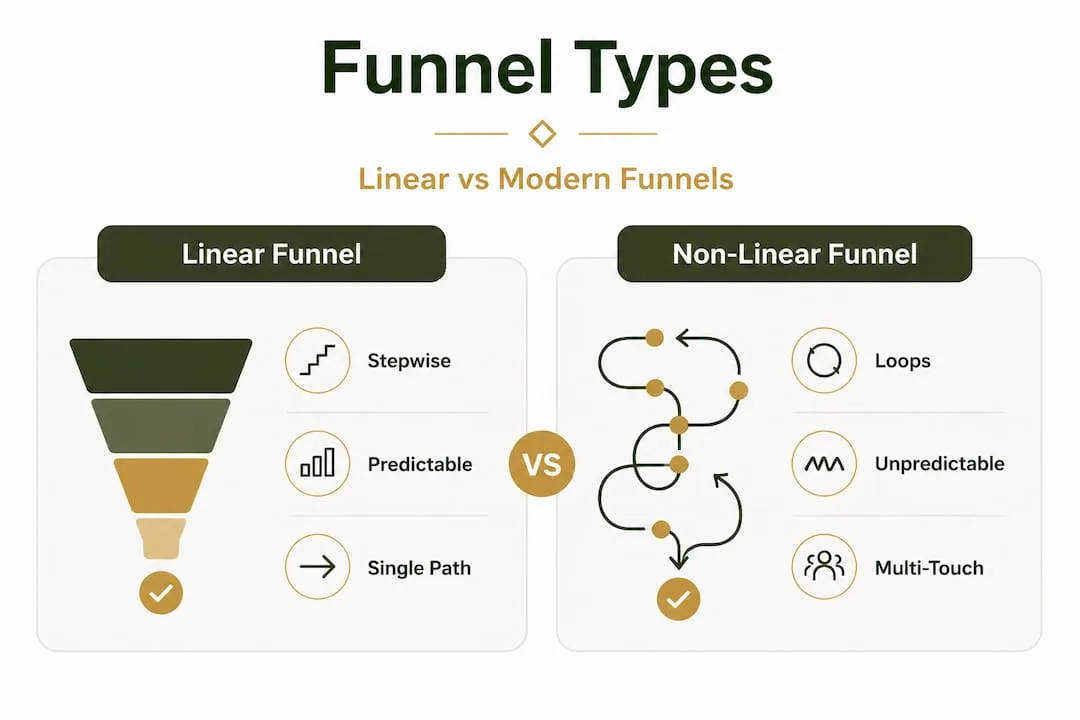
The "dark funnel" is customer activity that happens entirely outside your analytics: private conversations, word of mouth, anonymous browsing, screenshots shared in group chats. You cannot track it, but it shapes decisions. It also explains why high drop-off at every stage is normal. Plenty of people leave a basket or a form half-finished; that does not mean your funnel is broken. It means customers are human.
Pro Tip: If you see a big drop between consideration and conversion, check first whether your checkout or contact form is technically broken. Then ask whether you are building enough trust at the consideration stage. A single testimonial or a clear guarantee can do more than a full redesign.
A sound digital marketing strategy accounts for this behaviour by putting content and touchpoints at several stages, not only at the moment someone is ready to buy.
How to build a simple funnel for your small business
You do not need expensive software or a dedicated team. Most small businesses can start with three stages, a few free tools and the habit of measuring results. Here is a simple process:
-
Map your three core stages. Write down what awareness looks like for your business (SEO, social media, referrals), what consideration looks like (email list, blog, consultations) and what conversion looks like (purchase, booking, form submission). Keep it specific.
-
Set up a free or low-cost CRM. Tools such as HubSpot's free CRM let you see where leads sit in your funnel without spending anything. Knowing how many leads you have at each stage is the basis of every improvement.
-
Create one piece of content per stage. A blog post for awareness, an email sequence or lead magnet for consideration, a strong landing page for conversion. You do not need dozens of assets to start.
-
Connect your channels. Make sure social posts link to your website, the website has a clear email sign-up, and emails offer a direct path to purchase. Gaps between channels are where leads get lost.
-
Set up basic tracking. Google Analytics 4 is free and shows where visitors drop off. Simply comparing your most visited pages with the ones that lead to conversions tells you a lot.
-
Review the funnel weekly. Pick one number to improve each week: email open rate, landing page bounce rate, or clicks on your contact button.
Knowing which digital marketing tactics fit your budget makes the awareness stage much clearer. If you are unsure what content to create, our content marketing tips for small businesses explain how to build authority without a big production budget.
Here is what to watch at each stage:
| Funnel stage | What usually happens | What to measure |
|---|---|---|
| Awareness to consideration | Most visitors leave; a minority engage further | Click-through rate, page visits |
| Consideration to conversion | Many leads stall or compare elsewhere | Email sign-ups, form submissions |
| Overall funnel | Only a small share buy on the first pass | Total sales against total visitors |
| Post-purchase loyalty | Some customers drift away without follow-up | Repeat purchases, referrals |
Pro Tip: If your overall conversion rate is lower than you would like, do not try to fix everything at once. Find the single biggest drop-off point and fix that first. One focused improvement beats five simultaneous tweaks.
Optimising and evolving your funnel
Building the funnel is step one. Getting consistent results takes ongoing attention and good use of data. Many small business owners set up a funnel and then leave it alone for months, which is one of the quickest ways to lose sales.
Start by tracking where customers leave. Google Analytics, your email platform and your CRM all show where interest fades. If open rates are strong but the landing page converts poorly, the problem is the page, not the email. If nobody opens your emails, look at the subject lines or how recognisable you are as a sender.
Personalisation is where many businesses see real gains. Once you have basic data, segment your audience by behaviour. Someone who has visited your pricing page three times is showing buying intent. Someone who downloaded a free guide is still considering. Email them differently, and retarget them with ads that reflect where they are, not where you want them to be.
Agreeing definitions between sales and marketing matters more than most owners realise. A Marketing Qualified Lead (MQL) has shown enough interest to be worth nurturing. A Sales Qualified Lead (SQL) is ready for a direct conversation. Without agreed definitions for your business, you end up chasing the wrong people at the wrong time.
High-impact improvements that do not need a big budget:
- A/B test your subject lines in every campaign. Small gains in open rates add up over time.
- Add social proof at the conversion stage. Testimonials, case studies and star ratings reduce hesitation.
- Retarget website visitors with paid ads. People who already know you are usually warmer than cold prospects.
- Simplify your forms. Every extra field is another reason not to submit. Ask only for what you need.
- Follow up quickly. A lead who hears back while they are still thinking about you is far easier to convert than one contacted days later.
AI-powered personalisation tools can now automate much of the segmentation and timing that used to need a marketing team. Our marketing automation tips explain how to scale outreach without scaling your workload.
As HubSpot's guide to the B2B marketing funnel notes, AI and multi-touch attribution are turning funnels from rigid stage gates into systems that track signals and behaviour continuously. Even as a sole trader, it helps to understand this shift before it becomes urgent.
What most small businesses get wrong about marketing funnels
The uncomfortable truth is that most small businesses do not fail at funnels because the strategy was wrong. They fail because they overcomplicate the setup or give up too early.
The pattern is familiar. An owner reads about funnels, gets excited and builds a complex system with several email sequences, landing page variants, retargeting campaigns and a chatbot, all before making a single sale through any of it. Two months later nothing has converted as hoped, and the whole thing is scrapped. The funnel did not fail. The expectations were unrealistic and the complexity came too soon.
Businesses that succeed do the opposite. They start with the simplest version: one traffic source, one lead magnet, one email sequence, one offer. They run it for 60 to 90 days, measure what happens and improve the weakest link. Then they add a layer. It takes patience, which is rare in a busy business.
Drop-offs are not failures. They are data. Every person who leaves your funnel is telling you something about where your message, offer or experience needs work. Most people will not buy on the first pass, and a healthy funnel plans for that.
The other mistake is treating the funnel as a one-off project. Customer behaviour changes, algorithms change and competitors change. A funnel that works well in January may need updating by July. The businesses that win over time make improvement part of their routine.
For a closer look at how funnels turn into revenue, see our guide to driving sales with digital funnels.
Ready to strengthen your funnel?
Building a funnel is one thing. Building one that consistently attracts, nurtures and converts the right customers takes strategy, design and the right infrastructure.
At LOOM Brand Designs, we help small businesses and founders build the digital foundations their funnels need. We create web design that moves visitors towards action, brand identity that builds trust at every stage, and digital marketing campaigns that bring qualified leads into the funnel. If you are ready to stop losing customers at the top of your funnel, we would be glad to build that system with you.
Frequently asked questions
How many stages does a marketing funnel have?
Most simple funnels have three: awareness, consideration and conversion. Some businesses add loyalty and advocacy stages to encourage repeat purchases and referrals.
What is a normal conversion rate for a small business funnel?
It varies a great deal by industry, price point and traffic source. Most visitors will not buy on their first visit, which is expected. The useful benchmark is your own: measure your current rate and work to improve it.
Is the marketing funnel obsolete in the age of AI and multi-touch marketing?
The funnel is still a useful way to think. What has changed is that success now depends on using data and personalisation to influence customers across many touchpoints, rather than pushing them through rigid stages in order.
What is a "dark funnel"?
The dark funnel is customer research you cannot track: private social shares, word-of-mouth conversations and anonymous browsing that influence buying decisions but never appear in your analytics.
The Hashtag Loom