

TL;DR:
- A brand audit assesses brand health across identity, perception and marketing, not just visuals.
- Regular audits catch misalignment early, which saves money and supports growth.
- A professional audit can sharpen market positioning, customer trust and marketing return.
A brand audit is one of the most misunderstood tools in business. Many small and medium business owners assume it is only for large corporations planning a rebrand, or that it is simply a logo inspection. Neither is true. A brand audit is a full evaluation of how your brand performs across identity, customer perception and marketing. Done well, it shows what is working, what is holding you back and where your biggest opportunities are. This guide covers what a brand audit involves, how to run one, the signs you need one now and what you can expect to gain.
Key takeaways
| Point | Details |
|---|---|
| Brand audit definition | A full evaluation of your brand's strengths, weaknesses and market position. |
| Practical audit steps | Review visuals, messaging, perception and competitors using objective tools. |
| When to audit | Rising complaints, falling sales or dated visuals are signs it is time. |
| Tangible benefits | A thorough audit improves marketing return, customer trust and growth. |
| The value of expert help | A professional audit can uncover issues you might miss and give you a clear plan. |
What is a brand audit?
A brand audit is a structured review of your brand's current health. It goes far beyond checking whether your logo looks good. It looks at how customers perceive you, how consistently your messaging comes across on every channel, and how well your visual identity, values and positioning work together to support your goals.
Think of it as a health check for your business. A doctor does not just check one thing; they review vital signs, run tests and look for patterns. A brand audit does the same for your brand, giving you a clear picture of the strengths, weaknesses and gaps that may be quietly costing you customers.
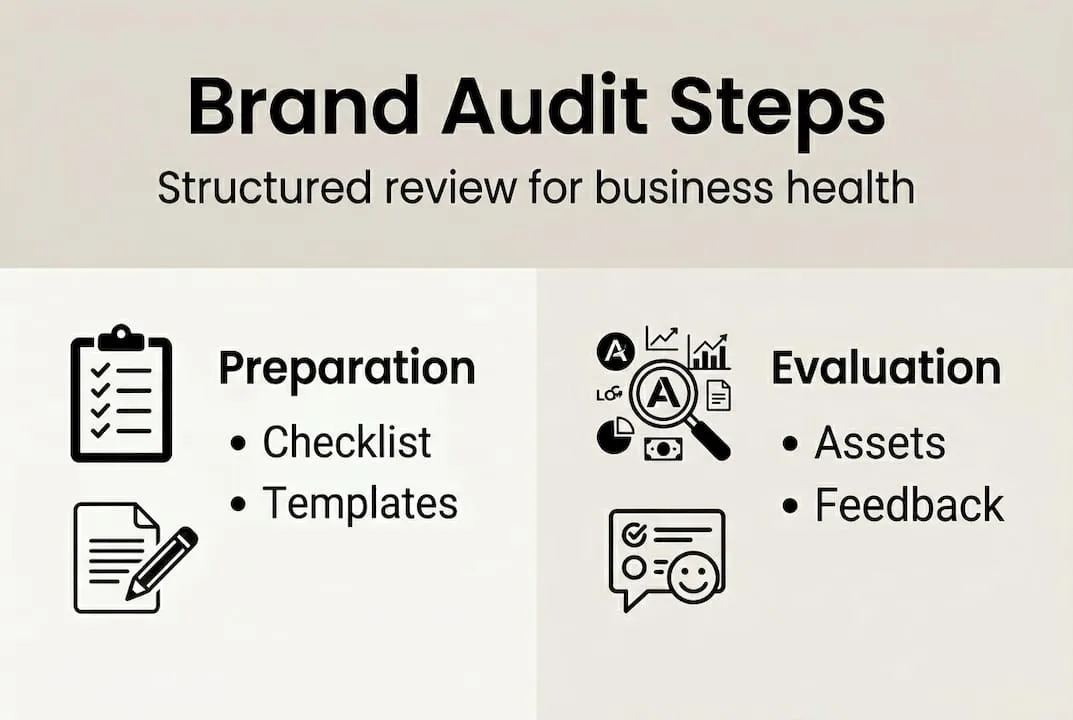
Harvard Business School Online's guide to brand audits begins with an inventory of brand equity: the assets already in place that shape how a brand is perceived. The guide is written for personal brands, but the same logic applies to a business. Look at both the internal side (how you present yourself) and the external side (how customers actually experience you).
A brand audit usually covers:
- Visual identity: Logo, colour palette, typography, imagery and design consistency
- Brand messaging: Taglines, tone of voice, value propositions and clarity
- Customer perception: Reviews, testimonials, survey data and social listening
- Digital presence: Website performance, SEO, social media and online listings
- Competitive positioning: How you compare with direct competitors in your market
One important point: an audit is not a rebrand. An audit tells you what needs attention. Rebranding is what you do if the audit reveals serious misalignment. Many businesses skip the audit and go straight to a new logo, only to find the real problem was their messaging or customer experience. Building a strong brand identity for small businesses starts with knowing where you stand, which is exactly what an audit gives you.
Regular audits also prevent expensive mistakes. Catching a messaging inconsistency early costs far less than losing customers for months before you notice the pattern.

Key steps in conducting a brand audit
So how do you actually run one? Here is a clear route.
A full audit covers equity, visuals, messaging and more, while a smaller audit might focus on a visual refresh or a single channel. For most small and medium businesses, a full audit every one to two years is a sensible rhythm. Step by step:
- Gather every brand asset. Collect all logo versions, brand guidelines, marketing materials, social profiles and website pages. You need the full picture before you can judge anything.
- Audit your visual identity. Check consistency across every touchpoint. Are you using the same fonts, colours and logo versions everywhere? Inconsistency erodes trust faster than most owners realise.
- Review your messaging. Read your website copy, emails and social captions as if you were a first-time visitor. Is the tone consistent? Is the value proposition clear within seconds?
- Assess your digital presence. Run your website through a speed and SEO check. Review your Google Business Profile, social bios and directory listings for accuracy and completeness.
- Analyse customer perception. Pull your reviews from Google, Yelp and industry platforms and look for recurring themes, good and bad. Survey existing customers if you can.
- Compare yourself with competitors. Pick your top three to five competitors and map how your positioning, messaging and visual identity differ from theirs.
An SME branding checklist keeps the process organised and makes sure nothing is missed. Templates and worksheets are especially useful if you are running the audit in-house.
Understanding your visual branding process before you start helps you judge your assets against a deliberate standard rather than guessing.
Pro Tip: Leave your emotional attachment at the door. You may love a logo you have used for ten years, but if customers do not connect with it, that attachment is costing you. Look at your brand the way a new customer would, not the way you built it.
Signs your business needs a brand audit
Every business benefits from regular check-ups, but some warning signs mean it is time to act now.
Severe misalignment may call for a full rebrand, while smaller issues might need only a visual refresh. Knowing which situation you are in stops you over-investing or under-investing.
How to tell the difference:
| Warning type | Scenario | Recommended action |
|---|---|---|
| Red flag | Falling sales with no clear market reason | Full brand audit, possibly a rebrand |
| Red flag | Customers are confused about what you offer | Messaging overhaul and positioning review |
| Red flag | Repeated negative reviews about the brand experience | Deep perception audit and strategy reset |
| Amber flag | Visuals look dated next to competitors | Visual refresh, not a full rebrand |
| Amber flag | Social engagement has slowly declined | Content and messaging audit |
| Amber flag | You have added services but not updated the brand | Incremental brand update |
More red flags to watch for:
- Your team cannot clearly explain what makes the business different
- New customers say they nearly did not get in touch because your website looked dated
- Your marketing materials look different from channel to channel
- You have entered a new market or launched a product line without updating your brand story
Consistency pays off. Trust, recognition and clarity build on each other across every customer interaction, and an inconsistent brand loses some of that effect every time.
If you are seeing amber flags, our brand refresh guide can help you make targeted improvements without a full overhaul. If red flags are piling up, it is worth revisiting your branding strategy for 2026 from the ground up.
Early audits prevent bigger problems. The longer you wait, the more customer relationships and marketing budget are affected by a brand that no longer represents the business accurately.
What you gain from a brand audit
What practical improvements does an audit bring?
A thorough audit clarifies your market position, how customers see you and what needs to happen next, all of which underpin brand equity. The results show up in revenue, customer relationships and marketing efficiency.
| Area | Before the audit | After the audit |
|---|---|---|
| Marketing spend | Scattered, low-return campaigns | Spend focused on proven channels |
| Customer trust | Mixed signals and mixed reviews | A clear, consistent brand experience |
| Competitive positioning | Unclear differentiation | A defined place in the market |
| Team alignment | Different messages from different teams | One brand voice and shared guidelines |
| Revenue trends | Flat or falling | Growth from a targeted strategy |
The gains go beyond the numbers. When your brand is clearly positioned, customers know exactly why they should choose you. That clarity shortens the sales cycle and makes referrals more likely.
Audits also reveal opportunities you may have missed: a gap in how competitors communicate, an underserved customer group, or a service customers did not know you offered. These come straight out of the perception and competitor stages.
For marketing, the audit works as a filter. Instead of guessing which campaigns to run, you have evidence of where your brand lands and where it falls flat. An SME brand strategy built on audit findings is far more effective than one built on assumptions.
Pro Tip: Turn your findings into a priority action list, not a wish list. Rank improvements by impact and cost and work through them in order. It helps you align branding and marketing for lasting growth without exhausting your team or budget.
Why most small businesses wait too long to audit their brand
The uncomfortable truth is that most small businesses do not audit their brand until something has already gone wrong. Sales drop, a competitor takes market share or a bad review spreads. Only then does the brand suddenly feel urgent.
The real cost of waiting is not the audit itself. It is the months or years of customer loyalty, marketing return and competitive position that quietly slip away while the brand goes unchecked. Small, regular improvements compound, much like interest. A business that audits every year and makes steady adjustments will usually outperform one that waits five years and then scrambles for a full overhaul.
Brand audits are not a one-off fix; they are a habit. Pairing them with a solid digital marketing checklist for 2026 keeps your whole strategy pointing the same way. Businesses that treat audits as routine maintenance rarely need emergency rebrands.
Get more from your brand with a professional audit
Running an audit yourself is a good start, but the most useful audits combine your inside knowledge with an outside view. An experienced team sees what you have become too close to notice.
At LOOM Brand Designs, we help small and medium businesses replace guesswork with structured brand evaluations and tailored strategies. You might start with our basic branding package, explore AI brand intelligence for deeper market insight, or book a website design consultation to bring your digital presence in line with your brand. Either way, we bring objectivity and experience. Let us find what is working, fix what is not and build a brand that supports real growth.
Frequently asked questions
How often should I do a brand audit?
Every one to two years is a good rhythm, or sooner if you notice warning signs in how the brand is performing. Regular check-ups stop small problems growing quietly into expensive ones.
What is the difference between a brand audit and rebranding?
An audit reviews the current state of your brand. Rebranding means making significant or total changes based on what the audit finds. A full rebrand follows from serious misalignment that an audit identifies first.
Do I need a professional to conduct a brand audit?
Small businesses can start with a DIY audit using checklists and templates. Specialists add objectivity and deeper analysis that internal teams often find hard to achieve on their own.
What areas are most often overlooked in a brand audit?
Customer perception, and the gap between what your marketing says and what customers actually experience, are the areas businesses most often miss when auditing themselves.
Can a brand audit improve my marketing return?
Yes. Knowing your brand's real strengths and weaknesses lets you run more targeted campaigns. An audit clarifies your market position so your marketing budget goes where it actually works.
The Hashtag Loom