

TL;DR:
- Niche marketing promotes products to a specific segment with shared needs rather than a broad audience. Tailoring your messaging and channels to that group improves engagement, loyalty and return on spend. Strong niche strategies validate demand early and deepen their focus to keep growing.
Niche marketing is the focused promotion of a product or service to a specific, well-defined segment of a larger market. Instead of broadcasting to everyone, you speak directly to a group with shared needs, values or problems that mainstream brands tend to ignore. It builds stronger customer connections, more engagement and a better return on marketing spend. Understanding niche marketing gives you a clear way to cut through the noise and become the obvious choice for the people who matter most to your business.

What is niche marketing and how does it differ from mass marketing?
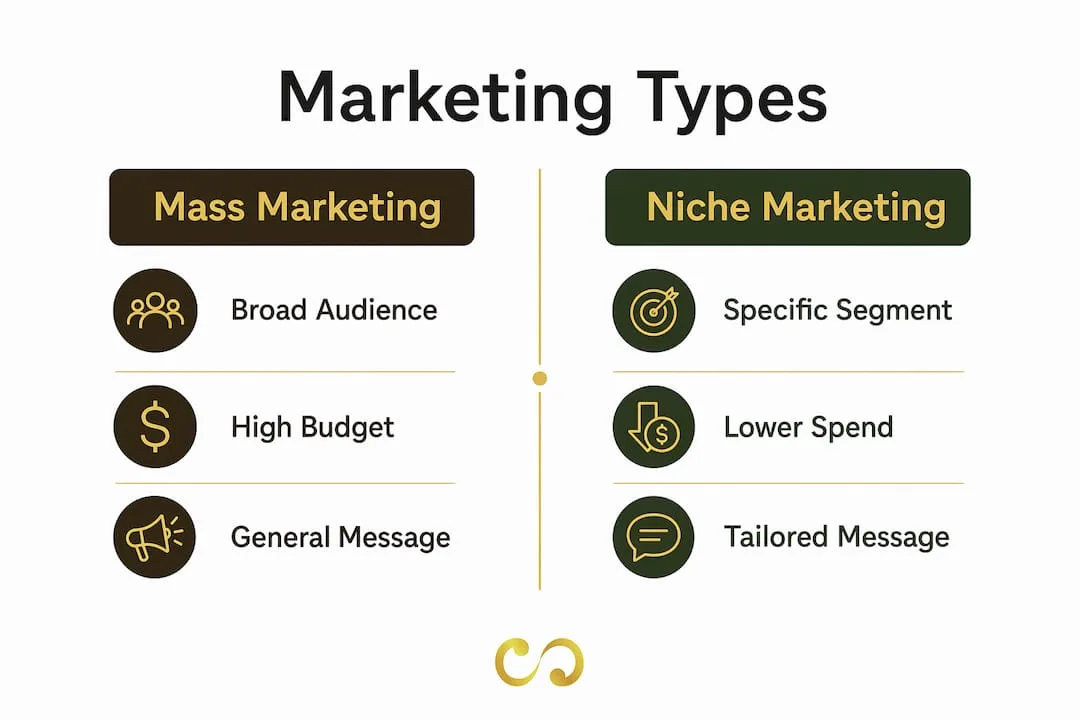
Niche marketing and mass marketing are two very different philosophies. Mass marketing shouts at a stadium full of people hoping a few will listen. Niche marketing is a one-to-one conversation with someone who already needs exactly what you offer. The difference shapes every decision, from budget to creative.
| Factor | Mass marketing | Niche marketing |
|---|---|---|
| Audience size | Broad, general population | Specific, defined segment |
| Ad spend efficiency | High waste on uninterested viewers | Focused spend on qualified prospects |
| Messaging depth | Generic, broad appeal | Tailored to specific pain points |
| Competition level | Intense, crowded | Lower, more defensible |
| Customer loyalty | Transactional | High, community-driven |
Mass marketing needs huge budgets to reach a wide audience often enough to be remembered. Niche marketing cuts waste by putting your money in front of people already inclined to buy. That efficiency is why smaller brands can beat larger ones in focused categories.
Pro tip: If your ad targeting covers a very broad audience on a limited budget, you're almost certainly paying for impressions that will never convert. Tighten the segment before you spend any more.
How to define your niche market in 6 steps
Defining a viable niche takes research before commitment. Skipping validation is one of the most common reasons niche strategies fail. HubSpot's approach to niche marketing follows a research-first sequence that moves from discovery to execution.
- Find your niche. Start with your existing skills, products or customer feedback. Look for underserved problems that bigger competitors dismiss as too small.
- Size the market. A niche must be small enough to own but big enough to sustain revenue. Check that enough buyers exist before building a campaign around them.
- Analyse the competition. Map who already serves this segment and how. Gaps in quality, price or messaging are your way in.
- Build your unique value proposition (UVP). Your UVP must speak directly to the niche's specific frustration, not offer a watered-down generic pitch. The best niche messaging sounds like one expert talking to a peer, not a sales pitch.
- Choose your channels. Where does this segment actually spend time? LinkedIn suits B2B professionals; Instagram suits lifestyle niches. The wrong channel wastes even the best UVP.
- Build an execution plan. Set measurable goals, assign a budget and decide your content rhythm before launch. A plan without metrics is just a guess.
Segmenting across three dimensions strengthens each step. Demographic segmentation covers age, income and location. Psychographic segmentation covers values, beliefs and lifestyle. Firmographic segmentation covers industry, company size and revenue for B2B niches. Using all three gives you a much sharper picture of who you're targeting.
Successful niche marketing also means checking profitability before committing serious resources. Run a small paid test, survey the segment or pre-sell a product to confirm real demand.
Pro tip: The most common validation mistake is confusing interest with intent. Someone who clicks an ad is interested. Someone who enters their card details has intent. Test for intent, not clicks, before you scale.
What are the real benefits of niche marketing?
Niche marketing doesn't limit growth. It speeds it up by building authority that mass-market players can't copy at scale, and the benefits build as your recognition within the segment grows.
- Higher engagement. Focused content resonates because it speaks to exactly what the reader cares about.
- Stronger brand loyalty. Customers who feel understood become advocates. They refer others in the same niche, bringing organic growth without extra ad spend.
- Less competition. Larger brands often avoid small segments because the revenue ceiling looks low. That leaves room for focused brands to lead.
- Better return. Precise targeting means fewer wasted impressions and higher conversion rates on every channel.
- Faster authority. Publishing deep, specific content on a narrow topic makes you the recognised expert faster than broad content could.
A common misconception is that going niche means staying small for ever. Often the opposite is true. Many well-known brands started by owning a specific niche and expanded only after establishing clear authority there.
The aim is to become the obvious hero for an underserved group, not a decent option for everyone.
That authority is hard for mass-market players to replicate. A large brand can't credibly claim deep expertise in a narrow category without alienating its broader audience. That structural advantage belongs to the niche player.
What niche marketing strategies actually work?
The most effective niche strategies share one principle: relevance over reach. Reaching 10,000 people who deeply identify with your message beats reaching a million who scroll past it.
Tailored messaging is the foundation. Your copy, visuals and offers must reflect the niche's own language, values and frustrations. Generic messaging relabelled for a narrower audience doesn't work, and the segment will spot the lack of authenticity straight away.
Channels that usually work for niche audiences:
- Micro-influencers. Creators with 10,000 to 100,000 followers in a specific category often carry more trust than celebrities with millions of general followers. Their audiences have gathered around a shared interest, which is exactly what niche marketing needs. Our guide to micro-influencer strategy covers how to vet and work with the right partners.
- Content marketing. Long-form articles, tutorials and case studies that tackle the niche's specific problems build organic authority over time. This is where digital marketing tactics for niche audiences differ most from broad campaigns.
- Community platforms. Private Facebook groups, Reddit communities, Slack channels and Discord servers are where niche audiences gather. Showing up honestly in these spaces builds trust faster than any paid ad.
- Email marketing. A small, engaged email list in a niche usually beats a large, disengaged one. Segment by behaviour, not just demographics.
Marketing campaign examples show that tight segmentation gives the sharpest results. A fitness brand targeting "postpartum strength training for new mothers" can speak far more precisely and empathetically than one targeting "women's fitness", and its messaging lands harder as a result.
Niche success also attracts imitators. Staying ahead in a niche takes continual refinement as competitors arrive. The defence is to niche down further, improve your service and reinforce the parts of your offer competitors can't easily copy.
Pro tip: When a competitor enters your niche, resist the urge to broaden your appeal. Niching down further, and serving a more specific sub-segment even better, is usually the stronger move.
Key takeaways
Niche marketing builds a lasting competitive advantage by focusing resources on a specific segment, which brings more engagement, stronger loyalty and a better return than broad-market approaches.
| Point | Details |
|---|---|
| Definition clarity | Niche marketing targets a specific segment with tailored messaging, not a broad audience with generic offers. |
| Engagement advantage | Focused content resonates more deeply because it speaks to exactly what the reader cares about. |
| Six-step validation | Always check niche size and profitability before committing budget to a full campaign. |
| Relevance beats reach | Micro-influencers and targeted content beat mass-reach channels for niche audiences. |
| Defence through depth | When competitors enter your niche, niche down further rather than broadening your appeal. |
Why most niche strategies fail before they start
Most niche marketing failures happen at the research stage, not in execution. Businesses choose a niche based on what they want to sell rather than what a specific group badly needs. That inversion produces campaigns with sharp visuals and weak results.
The deepest lesson I've learned working with brands on niche positioning is that the niche must already exist in the customer's mind before you name it. You aren't creating a category. You're finding words for a frustration a group of people already share but can't quite put into words. When your messaging does that, the response is immediate. People say, "This is exactly what I was looking for."
Balancing niche focus with growth ambition is the second challenge. Owners worry that going narrow will cap their revenue. In practice, a brand that owns a niche can charge for its expertise, earn referrals and expand into neighbouring niches from a position of strength rather than desperation. A brand strategy for growth starts with depth, not breadth.
Niches also shift. Customer needs change, new competitors arrive and the segment's language moves on. Ongoing niche analysis isn't optional. The brands that stay on top treat their positioning as a living document, not a one-off decision.
Pawan
How LOOM Brand Designs supports your niche marketing goals
Niche marketing only works when your brand identity is as precise as your targeting. A generic logo and inconsistent visuals undermine even the sharpest messaging.
LOOM Brand Designs builds brand identities for focused audiences. The Basic Branding Package gives growing businesses a clear, professional identity built around their niche positioning. For brands ready to go further, the Standard Branding Package adds the full set of design assets you need to stay consistent on every niche channel. Every package is designed to make your brand feel at home exactly where your customers already are.
FAQ
What is niche marketing in simple terms?
Niche marketing is promoting a product or service to a small, specific group of people with shared needs, rather than a broad general audience. The goal is relevance and depth of connection, not maximum reach.
How do I find my niche market?
Look for underserved problems within a larger market, then check that the segment is big enough to generate revenue. A six-step process covering niche finding, market sizing, competitor analysis, UVP development, channel choice and execution planning gives you a clear path.
Does niche marketing limit business growth?
No. It builds the authority and customer loyalty that make expanding into neighbouring markets easier and more profitable than starting broad.
What are examples of niche marketing strategies?
Micro-influencer partnerships, community platform engagement and highly specific long-form content are among the most effective. Each works because it puts relevance to a defined audience ahead of broad visibility.
How is niche targeting different from general targeting?
Niche targeting uses demographic, psychographic and firmographic segmentation to reach a precisely defined group. General targeting casts a wide net and accepts a lot of waste as the cost of reach.
The Hashtag Loom