

TL;DR:
- Programmatic advertising automates digital ad buying, using real-time data and algorithmic auctions to reach specific audiences quickly. It covers many channels and buying models, from open auctions to guaranteed deals, and offers efficient, precise targeting at most budget levels. Success depends on smart use of data, brand safety measures and human oversight alongside the automation.
Programmatic advertising is the automated buying and selling of digital ad space through technology platforms, using real-time data and algorithmic auctions to match ads with the right audiences in milliseconds. Over 90% of US digital display ad spending is now programmatic, according to eMarketer, so manual insertion orders are the exception rather than the rule. For marketers and business owners, understanding the system is essential. It is the basis of modern digital media buying, and platforms such as Google Display & Video 360, The Trade Desk and Amazon DSP have opened it up to a wide range of budgets.

What is programmatic advertising and how does it work?
Programmatic advertising is the automated buying and selling of digital ad inventory through software, replacing human negotiation and manual orders. You will most often hear it called "programmatic ad buying", and when it brings strategy, data and creative together it is sometimes called programmatic marketing.
The whole transaction happens extremely fast. Bids are evaluated and submitted within milliseconds, usually before the webpage has finished loading. That speed depends on a chain of connected platforms working at once.
The key platforms in the ecosystem
Four technology layers sit behind every programmatic transaction:
- Demand-side platform (DSP): the advertiser's tool. A DSP such as The Trade Desk or Google DV360 lets buyers set targeting, budgets and bid strategies, and bids on the advertiser's behalf in real time.
- Supply-side platform (SSP): the publisher's tool. An SSP such as Magnite or PubMatic connects a publisher's inventory to many buyers at once, so the publisher gets the best price for each impression.
- Ad exchange: the marketplace where DSPs and SSPs meet. Google Ad Exchange is the largest, but many others operate across display, video and mobile.
- Data management platform (DMP): the intelligence layer. A DMP brings together first-party and third-party audience data and feeds targeting signals into the DSP, so bids go only on impressions that match the advertiser's audience.
How a single ad impression is bought and delivered
When someone loads a webpage, the publisher's SSP sends a bid request with anonymised information about the user, the page and the ad slot. Each DSP connected to the exchange checks the request against its targeting rules and bids within milliseconds. The highest bid wins, the ad is served and the user sees it, all before the page finishes rendering.
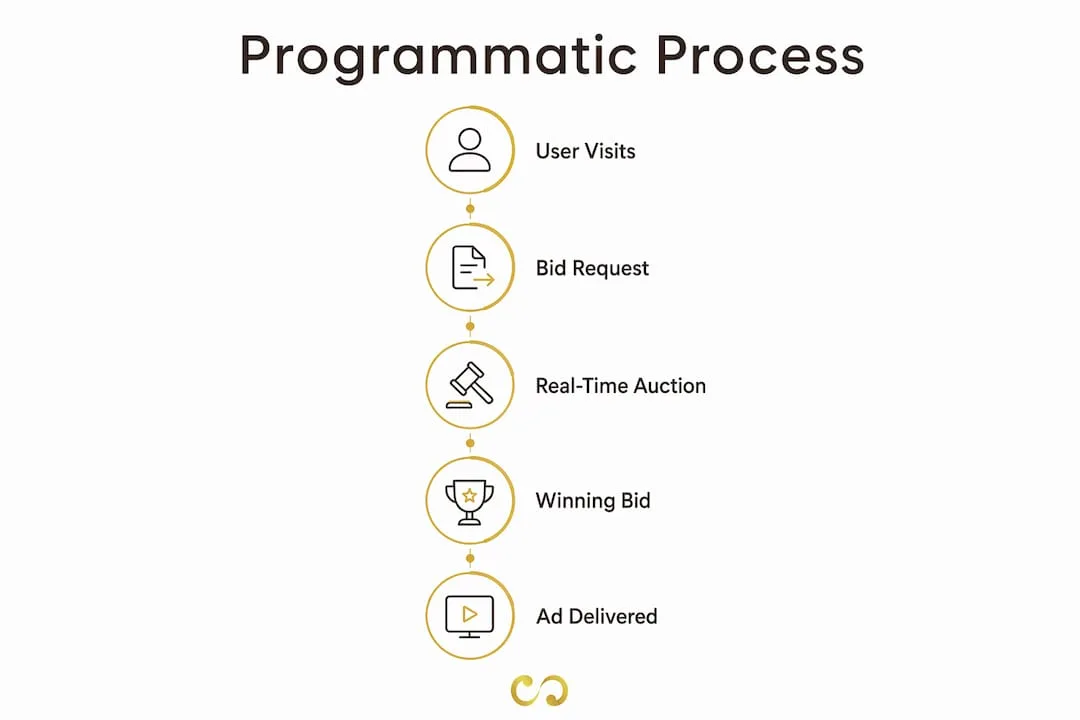
Header bidding runs several auctions at once before the publisher's ad server makes its decision, exposing inventory to more buyers and increasing competition. It is now standard on desktop and mobile web, which means publishers earn more and advertisers can reach premium inventory they would otherwise miss.
Pro tip: if you are new to programmatic, start with a managed-service DSP rather than self-service. Self-service gives you more control, but it takes real data skills to avoid wasting budget.
What types of programmatic advertising exist?
Programmatic covers display, video, mobile, connected TV (CTV), digital audio and digital out-of-home (DOOH). The auction mechanics are the same across channels, but the buying models differ a lot in cost, control and brand safety.
| Buying model | How it works | Best for |
|---|---|---|
| Open auction (RTB) | Real-time bidding open to all buyers; lowest CPMs | Broad reach, prospecting campaigns |
| Private marketplace (PMP) | Invite-only auction with selected publishers; mid-range CPMs | Brand-safe environments, niche audiences |
| Programmatic guaranteed | Reserved inventory at fixed prices; no auction | Premium placements, brand campaigns |
| Preferred deals | Fixed price, non-guaranteed access before the open auction | Testing premium inventory at scale |
Open auctions offer the lowest CPMs but give advertisers the least control over where ads appear. That trade-off matters a great deal for brand safety. A financial services brand buying in the open auction risks appearing next to content that harms its reputation.
Private marketplaces and programmatic guaranteed deals deal with that directly. Programmatic guaranteed reserves specific inventory at a fixed price, combining the efficiency of automation with the control of a traditional direct buy. For premium brand campaigns, it is a better starting point than the open auction.
When choosing a buying model, think about:
- Campaign goal: prospecting and awareness suit the open auction for reach. Retargeting and brand campaigns suit PMPs or programmatic guaranteed.
- Budget: open auction works at lower minimums. Programmatic guaranteed usually needs committed spend.
- Brand safety: regulated sectors such as finance, healthcare and pharmaceuticals should default to PMPs or programmatic guaranteed.
- Inventory quality: premium publishers such as The New York Times and ESPN offer PMP deals that are not available in the open auction.
What are the benefits of programmatic advertising?
Programmatic advertising automates and optimises media buying, letting marketers reach specific audiences more efficiently with real-time data. The shift from buying placements to buying audiences is what sets programmatic apart from earlier models of digital advertising.
Because programmatic moves buying from placements to audiences, you are no longer paying for a slot on a particular website. You are paying to reach a particular person wherever they are online. Someone who visited your pricing page last week can be shown a testimonial ad on a cooking blog, a sports news site and a podcast app, all in the same campaign.
The practical benefits:
- Less manual work. No more negotiating insertion orders with individual publishers. The platform handles bidding, pacing and delivery.
- Real-time optimisation. Performance data updates continuously. You can pause weak creatives, move budget to strong audiences and change bids within hours rather than weeks.
- Scale. One DSP campaign can reach a huge number of impressions across thousands of publishers at once, which no media buyer could do by hand.
- Precise targeting. Combine first-party CRM data, behavioural data from DMPs and contextual signals to build segments that match your customer profile.
- Cost efficiency. Because you only bid on impressions that match your targeting, you waste far less than with broad placement buys.
Pro tip: connect your data-driven marketing strategy to your DSP from day one. Programmatic without good audience data is automated guessing.
Programmatic is quicker to launch, too. A campaign can go from brief to live in hours, whereas a traditional direct buy can take days or weeks of negotiation before a single impression is served.
Common challenges and best practices for programmatic success
Automation removes repetitive tasks and reduces human error, but it does not remove the need for strategic thinking. The biggest mistake is treating programmatic as set-and-forget. The platforms optimise towards the objective you give them. Set the wrong objective and the algorithm will deliver the wrong result very efficiently.
The most common pitfalls, and how to avoid them:
- Weak audience data. Targeting is only as good as the data behind it. Build first-party segments from your CRM, website analytics and purchase history before you launch. Relying only on third-party data from DMPs is getting riskier as cookies are phased out.
- Brand safety gaps. Open auction buys can place your ads next to low-quality or harmful content. Use inclusion lists (approved publishers), exclusion lists and brand safety tools such as Integral Ad Science or DoubleVerify.
- No frequency capping. Without limits, the same person can see your ad dozens of times a day. That burns budget and annoys people. Set frequency caps at campaign and creative level.
- The wrong service model. Self-service programmatic needs technical and data skills. If your team does not have them yet, a managed-service partner will get better results while you build that knowledge.
- Neglecting creative. Programmatic optimises delivery, not creative. A badly designed banner will underperform however precise the targeting. Produce several creative variants and let the platform find the one that works.
The role of automation in marketing goes beyond ad delivery. The strongest programmatic strategies automate audience segmentation, creative testing and reporting too, creating a feedback loop that improves with each campaign. Add a clear data strategy and human oversight, and programmatic becomes one of the most efficient channels in your media mix.
Key takeaways
Programmatic advertising works when automation, good audience data and human oversight come together in the right buying model for each campaign goal.
| Point | Details |
|---|---|
| Programmatic definition | Automated, real-time buying and selling of digital ad inventory through DSPs, SSPs and ad exchanges. |
| Speed of transactions | Auctions and ad delivery happen within milliseconds, usually before the page has loaded. |
| Buying model selection | Match the model (open auction, PMP, programmatic guaranteed) to your brand safety needs and campaign goal. |
| Audience over placement | Programmatic targets specific people across any site, replacing site-based buying with audience-based targeting. |
| Human oversight required | Automation optimises towards your objective, so setting the right goal and monitoring performance is essential. |
Why programmatic changed how I think about media buying
The pattern I see most often with marketing teams, from e-commerce start-ups to regional service businesses, is the same. They hear "programmatic" and assume it is only for big brands with huge media budgets. That assumption costs them.
Programmatic ad buying is now open to budgets that would have been laughable a decade ago. A local business can run a connected TV campaign aimed at homeowners within a set radius on a modest monthly budget, and get impression-level reporting that a traditional TV buy could never offer.
What I tell every client who is new to programmatic is this: the technology is not the hard part. The hard part is the data strategy and the discipline not to over-automate. The platforms will spend your budget efficiently. Whether they spend it on the right people, in the right context, at the right frequency is still a human decision. Marketers who treat programmatic as a tool rather than a solution are the ones who get consistent results.
For small and mid-sized businesses, our SME paid advertising guide is a practical starting point before you commit to a full programmatic setup. Understand your audience, build your first-party data and then give the algorithm something real to work with.
Pawan
Ready to put programmatic advertising to work for your brand?
Understanding programmatic is one thing. Running it with the right creative, data strategy and campaign structure is where most businesses need a partner.
LOOM Brand Designs builds digital marketing that connects strategy to execution, from audience research and ad creative to campaign management and reporting. Whether you are planning your first programmatic campaign or growing an existing media mix, our Standard Branding Package gives you a strong brand foundation to build on. If your website needs to work harder for your ad spend, our website design and development service helps the traffic you pay for turn into customers. Book a consultation and we will build a strategy around your goals.
FAQ
What is programmatic advertising in simple terms?
Programmatic advertising is the automated buying and selling of digital ad space using software and real-time auctions, in place of manual negotiation between advertisers and publishers.
How does programmatic advertising differ from Google Ads?
Google Ads works within Google's own ecosystem, while programmatic advertising uses DSPs and SSPs to reach inventory across thousands of publishers and channels, including CTV, audio and DOOH, at the same time.
What is a DSP in programmatic advertising?
A demand-side platform (DSP) is the software advertisers use to set targeting, manage bids and buy ad inventory across several ad exchanges from one interface.
Are programmatic ads worth it for small businesses?
They can be. Programmatic buying is available at modest budgets and offers more precise targeting than broad placement buys, which makes it a good fit for small businesses with a clearly defined customer profile.
What is the difference between programmatic guaranteed and real-time bidding?
Real-time bidding is an open auction where the highest bid wins each impression. Programmatic guaranteed reserves specific inventory at a fixed price in advance, giving a predictability and brand safety that open auctions cannot.
The Hashtag Loom