

TL;DR:
- Web design is the foundation for building trust, improving search rankings and turning visitors into customers.
- Layout and usability shape how people see your brand, how credible you look, how well you rank and how fast the business grows.
Web design is the work of shaping a website's visual layout, user experience and structure so it builds trust, engages visitors and turns them into customers. For business owners, the reason it matters is simple: your website is your most active salesperson, working day and night. A poorly designed site loses sales before a visitor reads your offer. A well-designed one builds credibility in seconds, ranks better on Google and leads people towards action. Good design is not a matter of taste. It is part of how the business sells.
Why is web design important for user trust and brand credibility?
Your website makes its first impression almost instantly. According to Shopify, studies show users form an opinion of a website in milliseconds, and more than half of potential customers leave if a page takes longer than a few seconds to load. A slow, cluttered or inconsistent site is costing you customers before they read a word of your copy.
Consistent branding through colour and typography sets your business apart and makes it memorable. Visual consistency also reduces the effort visitors spend working out your site, leaving more attention for your offer. When fonts, colours and layout feel coherent on every page, people read the business as professional and trustworthy.
Inconsistent design can undermine even a strong offer. A premium product sold through a site with clashing colours, broken layouts or generic stock photos sends a mixed message, and visitors notice. Picture a builder arriving to quote for your renovation in a torn shirt with no business card: you would doubt them, whatever their actual skill.
Common trust-killers include misaligned calls to action, text too small to read on a phone, and pages that look nothing like each other. These are not cosmetic details. They tell visitors the business does not pay attention.
Pro tip: Look at the first two screens of your homepage. If a stranger cannot tell what you do, who you serve and what to do next within ten seconds, the design is letting the business down.
- Slow load times push visitors away before they engage
- Inconsistent typography and colour schemes weaken brand recognition
- Broken or misaligned calls to action confuse users and cost conversions
- Generic or poor-quality images look unprofessional
- Cluttered layouts overwhelm visitors and raise bounce rates
How does web design affect SEO and search visibility?
Web design and SEO work as one system. Site architecture, including navigation hierarchy and internal linking, is planned at the design stage to support search visibility. If your design buries key pages three clicks deep with no internal links pointing to them, Google struggles to crawl and rank them. Poor structure holds back your rankings before you have written any content.
Search engines take user experience into account, including load speed, responsive design and crawlable structure. Google's Core Web Vitals, measured with tools such as PageSpeed Insights and Lighthouse, score your site on loading, visual stability and responsiveness to input. Weak scores can hold back pages that would otherwise compete on content.
Mobile friendliness is not optional. Google uses mobile-first indexing, so it judges your mobile site when ranking pages for everyone, including desktop users. A site that looks great on a large monitor but breaks on a phone suffers in search and loses the many visitors who browse on mobile.
| Design factor | SEO impact | Tool to assess |
|---|---|---|
| Page load speed | Directly affects Core Web Vitals | Google PageSpeed Insights |
| Mobile responsiveness | Required for mobile-first indexing | Google Search Console |
| Site architecture | Determines crawlability and how link equity flows | Screaming Frog, Lighthouse |
| Internal linking | Spreads authority and helps navigation | Ahrefs, Google Search Console |
| Accessible markup | Supports indexing and assistive technology | WAVE, axe DevTools |
The role of SEO in marketing is closely tied to design decisions made before any blog post is written. Clear navigation, heading hierarchy and image alt text are design choices that either support or undermine your organic traffic.
How does web design drive conversions and business growth?
A better user experience turns more visitors into customers, and that is the difference between a website that pays for itself and one that drains your marketing budget. The gains compound: a site that converts better lowers your cost per acquisition on every channel you pay for.
How design choices turn into revenue:
- Reduce navigation friction. Visitors who cannot find what they need quickly leave. Clear menus, logical groupings and a visible search box keep them moving towards a purchase or enquiry.
- Place calls to action carefully. A "Book a call" button buried at the bottom of a long page does far less than one placed near the top and repeated at natural decision points.
- Show your value proposition visually. A bold headline, short supporting line and one focused hero image communicate your offer faster than three paragraphs of copy.
- Earn repeat visits. Sites that are easy to use bring people back and reduce reliance on paid channels. When people trust your site, they return and recommend you.
- Remove clutter. Every unnecessary element competes for attention. White space is not wasted space. It draws the eye to what matters.
Design affects sales through both visual appeal and trust. Treating it as decoration is an expensive mistake, because every layout decision is a business decision.
Pro tip: Run a five-second test with a tool such as Maze or Lyssna. Show your homepage to someone who does not know your business for five seconds, then ask what you do. If they cannot say, your design is not communicating your offer quickly enough.

What are the core principles of effective web design?
Good web design rests on three principles: usability, responsiveness and accessibility. They are not trends. They decide whether your site works for the people you want to reach.
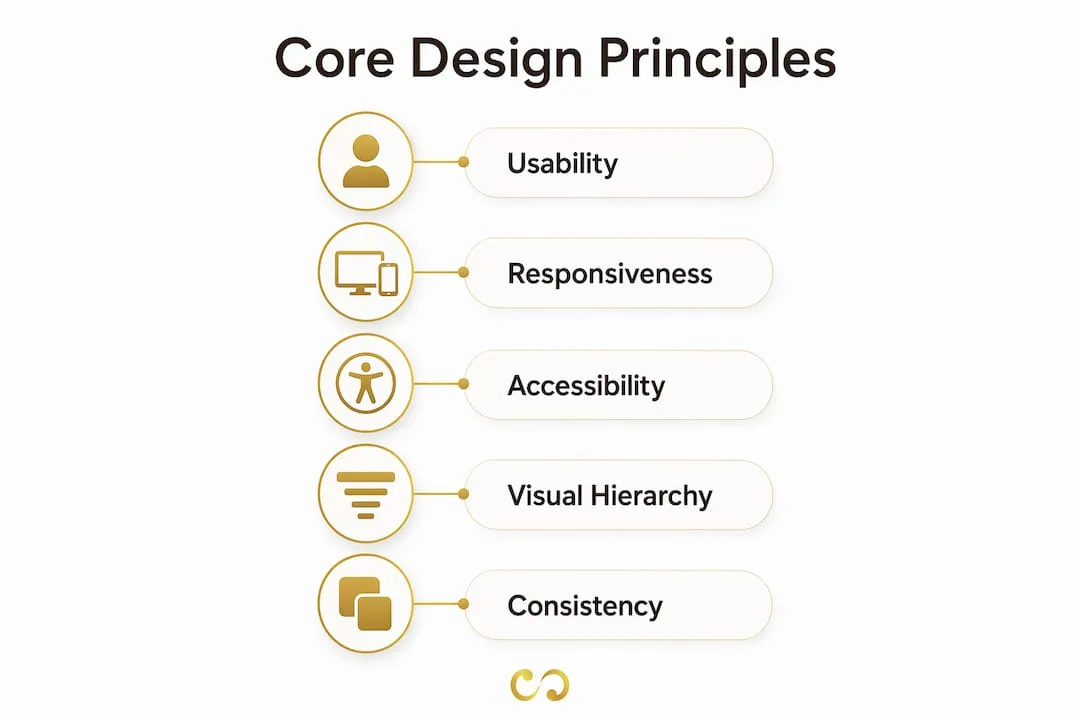
Usability means the site makes sense without instructions. Navigation labels match what people expect, text is readable without zooming, and the layout leads the eye from headline to detail to action. When usability fails, even motivated visitors give up.
Responsiveness means the site adapts cleanly to any screen. Working well on every device lowers bounce rates and improves engagement, which helps in search. A responsive site is not a squeezed-down desktop site. It is a properly considered experience on each type of device.
Accessibility is where many businesses leave money on the table. Accessible design includes people with disabilities, widens your reach and reduces legal risk, while making the site easier for everyone. Readable type, enough colour contrast, keyboard navigation and compatibility with screen readers such as JAWS or NVDA are not extras. In many places they are legal requirements, with WCAG as the reference standard.
Understanding graphic design in marketing helps here too. Visual hierarchy, contrast and spacing are graphic design principles that support usability and accessibility when applied well.
| Principle | What it means | Business benefit |
|---|---|---|
| Usability | Intuitive navigation and readable layouts | Lower bounce rates, higher engagement |
| Responsiveness | Consistent experience on every device | Better rankings, wider reach |
| Accessibility | Inclusive design for all users | Legal compliance, larger market |
Key takeaways
Web design decides whether your website builds trust, ranks on Google and turns visitors into customers.
| Point | Details |
|---|---|
| First impressions are instant | People judge a site within milliseconds, so speed and visual clarity are essential. |
| Design and SEO are one system | Site architecture, internal linking and mobile responsiveness are design decisions that affect rankings. |
| Good UX lifts conversions | A well-designed experience turns more visitors into customers and improves returns on every channel. |
| Accessibility widens your reach | Inclusive design serves more people, reduces legal risk and helps everyone. |
| Consistency builds brand trust | Coherent typography, colour and layout signal professionalism and reduce doubt. |
Web design is not a cost. It is one of your best investments.
I have worked with enough owners to recognise the pattern. They spend heavily on Google Ads or social campaigns, then send that traffic to a website built over a weekend three years ago. The ads get the blame. The real problem is the destination.
What I see again and again: owners who treat web design as a one-off expense rather than an ongoing asset hit a ceiling. Cost per lead stays high because the site does not convert. SEO stalls because the structure was never built for it. The brand feels forgettable because the design is generic.
The ones who break through treat their website the way a retailer treats the shop floor. They test it, refine it and invest in it, because every visitor is a real opportunity won or lost in seconds.
The biggest mistake I see is neglecting mobile users. A large share of web traffic now comes from phones, yet many business sites are still designed for desktop first and squeezed onto mobile afterwards. That costs rankings and customers at the same time.
My practical advice: start with an honest audit using Google PageSpeed Insights and Google Search Console. Find your three slowest pages, and your busiest pages with the worst bounce rates. Fix those first. Then set up a simple design system with consistent fonts, colours and call-to-action placement, and apply it to every page. You should start seeing the effect in your analytics within weeks.
Done properly, web design is not decoration. It is the foundation the rest of your digital marketing sits on.
Pawan
Ready to build a website that actually works for your business?
At LOOM Brand Designs we build websites that do more than look good. Every site is designed for conversion, with an SEO-friendly structure and consistent branding from the start. Whether you are launching a new business or rebuilding a site that is underperforming, we bring web design, branding and digital strategy together in one focused process.
Our website design and development service is built for owners who want measurable results, not just a pretty page. We also offer branding packages that give your website the visual identity it needs to build trust from the first click. If you are serious about your online presence, let's build something that performs.
FAQ
Why is web design important for small businesses?
It shapes how potential customers judge your credibility, whether they find you on Google and whether they get in touch. A professionally designed site turns more visitors into leads, which reduces your reliance on paid advertising over time.
How does web design affect SEO rankings?
Google takes load speed, mobile responsiveness and site structure into account. Slow pages, broken navigation or layouts that do not adapt to phones hold back your rankings even when the content is good.
What is the most important element of good web design?
Usability. A site visitors cannot find their way around fails at everything else, including conversions and SEO. Clear navigation, readable text and a logical page structure are the foundation of every effective website.
How often should a business update its website design?
A full redesign is often due every three to four years, but speed, the mobile experience and call-to-action placement should be improved continuously based on analytics and user behaviour.
Can good web design really increase conversions?
Yes. Clear calls to action, less navigation friction and visual clarity all help more visitors take the next step. The best way to see the effect on your own site is to test changes and compare conversion rates before and after.
The Hashtag Loom