

TL;DR:
- Local SEO helps SMEs show up in local search results and reach nearby customers who are ready to buy. Steady work on your Google Business Profile, reviews and citations builds trust signals that keep bringing in leads long after paid ads would have stopped. Success comes from disciplined, ongoing effort rather than a large budget, and the most important single step is completing and maintaining your Google Business Profile.
Local SEO is the practice of improving your online presence so nearby customers find your business first when they search for what you offer. For small and medium-sized businesses, it isn't a marketing luxury. It's the most direct route to buyers in your area who are ready to spend. Google Business Profile, local citations and customer reviews form the core of any local search strategy, and the businesses that keep on top of them win the most visible spots in search results. This article explains why local SEO gives SMEs something paid advertising can't.
Why local SEO for SMEs drives real visibility
Google ranks local results on three signals: relevance, distance and prominence. Distance is mostly fixed, but relevance and prominence are within your control. That's the opportunity for every SME competing with larger brands and bigger budgets.

Google Business Profile (GBP) is the most powerful lever you have. It feeds directly into the Local Pack and Google Maps, and moving from an incomplete profile to a complete, well-maintained one is usually the quickest local ranking win available. Many businesses see movement within a few months, which is quicker than most people expect from SEO.

The Local Pack, the three business listings at the top of Google's local results, is where the attention concentrates. If your business doesn't appear there, many potential customers in your area will never see you. That's the core argument for treating local search as a priority.
Customer reviews strengthen every other signal. Google lists reviews among the things that affect local prominence, so getting new reviews isn't a soft metric. It has a direct effect on how often your business is found.
Here's what separates top-ranked SMEs from invisible ones:
- Consistent NAP data (name, address, phone) across every directory, including Yelp, Bing Places, Apple Maps and industry-specific listings
- Regular GBP updates, with photos, posts and service descriptions refreshed at least weekly
- Active review management, replying to every review within 48 hours
- Accurate business categories in GBP that match exactly what customers search for
Pro tip: Book a recurring 20-minute weekly slot for GBP maintenance. Upload one new photo, reply to any pending reviews and check your hours are current. This one habit separates businesses that rank from those that don't.
Improving your online presence through these steady actions builds the prominence signal Google rewards over time.
What are the financial benefits of local SEO vs. paid ads?
The cost case for local SEO is simple. Paid ads charge you for every click, and the cost per lead tends to rise as more competitors bid on the same searches. Local SEO takes time and effort up front, but once you rank, the leads it brings in don't come with a per-click bill.
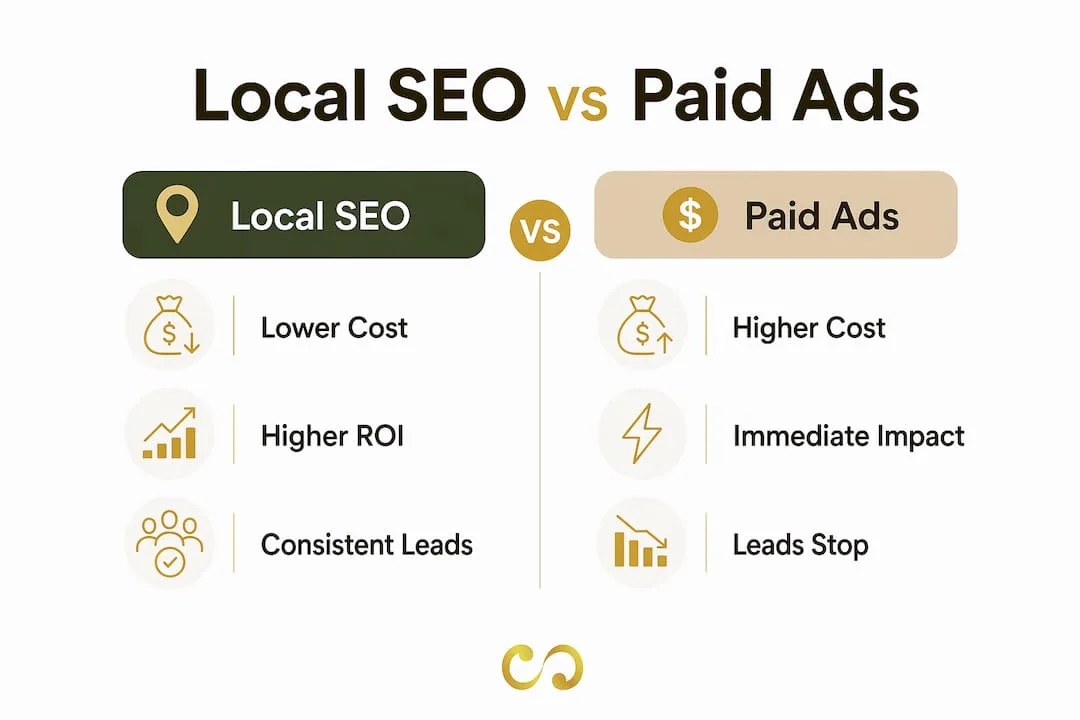
The bigger difference is what happens when you stop spending. Paid ads stop delivering the moment your budget runs out. Local SEO builds assets (rankings, reviews, citations and content) that keep bringing in leads long after the initial work is done. Over time, your cost per lead from local SEO tends to fall, while a paid campaign's usually climbs as competition grows.
| Factor | Local SEO | Paid advertising |
|---|---|---|
| Cost per lead | Falls as rankings and reviews build | Ongoing, and tends to rise with competition |
| Lead quality | High intent, local | Variable, broad |
| Long-term effect | Builds over time | Stops when budget stops |
| Trust signal | Reviews build credibility | Ads carry no trust signal |
| Time to results | Usually a few months | Immediate but temporary |
Reviews also help people decide. A steady flow of recent, positive reviews reassures searchers comparing you with the business next door. A business that asks for a review after every job isn't just collecting social proof. It's making its listing more convincing with every new entry.
Pro tip: After a sale or service, send a follow-up text or email with a direct link to your Google review page. Friction kills reviews, so remove every step you can between a happy customer and a published review.
If you're deciding where to put a limited marketing budget, the SME paid advertising guide offers a useful way to decide when paid ads should complement local SEO rather than compete with it.
What mistakes do SMEs make with local SEO?
Most SMEs underperform on local SEO not because they lack technical knowledge but because they don't do the basics consistently. Replying to reviews within 48 hours, updating photos weekly and keeping NAP data consistent across directories are what separate top-ranked businesses from invisible ones. The gap is almost never budget. It's discipline.
The common mistakes follow a familiar pattern:
- Treating GBP as a one-off set-up. A profile created and never updated tells Google the business may be inactive. Treat your GBP like a shop window that needs a new display every week.
- Using duplicate location pages. If you operate in several cities and just swap the city name on otherwise identical pages, Google spots the pattern and discounts every version. Each location page needs original content written for that community.
- Ignoring review recency. A business with 200 reviews from three years ago and nothing since loses ground to a competitor with 80 reviews earned over the past six months. A steady stream of new reviews shows the business is active and trusted.
- Inconsistent NAP data. A phone number formatted differently on Yelp, your website and a local chamber of commerce directory creates conflicting signals, and Google responds by trusting all of them less. Audit every directory listing at least once a quarter.
- Skipping the Q&A section on GBP. This lets you answer common customer questions in advance. Leaving it empty means missing a chance to tell your own story and make things easier for potential customers.
Local SEO levels the playing field for SMEs with limited budgets, but only when the work is consistent. Large brands have scale. You have specificity. Use it.
How to build a local SEO strategy that works
A working local SEO strategy for an SME doesn't need a large team or an enterprise budget. It needs a clear system carried out without gaps. This framework covers the highest-impact activities in order of priority.
Start with GBP as your foundation
Choose the most accurate primary and secondary categories for your business. Upload at least 10 photos of your shopfront, team, products and workplace. Write a business description in the plain language customers actually search with, not marketing copy. Post a GBP update at least once a week, whether it's a promotion, a new product or a community event you're attending.
Build citations across trusted directories
List your business on Google, Yelp, Bing Places, Apple Maps, Facebook and any directories specific to your sector. A plumber in Chicago should be on Angi and HomeAdvisor. A restaurant in Austin should be on Tripadvisor and OpenTable. Every accurate citation reinforces your prominence signal.
Create location-specific content
Write blog posts, service pages and landing pages that mention your city, neighbourhood and local landmarks in context. A post titled "HVAC maintenance tips for Houston summers" serves both your local audience and your local rankings. Generic content doesn't build local authority; specific content does. The role of SEO in marketing goes well beyond rankings. It builds the kind of topical authority that earns trust from Google and your customers.
Use social media to reinforce local signals
Geo-tagged posts on Instagram and Facebook, check-ins and location-tagged content all add to the wider picture of a business that's active locally. Engaging with customers on GBP, by replying to reviews and keeping information up to date, is closely tied to how many searchers become customers. Social activity doesn't replace GBP management, but it supports it.
- Reply to every review, positive or negative, within 48 hours
- Tag your location in every social post about your business
- Share local news and events to show you're part of the community
- Encourage check-ins from customers visiting your premises
People searching on their phones for something nearby often want it today. Every improvement to your local presence is an investment in footfall and same-day sales.
Key takeaways
Local SEO works for SMEs because it builds trust-based visibility that grows over time, something paid advertising can't do, and usually at a lower cost per lead.
| Point | Details |
|---|---|
| GBP is the top lever | A complete, actively maintained Google Business Profile is usually the fastest local ranking win. |
| Reviews drive decisions | A steady flow of recent reviews helps you appear in the Local Pack and persuades searchers to choose you. |
| Local SEO gets cheaper over time | Paid leads cost money every time; local SEO leads keep coming once you rank. |
| Consistency beats budget | Replying to reviews, updating photos and keeping NAP data consistent separate ranked businesses from invisible ones. |
| The Local Pack is the goal | The top three listings get most of the attention in local results, so that placement is what to aim for. |
Why most SMEs are leaving their best customers on the table
We often meet small business owners who spend money every month on social ads while their Google Business Profile sits half-finished, with a few old photos and no review replies. The maths rarely adds up. They're paying to reach people who may not need them right now, while ignoring the channel that reaches people actively searching for exactly what they sell.
A small local operator can outrank a national chain in its own town. It doesn't need paid ads to do it. It needs plenty of reviews with replies to every one, a profile updated every week and a handful of genuinely local pages. The chain may have a bigger brand and a bigger website, but the local business has more relevance and more trust signals in that market.
SMEs that treat their online profiles as active communication channels outperform competitors who treat them as static listings. That's the real advantage open to every small business owner reading this. You don't need to outspend anyone. You need to out-communicate them, consistently, in the places your local customers already look.
Start with one thing: claim and fully complete your Google Business Profile this week. Then build from there. Local SEO rewards patience and consistency more than almost any other channel.
How LOOM Brand Designs helps SMEs win local search
LOOM Brand Designs helps SMEs build the kind of digital presence local search rewards. From Google Business Profile set-up and local citation management to website design built for SEO performance, our team handles the execution so you can focus on running your business.
If you're starting from scratch or rebuilding a neglected online presence, the Basic Branding Package gives you a professional foundation that supports every local SEO effort from here on. Strong branding and consistent local signals work together, and we build both. Book a consultation for a strategy tailored to your market and goals.
FAQ
What is local SEO and why does it matter for small businesses?
Local SEO is the process of improving your online presence so your business appears in search results when nearby customers look for your products or services. It matters because people searching locally usually want to buy soon, which makes them some of the most valuable visitors an SME can attract.
How long does it take to see results from local SEO?
Many SMEs see ranking improvements within a few months of fully completing their Google Business Profile. Results from citation building and review generation usually keep growing over three to six months and beyond.
Is local SEO better than Google Ads for SMEs?
They do different jobs. Google Ads produce results quickly but stop the moment your budget runs out. Local SEO takes longer, but it keeps bringing in leads after the initial work, which makes it the stronger long-term investment for most SMEs. Many businesses use both.
How many reviews does a business need to rank in the Local Pack?
There's no fixed number. What matters is having more recent, relevant reviews than the competitors you're up against, and earning them steadily rather than in one burst.
What is the single most important local SEO action an SME can take?
Fully completing and actively maintaining your Google Business Profile. It feeds the Local Pack and Google Maps directly, and moving from an incomplete profile to a complete one usually produces quicker results than any other single change.
The Hashtag Loom