

TL;DR:
- Agile marketing is a flexible, iterative way of working that helps teams respond quickly to market shifts and surprises.
- It relies on short cycles, cross-functional collaboration, visible work, measurable outcomes and regular adjustment.
Most marketing managers know the feeling of watching a carefully built annual plan go out of date within weeks. A competitor launches something unexpected, a platform changes its algorithm overnight, or customer mood shifts after a moment nobody saw coming. Rigid, front-loaded plans were built for a slower world. Agile marketing offers an alternative: an iterative approach that keeps your team moving, learning and delivering even when the market ignores your calendar.
Key takeaways
| Point | Details |
|---|---|
| Flexible approach | Agile marketing replaces static plans with short, adaptable cycles. |
| Choose your framework | Pick or combine Scrum, Kanban and Lean to suit your team and the complexity of your campaigns. |
| Continuous improvement | Frequent planning, review and feedback drive both learning and results. |
| Practical application | Start small, measure success and adapt the framework as you go. |
| Cultural shift required | Agile marketing needs leadership support, open communication and a willingness to experiment. |
Defining agile marketing: principles and foundation
Agile marketing came from software development. In the 1990s and early 2000s, development teams grew frustrated with huge, slow project plans that produced outdated software by the time it shipped. Marketers began asking what would happen if the same adaptive thinking were applied to campaigns, content and brand work.
Atlassian defines agile marketing as applying agile principles to marketing work, using self-organising, cross-functional teams that work in frequent iterations, get continuous feedback and release and learn incrementally. That packs a lot in, so it is worth unpacking.
"Frequent iterations" is the heart of it. Instead of planning a six-month campaign in detail and then executing it in silence, an agile team works in short cycles, often one to four weeks, called sprints. At the end of each sprint, the team reviews what worked and what did not, and adjusts the next cycle.
Core principles of agile marketing:
- Collaboration over silos. Designers, copywriters, analysts and strategists work together from day one rather than passing work down a chain.
- Visible progress. Work sits on shared boards, so everyone knows what is happening, what is blocked and what is done.
- Outcomes, not just outputs. Agile teams care about results (click-through rates, conversions, pipeline value) more than the number of deliverables.
- Experimentation as a habit. Every sprint is a low-risk experiment. Failing fast is welcome because it teaches you more, sooner, than cautious long-cycle planning.
- Ongoing adaptation. The market is your feedback. You listen, adjust and move.
Agile brings the discipline of short cycles and feedback loops to work that has usually been defined by long lead times and slow changes of direction.
The contrast with "plan once and execute" marketing is sharp. Traditional campaigns are like building a whole house before asking the family which rooms they need. Agile campaigns build one room at a time, check in after each, and redesign the next based on what was learned. For SME marketing managers working with tight budgets and strong competition, it is a practical way to survive.
Core agile frameworks for marketing teams
Principles are the foundation. Choosing a framework is where they become practice. Streamlining your marketing workflow often depends on which framework suits your team's structure, campaign types and rhythm.

The common frameworks are Scrum, Kanban and Lean, and marketing teams often mix practices from each to fit their organisation.
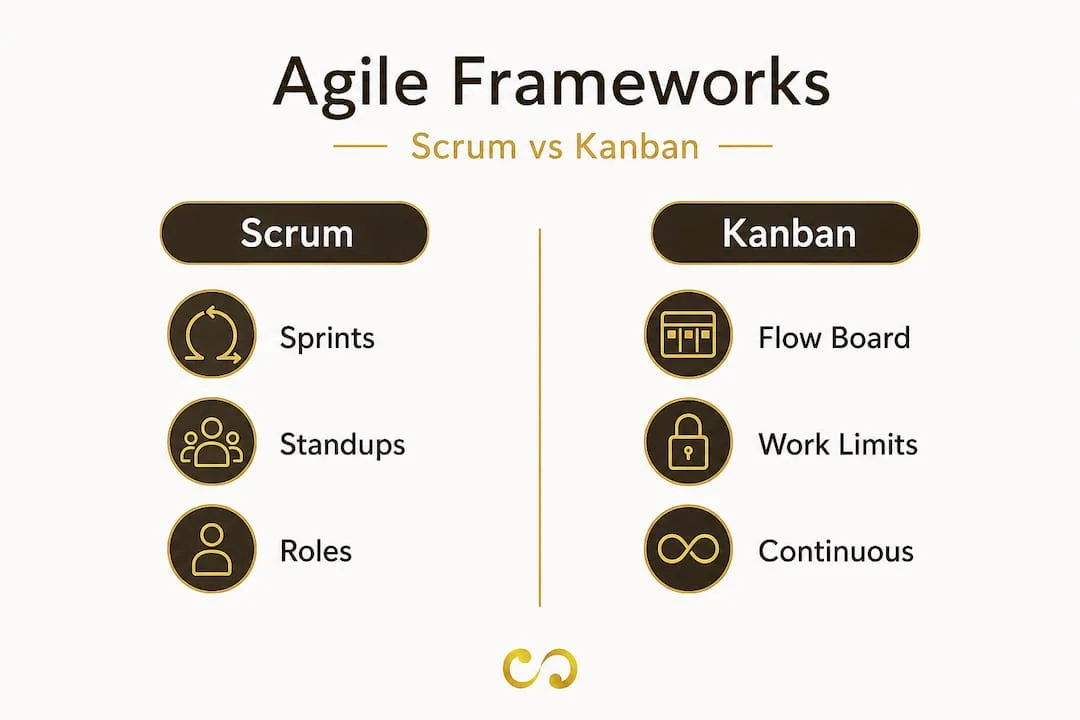
Here is how each one works and when to use it:
| Framework | Structure | Best for | Watch out for |
|---|---|---|---|
| Scrum | Sprints (one to four weeks), daily stand-ups, sprint reviews | Campaign launches, content calendars, structured teamwork | Can feel rigid for fast-reacting teams |
| Kanban | Visual board, continuous flow, WIP limits | Always-on content, social media, support tasks | No timeboxing can lead to scope creep |
| Lean | Remove waste, maximise value | Process improvement, budget efficiency | Needs clear sight of your process first |
Scrum is the most structured. It has defined roles (a Scrum Master who clears blockers, a Product Owner who prioritises the backlog, and the team itself), regular sprint planning, daily 15-minute stand-ups and end-of-sprint retrospectives. If your team runs launches or content campaigns with clear deliverables, Scrum gives you accountability and rhythm.
Kanban is more fluid. Work items move across columns on a board (usually "To do", "In progress" and "Done"), and the key rule is limiting how much work is in progress at once. That prevents bottlenecks and makes overload visible straight away. Kanban suits teams handling continuous social publishing, SEO updates or email nurture sequences.
Lean marketing focuses on cutting anything that does not create value for the customer. It borrows from manufacturing and asks which steps in your process cost time or money without improving the customer's experience. Remove those and put the effort into work that matters.
Most experienced teams end up blending frameworks. You might run Scrum sprints for campaign development and a Kanban board for ongoing content. That lets you add structure where the work is complex and stay flexible where speed matters. As you work through essential digital marketing tactics, you will find the tactics themselves often point to the right framework.
One caveat: not all marketing work breaks neatly into sprints. Annual brand strategy, regulated communications or multi-month sponsorships may not suit sprint cycles because their dependencies are long or their deliverables are hard to test in small pieces. Recognising when a framework does not fit is a sign of agile maturity, not failure.
Key benefits of agile methodology in marketing
So what can you expect when you put agile into practice?

As Aha! points out, agile marketing "requires ongoing planning and adjustment rather than 'plan once and execute,' with frequent recalibration based on learning." That regular recalibration is where the advantage comes from.
What agile gives marketing teams:
- Faster time to market. Campaigns go live in weeks rather than months. A two-week sprint turns what used to take a quarter into a manageable, testable piece of work.
- Better adaptability. When a competitor moves or the news creates an opening, an agile team can redirect a sprint without wrecking the annual plan.
- More transparency. Shared boards and regular stand-ups end the "what is everyone working on?" question.
- Decisions based on data. Each sprint ends with a look at the numbers, which feed the next cycle instead of sitting in a quarterly report nobody reads until it is too late.
- Stronger collaboration. Cross-functional sprints break down the walls between design, copy, analytics and strategy. Everyone owns the outcome.
- Learning that builds up. Retrospectives (end-of-sprint reflection sessions) build shared knowledge, so the team gets sharper with every cycle.
Agile does not mean working without a plan. It means having a plan that can change when reality asks it to.
Automation in marketing adds to these benefits. Tools that handle email scheduling, social posting and lead scoring free up sprint time for strategic and creative work. Pairing an agile rhythm with marketing automation is one of the most useful moves an SME marketing team can make.
Pro tip: do not skip retrospectives. Teams often drop them when schedules get tight, but that is where improvement comes from. Even a 20-minute reflection each sprint adds up over six months in a way rigid teams cannot match.
One pitfall to avoid: agile does not mean no structure. Some teams read "flexibility" as permission to skip planning. That is not agile, it is chaos. Every sprint should start with a clear, prioritised backlog, defined goals and agreed success measures. The quality and design standards of your marketing materials matter just as much in an agile team as anywhere else.
How to implement agile marketing in your team
Here is how to move from theory to practice.
Agile marketing moves away from rigid long-term planning towards flexibility, frequent analysis of data, and a marketing roadmap that keeps the team pointed at meaningful work. That roadmap is your anchor. It keeps agile from drifting while still letting the tactical layer adapt.
Step-by-step implementation guide:
- Start with a pilot. Do not convert your whole marketing operation overnight. Pick one campaign or content stream, form a small cross-functional team of three to five people, and run two or three sprints. Learn before you scale.
- Set clear goals and measures up front. Each sprint needs a measurable objective. "Increase email open rate by 8% this sprint" is useful. "Improve email performance" is not. Specific goals make retrospectives meaningful.
- Build your backlog. A backlog is a prioritised list of all the tasks and ideas your team wants to tackle. Review and reorder it before every sprint so the team always works on the most valuable items.
- Set your cadence. Choose a sprint length (two weeks is a good starting point for most SME teams), schedule daily or twice-weekly stand-ups of 15 minutes, and block time for reviews and retrospectives.
- Choose your board. A physical whiteboard works. Digital agile tools work better for distributed teams. The board makes work visible and accountability natural.
- Review data at the end of every sprint. Bring campaign analytics, A/B test results and customer feedback into each review, and let them shape the next backlog.
- Iterate and scale. Once the pilot shows momentum, extend the model to other teams or projects. Write the process down so new people can pick it up quickly.
Pro tip: keep your marketing roadmap visible but loosely held. Review it monthly rather than quarterly. A roadmap that cannot flex is just another rigid annual plan under a new name.
Common mistakes include overloading sprints, skipping backlog prioritisation, and letting stand-ups turn into hour-long status meetings. Getting the digital marketing essentials right first means you are not layering process on top of a strategy that has not been defined. AI in digital marketing can also sharpen the analysis between sprints, giving you clearer signals about what to prioritise next.
Our take: why agile marketing succeeds, and when it doesn't
Here is the part most agile guides skip: the method is not the hard part. The culture is.
Teams can adopt all the right tools, run sprints, use Kanban boards and hold retrospectives, and still produce slow, political work that frustrates everyone. Usually that is because leadership will not let the team make real decisions. Agile without empowerment is just a set of meetings with new names.
For agile marketing to change how your team works, three things have to be true. Leadership must trust the team to make tactical decisions without sign-off at every turn. The team must be willing to experiment and accept that some sprints will miss. And everyone must stay focused on customer value rather than following the process for its own sake.
The practical steps in your digital marketing checklist matter far less than whether your team feels safe to test ideas, report honest results and change direction without blame.
Agile also has real limits. As Atlassian notes, when work cannot be broken into short, inspectable pieces because of long dependency chains or hard-to-test deliverables, teams may not see the expected benefits of a regular cadence. A regulated rebrand, a multi-party partnership launch or a full website overhaul may need a different management approach for some phases.
The best agile marketing teams treat agile as a mindset, not a rulebook. They use sprint thinking where it helps and switch approach when the work calls for it. Knowing when to apply the framework and when to adapt it is what separates teams that succeed with agile from those going through the motions.
Lasting agility comes from building feedback loops into how the team works. Every piece of data tells you something about your market. Teams that listen, learn and adjust each sprint build an advantage that rigid competitors find hard to copy.
Speed up your results with agile-ready marketing support
Agile marketing moves fast, and the creative work has to keep up. When your team is running sprints and launching campaigns at pace, every asset needs to be sharp, on-brand and ready to use without rework.
At LOOM Brand Designs, we build the creative and strategic foundation that helps agile marketing work. Whether you need a consistent branding package your team can apply across every sprint deliverable, or AI brand intelligence that gives you faster, clearer signals for your backlog, we can support your pace. Browse our branding portfolio to see how we help growing teams build brands that are strong and adaptable.
Frequently asked questions
What is the goal of agile marketing?
Agile marketing aims to deliver faster, more relevant marketing through adaptability, frequent feedback and continuous improvement. It puts data-informed decisions and frequent iterations ahead of rigid long-term planning.
Is agile marketing only for tech companies?
No. Agile marketing helps any team that needs to respond quickly to changing markets or customer needs, including agencies, retailers and small businesses. Speed and responsiveness matter in every sector.
How do agile teams handle long-term marketing goals?
They use a flexible marketing roadmap, reviewing data regularly and adjusting tactics as they learn. Long-term goals stay in view while the plan for reaching them adapts.
Which agile frameworks are used in marketing?
Scrum, Kanban and Lean are the most common, or a hybrid tailored to your team and the kind of marketing work you manage.
What's a common obstacle with agile marketing?
Teams struggle when marketing work cannot be broken into small, inspectable pieces, which makes quick wins within a sprint hard. Long dependency chains and hard-to-test deliverables are where sprint-based agile meets its limits.
The Hashtag Loom