

TL;DR:
- Design systems improve consistency, efficiency and brand recognition across all your materials.
- They make updates quicker, onboarding faster and assets reusable, which pays back over time.
- Making one work takes gradual building, team buy-in and ongoing maintenance.
Most small business owners assume design systems belong to Google, Airbnb and Amazon. That assumption costs them time and money. When Figma measured the value of design systems, designers given a relevant, up-to-date design system finished a task 34% faster than those without one. This guide explains what a design system is, how it works in plain business terms, and how to start one even if your team is two people with a shared Dropbox folder and a Canva account.
Key takeaways
| Point | Details |
|---|---|
| Faster work | Reusing ready-made components means teams spend far less time rebuilding the same things. |
| Consistent branding | A design system keeps your brand looking unified everywhere. |
| Easier updates | Centralised design changes save time and reduce mistakes. |
| Lasting return | The effort of building a system pays back through time saved and higher quality. |
What is a design system?
A design system is easier to start than many people assume. Here is what it actually is.
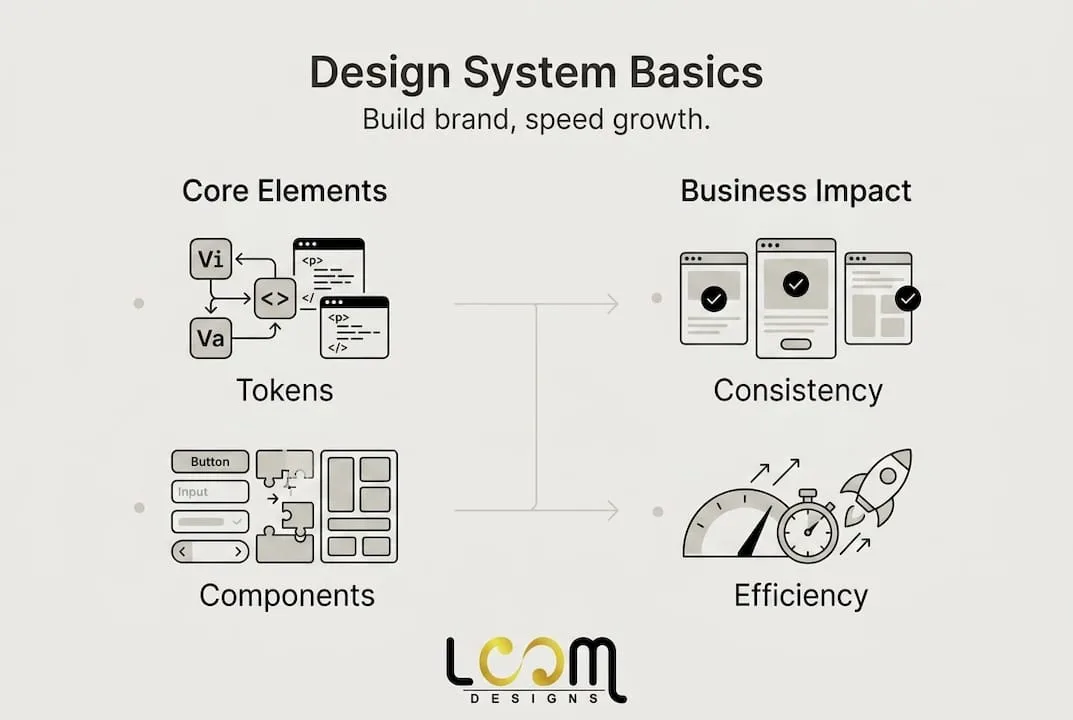
A design system is a shared collection of rules, reusable components and visual guidelines that governs how your brand looks and behaves at every touchpoint. Think of it as a style guide that does more. Instead of a static PDF nobody opens, a design system lives where your team works, and every piece connects to the others.
At its core, a design system has three layers:
- Design tokens: the smallest units of your brand, such as exact colour codes, font sizes, spacing values and shadow styles. These are the raw ingredients.
- Components: reusable building blocks made from tokens. A branded button, a card layout, a navigation bar. Build it once, use it everywhere.
- Guidelines: the written rules for when, where and how to use each element. These stop your team improvising in ways that dilute the brand.
The idea comes from atomic design, a method that builds from simple parts to complex ones. Atoms (a colour swatch) combine into molecules (a button), which combine into organisms (a navigation header), which combine into full pages. For small businesses, this layered thinking makes your visuals feel intentional rather than random.
Here is a simple breakdown of the core building blocks:
| Component | What it is | Business example |
|---|---|---|
| Design token | A single visual value | Your brand's primary blue: #0047AB |
| UI component | A reusable visual element | A styled "Contact Us" button |
| Pattern | A repeated layout or interaction | A consistent card grid for services |
| Guideline | A written rule | "Use bold headlines only for CTAs" |
Following a step-by-step brand process from the start makes these layers far less daunting.
The good news is that you can start small: define your tokens, build 5 to 10 core components, write basic guidelines and set up a shared library. That is version one. A single consistent button style used across your website, social ads and email newsletters already looks more polished and trustworthy than most small businesses manage. Pair that foundation with practical branding tips and you reinforce your identity at every customer touchpoint.
The main benefits of design systems for small businesses
Once you see the structure, it is clear why a design system multiplies brand clarity and team efficiency. The benefits show up in your bottom line, your team's morale and how customers see your brand.
Benefit 1: Consistency across all materials
As Built In notes, design systems enable consistency across products while improving productivity and cutting maintenance. When every email, social post, landing page and brochure follows the same rules, customers recognise you faster. Recognition builds trust, and trust drives conversions. That chain starts with consistency, and brand consistency is something your design system enforces for you.

Benefit 2: One change updates everything
Say you decide to refresh your primary brand colour. Without a design system, that means hunting through dozens of files, templates and web pages. With one, you update a single token and the change flows everywhere. For a small team, that is a big saving.
Benefit 3: Faster onboarding
When a new designer, marketing coordinator or web developer joins, your design system is their training manual. They do not have to guess heading sizes or ask which shade of green is "your" green. Everything is documented, accessible and ready to use.
Benefit 4: Reuse frees up creative energy
When your team is not rebuilding the same button for the seventh time or resizing a logo from scratch again, they can spend that energy on strategy, messaging and ideas that move the business forward.
Adoption is already widespread. Forrester reports that two-thirds of organisations tell it they use a design system, and it expects that share to grow. Businesses that skip this step are falling behind on efficiency and brand quality.
Applying these benefits to cross-platform branding is where the compounding effect begins. Your social ads, website, print flyer and emails all start to look as if they came from the same confident brand.
Pro Tip: Schedule a quarterly design system review. Block 30 minutes every three months to check components still reflect your brand, remove outdated assets and add the ones your team has been using informally.
The return and real-world impact of design systems
Consistency and efficiency matter, but so does the payback. A design system's return is not a one-off. It compounds. Every time someone reuses a component instead of building it fresh, that is time saved. Every time the system catches an inconsistency before it ships, that is a revision avoided. Every time a new hire gets up to speed in days rather than weeks, that is payroll protected.
Here is an illustrative before-and-after for a single landing page:
- Before: your marketing team spends 6 hours designing a campaign landing page from scratch because there is no template. The developer takes another 4 hours to build it. Total: 10 hours.
- After: with a design system, the designer assembles the page from existing components in 2 hours, and the developer applies pre-built code patterns in 1.5 hours. Total: 3.5 hours.
- The maths: across 20 campaigns a year, savings on that scale add up to well over a hundred hours.
- Fewer errors: standardised components mean fewer design inconsistencies and coding mistakes, so less time in revision cycles.
- Happier clients: when deliverables look polished and consistent from day one, clients and customers see higher quality and professionalism, which supports premium pricing.
The initial effort pays back through reuse, fewer mistakes and faster onboarding, and the returns grow as your team and projects scale.
If you are investing in graphic design marketing materials, a design system stops that money going on one-off assets that cannot be repurposed. Every designed piece becomes a reusable part of your brand.
Onboarding is where the return is easy to overlook but deeply felt. With documented components and clear guidelines, a new team member can produce on-brand work within days. Without them, the learning curve stretches into weeks of corrections.
As your business grows, a design system lets you scale your processes without rebuilding every workflow from scratch. It is the difference between laying train tracks once and laying them fresh every time you want to go somewhere new.
Common pitfalls and how to avoid them
Not every design system succeeds, and the reasons are predictable. Knowing them in advance puts you well ahead.
- Pitfall 1: Building too much too soon. Many businesses try to document every possible scenario on day one. The result is an overwhelming system nobody uses. Start with your 5 to 10 most-used components and build from there.
- Pitfall 2: No team buy-in. A design system nobody uses is just a folder gathering digital dust. If your team does not understand why it exists or how it helps them, they will ignore it.
- Pitfall 3: No maintenance plan. Design systems are not set-and-forget tools. Brands evolve and platforms change. Without a process for updates, the system drifts out of step with reality and causes confusion instead of clarity.
- Pitfall 4: No owner. Every effective design system needs a named person, the system owner, responsible for updates, governance and communication. Without one, nobody feels accountable.
Poor maintenance and low adoption are the usual reasons design systems fail, so governance is your most important investment. That simply means deciding who updates the system, when reviews happen and how changes are communicated.
AI design tools make this more pressing. When team members start generating assets with AI, a well-maintained design system is the filter that keeps that output on brand. Without it, AI-generated content drifts in all directions and your identity fragments.
If you use a design system to govern your marketing materials, this governance layer keeps every asset, human or AI-made, aligned with your brand standards.
Pro Tip: Give every new team member a 15-minute walkthrough of your design system on day one. Frame it as "this is how we stay professional" rather than "these are the rules". That framing drives adoption far better than a policy document.
A fresh take: why design systems are your quiet growth engine
Most design system content targets enterprise companies with 50-person design teams. The examples feature Salesforce and Shopify. The complexity runs to thousands of components. Small business owners come away thinking, "That's not for me."
That is backwards. Small businesses gain more from design systems, not less. A 10-person company where the owner also approves the marketing cannot afford inconsistency. There is no army of brand managers to catch rogue fonts and off-colour logos. The design system becomes your quality control department, running quietly in the background.
A single source of truth matters even more now that AI tools are part of the design workflow. When anyone can generate a dozen logo variations in two minutes, the risk of brand drift multiplies. A strong design system is the most reliable defence.
The biggest win we see for small brands is the ability to pivot fast. When your market shifts, a design system lets you refresh colours, tone or visual style without rebuilding the brand from zero. Update the tokens, swap a few components, and your whole brand presence changes in step. That kind of agility is usually reserved for companies with full-time creative directors.
Governance is not bureaucratic overhead. It is insurance. A 30-minute quarterly review protects months of design work from quietly slipping into inconsistency.
Build your brand on a design system
Ready to bring a design system to your own branding and marketing? LOOM Brand Designs can help you move from concept to a working brand identity system.
Our Branding Starter Package gives small businesses the brand foundations they need, from colour palettes and typography to logo systems that scale. If you need a digital presence that brings your design system to life, our Website Design & Development service builds sites on consistent, component-driven design. And if you need ongoing visual assets, our Graphic Design Services keep every deliverable on brand. Let's build your system together.
Frequently asked questions
What's the fastest way for a small business to start a design system?
Document your colours, fonts and 5 to 10 basic components, then set up a simple shared library every team member can reach. Keep it minimal at first and grow it as your needs change.
How do design systems save money?
They cut design and development costs by making updates simple and reducing repeated work. Figma's own experiment found designers with a relevant design system finished a task 34% faster. Fewer revision cycles and faster production make your budget go further on every project.
What is the biggest risk when adopting a design system?
Poor maintenance and low adoption. Regular updates, clear ownership and simple governance keep the system useful over time.
Do most businesses actually use design systems?
Many do. Forrester says two-thirds of organisations it hears from use a design system, and it expects adoption to keep rising as teams see the efficiency and brand quality benefits.
The Hashtag Loom