

A lot of founders think brand storytelling means telling stories about the business: the origin anecdote, the company history, the odd customer win. Those help, but on their own they rarely build a brand. Storytelling works best as a framework that ties your brand identity to how customers engage with you and, in the end, to how the business performs. This guide shows how to use it to set your brand apart, build an emotional connection and get results you can measure.
Key takeaways
| Point | Details |
|---|---|
| Strategic and tactical storytelling | Storytelling is a framework that lines up brand identity with customer engagement and measurable results. |
| Positioning links identity and performance | A clear strategic narrative guides individual messages so they build recognition and trust across channels. |
| Hero's Journey adaptation | Founders can shape the framework for both B2C and B2B audiences. |
| Test stories with experiments | Surveys and A/B tests show which stories work before you spend on them. |
| Small business storytelling | Story-led branding helps small firms build genuine connections that set them apart in crowded markets. |
Understanding storytelling's strategic and tactical roles in branding
Brand storytelling works on two levels that connect to each other. The strategic level treats your brand as an overarching story that shapes your messaging, visual identity and customer experience. It defines who you are, what you stand for and why anyone should care. The tactical level is the individual stories you tell: about products, customer successes, values or the journey of the business, delivered through specific campaigns and content.
Positioning is what joins the two. Your strategic story gives every tactical story a frame, so the messages stay coherent across channels and touchpoints. If your strategic story casts you as the practical problem solver for overwhelmed founders, your tactical stories might show specific client turnarounds, product improvements or how you work through a problem behind the scenes.
The linked research on storytelling in SMEs makes the same split: the brand as a story, and stories about the brand, with positioning carrying brand identity through to performance. Knowing the difference helps you avoid a common mistake, which is producing marketing stories that have nothing to do with each other and so never add up to brand equity. When each tactical story expresses the strategic one, recognition, trust and loyalty build over time.
How the two levels differ in practice:
- Strategic storytelling sets the core narrative, values and positioning, and stays steady for years
- Tactical storytelling covers campaigns, social posts and marketing messages that express that narrative in timely ways
- Strategic elements include your brand archetype, origin story, mission and value proposition
- Tactical elements include testimonials, launch stories, seasonal campaigns and content marketing
Small businesses that get both levels right have an advantage. The strategic story gives customers something genuine to connect with, and tactical flexibility lets you respond to the market without losing coherence. That matters most when budgets are tight and every pound of marketing spend has to work. Aligning everything to one strategic story also builds brand positioning that competitors find hard to copy.
Adapting classic story frameworks to small business branding
The Hero's Journey is a well-tested template for brand stories. Identified by the mythologist Joseph Campbell, it describes a pattern in which a hero faces a challenge, is changed by the trials along the way and returns with something of value. For branding, the trick is to make your customer the hero and your brand the guide who helps them succeed.
This works because it mirrors what customers actually go through when they face a business problem or a personal need. Rather than putting your brand at the centre, you recognise the customer's struggle and present your product or service as the tool that helps them change. That builds trust and avoids the self-promotional tone that puts people off.
Here is the adapted structure:
- Ordinary world: the customer's situation before they find you, including the frustrations they have come to accept
- Call to adventure: the opportunity or problem that pushes them to look for change, such as a growth goal or competitive pressure
- Meeting the mentor: your brand appears as the guide who understands the challenge and has a way through it
- Crossing the threshold: the moment they commit to working with you or using your solution
- Tests and trials: the bumps in implementation, and how you support them through each one
- Transformation: the concrete results and growth they achieve with your help
- Return with wisdom: they become advocates who share their success with others
The framework plays out differently in B2C and B2B. Consumer brands tend to lean on emotional change and lifestyle benefits, while B2B stories focus on business outcomes, lower risk and return on investment. Both work better when they remember the person in the story, whether that is a founder chasing growth or a shopper pursuing a personal goal.

Pro tip: test individual story elements with your audience through A/B tests or short surveys before rolling out the full narrative. It is far cheaper than discovering a mismatch after launch.
Story frameworks work well alongside brand archetypes. A Sage brand might tell its Hero's Journey as knowledge passed on and wisdom gained. A Rebel brand would frame it as breaking conventions and challenging the way things are done. Matching the two keeps your tactical stories consistent with your strategic identity.
Mapping the customer journey next to your brand story adds more chances to connect. Each stage of the buying decision can carry story elements that answer a particular worry, build trust and move people closer to buying, while the overall narrative holds together.
Practical approaches to testing and refining brand stories
Untested stories are a real risk for small businesses on limited budgets. A story that does not land wastes money, and one that clashes with customer values can damage how the brand is seen. Testing turns a decent story into a strong one.
There are several practical ways to check a story before full rollout. A/B tests compare versions across emails, landing pages or social ads to see which gets the better response. Customer surveys gather feedback on clarity and emotional pull. Focus groups go deeper into how people read your narrative and which parts connect.
Each method has its strengths and limits:
| Testing method | Best for | Typical cost | Time required | Key limitation |
|---|---|---|---|---|
| A/B testing | Measuring story performance on specific metrics | Low to moderate | 2 to 4 weeks | Needs enough traffic for statistically meaningful results |
| Online surveys | Broad feedback on story elements | Low | 1 to 2 weeks | Answer quality depends on question design and incentives |
| Focus groups | Deep insight into how stories are interpreted | Moderate to high | 2 to 3 weeks | Small samples are hard to generalise from |
| Social listening | Organic reactions to story themes | Low | Ongoing | Indirect feedback needs interpreting |
| Analytics review | Engagement with story-led content | Very low | Ongoing | Shows behaviour but not the reasons behind it |
Pro tip: AI-powered brand intelligence tools can analyse customer sentiment, show which story themes resonate and highlight gaps between the story you intend and the one your audience hears, across several channels at once.
Reading feedback means looking past first reactions for patterns. If customers keep misreading a story element, the problem is usually clarity, not your audience. If the emotional response is flat, ask whether the story genuinely reflects your values or leans on generic appeals. Strong negative reactions to one part of a story point to a clash with customer expectations, and that needs fixing quickly.
Then iterate. Make small changes to the weak parts rather than rewriting the whole narrative, and test the new version against the original. Note what works and why, so future stories start from what you have learned. Done steadily, this compounds.
Analytics tools now show more than whether people engaged with a story. They show how people move through it, where they drop off and which elements line up with conversions. Founders who use that detail can make their storytelling sharper and easier to measure.
Using storytelling to stand out and connect emotionally
Good storytelling turns casual buyers into loyal advocates. The connection comes from honest narratives that reflect shared values, acknowledge customer challenges and show you understand what they are aiming for. Because storytelling carries brand identity through positioning to performance, it matters even more for small and medium businesses up against larger rivals with bigger advertising budgets.
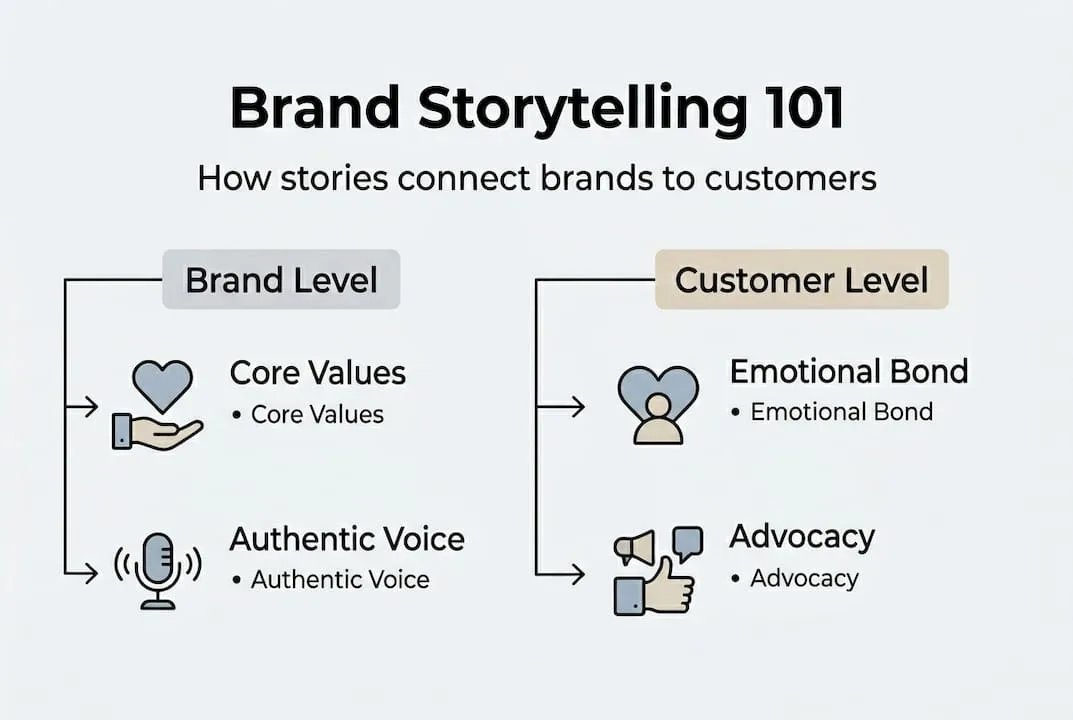
Emotional connection underpins loyalty because buying decisions are rarely just a comparison of features. When your story resonates, customers feel understood and aligned with what you are trying to do. That makes them more likely to come back, to forgive the odd mistake and to recommend you to people with the same problem.
The difference between story-led and feature-led branding looks like this:
| Branding approach | Customer engagement | Brand recall | Loyalty and retention | Differentiation | Emotional connection |
|---|---|---|---|---|---|
| Storytelling-driven | Active interaction with content, social sharing, community participation | Strong recognition through memorable narratives and consistent themes | Repeat purchases, referrals, advocacy | Clear positioning through a distinct narrative identity | Deep bonds based on shared values and honest communication |
| Non-story-driven | Passive consumption, transactional interactions, little engagement | Weak recall based mainly on visuals or product features | Price-sensitive, easy switching to competitors | Commodity positioning exposed to feature comparison | Little emotional investment, purely functional relationships |
What small businesses gain from strategic storytelling:
- More trust, because the narrative shows real expertise, values and commitment to customers
- Experiences people remember and recommend
- Relationships built on connection rather than one-off transactions
- A distinct position even in crowded markets
- Higher perceived value, which supports premium pricing
Storytelling sets a brand apart at a fundamental level. Instead of competing only on features, price or convenience, you lead with your perspective, values and way of solving problems. Competitors cannot easily copy that, because a genuine story comes from your own identity and experience.
Take a local coffee roaster that talks about its direct relationships with farmers, how it sources responsibly and the craft of turning raw beans into great coffee. Those stories separate it from commodity brands and connect with customers who care about craft, sustainability and honest relationships. They give people a reason to care beyond the caffeine, and that loyalty holds up when a cheaper option appears.
Your branding strategy should carry the story through every touchpoint, from first discovery to after the sale. Consistency reinforces the narrative and gives customers more chances to connect. Visual storytelling through graphic design adds to it with imagery that supports and extends what your words say.
Strengthen your brand storytelling with expert design
A strong brand story needs more than words. It needs a visual identity, clear positioning and consistent execution across every touchpoint. LOOM Brand Designs helps founders turn storytelling ideas into brand assets that support engagement and growth.
Our Basic Branding Package covers the foundations for telling your story visually, including logo design, colour palettes and typography that reflect your narrative. For businesses that want deeper insight, our AI Brand Intelligence Enterprise service analyses customer sentiment, tests story themes and finds where your narrative could be sharper based on real market data. Our graphic design services produce story-led marketing materials that keep your identity consistent across digital and print.
What working with us gives you:
- Strategic guidance that lines your story up with business goals and audience values
- Professional design that brings the narrative to life through a cohesive visual identity
- Data that shows whether your story is working and where to improve it
- Consistent brand expression across every channel and touchpoint
Explore our branding packages to see how we can help your brand tell its story and build lasting customer relationships.
Frequently asked questions
What is the difference between strategic and tactical storytelling in branding?
Strategic storytelling is your brand's overarching narrative, shaping identity, values and positioning consistently over time. Tactical storytelling is the specific stories about products, customers or campaigns that express that narrative in timely ways. The strategic layer is the foundation and the tactical layer is the flexible, day-to-day execution.
How can small businesses adapt the Hero's Journey for their brand story?
Simplify the stages so they focus on the customer's challenge, with your brand as the guide rather than the hero. The customer is the protagonist facing obstacles, and your business provides the tools, expertise and support for their transformation. Test the narrative with your audience through surveys or A/B tests before rolling it out across channels.
What are effective methods to test brand storytelling?
A/B testing compares story versions across emails, landing pages or ads. Customer surveys collect feedback on clarity, emotional impact and fit with values. Focus groups explore how people interpret the narrative in more depth. Analytics and social listening show engagement patterns and sentiment around story-led content.
Why does storytelling create stronger customer loyalty than feature-based marketing?
Storytelling builds an emotional connection by acknowledging customer challenges, reflecting shared values and showing real understanding of what people want. That investment goes beyond comparing features, so customers are more likely to come back, forgive occasional problems and recommend you. It turns transactions into relationships.
How does storytelling help small businesses compete against larger competitors?
A genuine narrative shows the perspective, values and customer commitment that separate a small business from a corporate rival. Story-led positioning creates space based on identity rather than features or price alone, and it highlights strengths such as personal service, local knowledge or a clear mission that customers value.
The Hashtag Loom