
TL;DR:
- Logos are working tools for brand recognition, trust and scalability.
- Simple, strategic logos are usually the more effective and versatile choice for small businesses.
- Professional design and testing with your audience give better long-term results.
Your logo is often the first thing a potential customer sees, and research in the Journal of Brand Management shows that logos are among the brand elements most likely to be linked uniquely to one brand, and that marketers' gut feel about which elements work is often wrong. Yet many small business owners treat logo design as a box to tick. They pick a template, choose a font and move on, and end up with a forgettable mark that blends into a crowded market. This guide explains what logo design really means, why it matters to your bottom line, and how to make good decisions whether you are starting from scratch or refreshing an existing identity.
Key takeaways
| Point | Details |
|---|---|
| Logos build trust | A professional logo makes your business look credible and helps customers remember you. |
| Simplicity is powerful | Simple logos are easier to recognise and scale, but do not lose what makes your brand distinctive. |
| Test for effectiveness | A/B testing your logo checks that it connects with your intended audience. |
| Invest in quality design | Treating your logo as an investment pays off in recognition and engagement. |
Defining logo design: more than a symbol
Logo design is the process of creating a visual mark that represents your business at a glance. Calling it "just a symbol" misses the point. A well-made logo communicates your values, personality and promise before anyone reads a word. Think of McDonald's golden arches or Apple's apple silhouette. Neither needs a name beside it to be recognised around the world. That is what intentional logo design can do.
For small business owners, a logo does several practical jobs:
- Brand recognition: a consistent logo makes your business instantly identifiable everywhere, from your website to your packaging.
- Trust and credibility: a polished logo signals that you are serious, established and worth doing business with.
- Scalability: a good logo works at any size, from a billboard to a business card.
- Versatility: it works on digital platforms, print, signage and merchandise without losing clarity.
Here is what people often overlook: logo design is about function, not prettiness. A logo that looks stunning in a design file but falls apart in black and white, or becomes unreadable at small sizes, has failed however good it looks on screen.
A logo is the face of your brand. Its job is to communicate, not to decorate.
The logo's role in brand success goes beyond looks. Perception drives buying behaviour. When your logo looks professional and consistent, customers tend to assign more value to what you sell. When it looks generic or inconsistent, trust slips before you have had a conversation. For a new business, that first impression may be the only chance you get.
Why logo design matters for entrepreneurs
A logo is not a nice-to-have. It is a core business asset that affects how customers find you, remember you and choose you over a competitor.
When a business refreshes its logo with intention and strategy, it should measure the effect. Here is what to track before and after a refresh:
| Metric | How to measure it |
|---|---|
| Brand recall among your target audience | A short survey asking people to name or describe your brand from memory |
| Social media engagement rate | Platform analytics, compared over the same period before and after |
| Customer trust | Survey-based trust or credibility ratings from customers and prospects |
| Website click-through rate | Analytics on key pages and ads that show the logo |
The pattern to look for is simple: when a logo is redesigned with audience research and a clear purpose, the clarity and professionalism it signals should show up in these numbers. The logo does not create results by itself. What it signals does.
One of the most underused tools for small business owners is A/B testing a logo. It gives you real data instead of gut feeling. You can test two versions with your actual audience using social media polls, email surveys or split-tested ads. The version that earns more clicks, saves or positive responses wins.
Understanding how design affects engagement matters as you build your digital presence. A logo that does not work as a social thumbnail or app icon will cost you visibility, and for a small business visibility is everything.
Neglecting your logo has a hidden cost. A generic or inconsistent logo makes every stage of marketing harder. You spend more on ads because your brand is not memorable, and you lose customers to competitors who simply look more established. Use the branding checklist for small businesses to check where your current logo may be holding you back.
Pro tip: do not wait until you can afford a "perfect" logo. A strategically designed logo at launch will pay back far sooner than a placeholder you plan to fix later.
Simple vs complex logos: finding the right fit
This question trips up more entrepreneurs than any other. Should your logo be clean and minimal, or detailed and intricate? The honest answer is that it depends on your brand, your audience and your goals.
Simple marks are generally easier to recognise, but complexity has its place. A 2025 study in Frontiers in Communication found that more complex logos can strengthen perceptions of luxury, especially for newer and lesser-known brands. That is not a contradiction. It is a reminder that logo design is strategic, not one-size-fits-all.
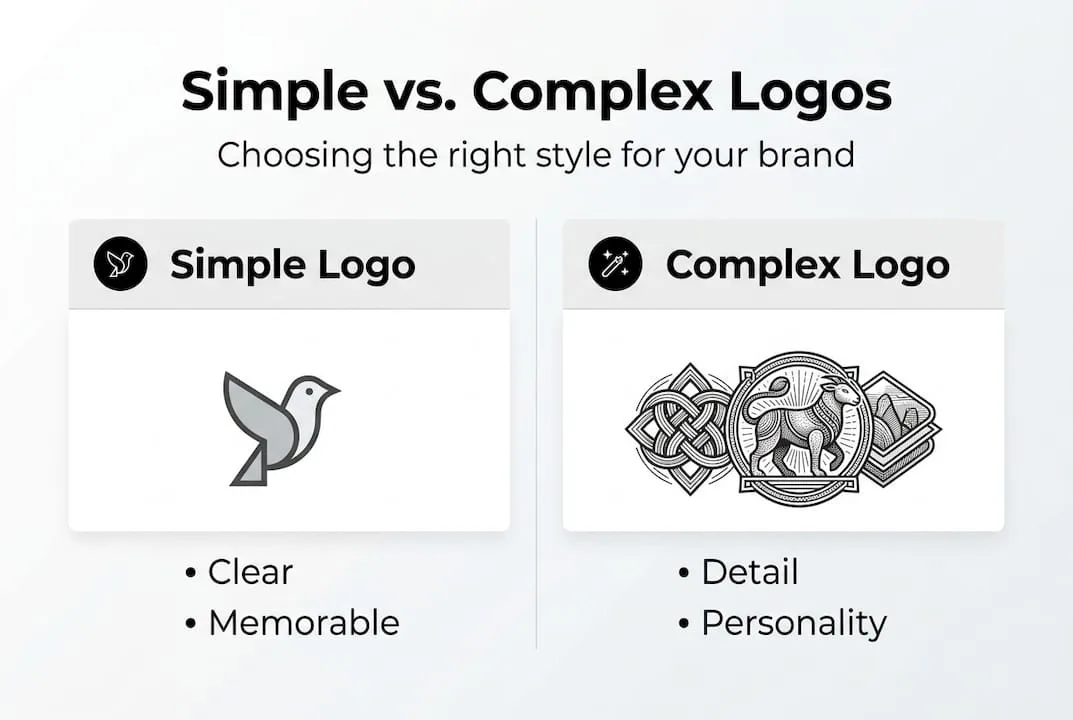
A practical comparison:
| Logo style | Best for | Strengths | Weaknesses |
|---|---|---|---|
| Simple/minimal | Most small businesses, apps, retail | Easy to recognise, scales well, versatile | Can feel generic without strong colour and typography |
| Complex/detailed | Luxury, artisan and heritage brands | Communicates craftsmanship, uniqueness, prestige | Hard to scale, loses detail at small sizes |
For most entrepreneurs, a simple logo is the smarter starting point:
- Simple logos are easier to remember after one sighting.
- They reproduce cleanly everywhere, from embroidery to digital icons.
- They cost less to update as your brand evolves.
- They tend to feel modern and approachable to a broad audience.
If you are launching a premium product line, a boutique service or a brand that needs to signal heritage and craftsmanship, a more detailed logo can be a deliberate and effective choice. The key is intention. Do not add complexity because it looks impressive. Add it because your audience expects it and your brand story calls for it.
Exploring branding strategies for small businesses will help you decide which direction fits your positioning. To see how visual identity decisions connect to your wider brand, the visual branding process guide walks through each step.
How to get a logo design that works for your business
Knowing what makes a good logo is one thing. Getting one is another. Here is a clear process, whether you work with a designer or explore options yourself.
- Define your brand foundation first. Before anyone opens a design tool, be clear on your target audience, core values and competitive position. A logo without that context is just decoration.
- Gather visual inspiration. Collect logos, colour palettes and styles that suit your brand. This gives designers a starting point and helps you say what you want.
- Brief your designer clearly. Share your audience, brand personality, industry and any logos you admire or want to avoid. Vague briefs produce vague results.
- Ask for several concepts. A good designer will show more than one direction. Judge each against your brand goals, not just your personal taste.
- Test with your real audience. Show the shortlist to customers or people in your target market. Ask which feels most trustworthy, memorable and relevant.
- Refine based on feedback. Let the testing guide revisions. Over-simplifying can strip out distinctiveness, so check recall before you finalise a pared-back design.
- Check scalability and versatility. Look at the final logo at several sizes, in colour and in black and white, and on different backgrounds before signing off.
Pro tip: your logo is one part of a complete brand identity. Build it alongside your colour palette, typography and brand voice so everything works together. A logo designed in isolation rarely performs as well as one that belongs to a system. Read more about building a branding strategy in 2026 and use this branding guide for small business owners to connect the pieces.
Why most small business logos miss the mark, and how to do better
Working with entrepreneurs, we see the same pattern again and again: most small business logos fail because of the process, not the design. The owner picked something they personally liked, skipped audience testing and called it done. Then they wonder why the brand is not gaining traction.
The uncomfortable truth is that your logo is not for you. It is for your customer. The moment you design for your own taste rather than your audience's expectations, you have lost the plot.
Another common mistake is chasing design trends. Trendy logos feel fresh briefly and then look dated for years. Long-term recognisability is worth far more than short-term novelty. The most enduring logos, such as FedEx, Nike and IBM, chose clarity and distinctiveness over whatever was fashionable at the time.
Entrepreneurs also treat logo design as a one-off expense rather than an ongoing investment. Your logo will need to evolve as your business grows. Building brand consistency from the start makes future updates less disruptive and more effective. Design for longevity, test with your real audience, and make every revision a decision based on evidence rather than preference.
Ready to grow your business with a professional logo?
Putting these principles into practice is easier with an experienced team behind you. At LOOM Brand Designs, we create logos and brand identities built for real business results, not just visual appeal.
Whether you are launching a new business or refreshing an existing brand, our graphic design services give you a mark that works on every platform and for every audience. If you are ready to invest in a brand identity that performs, explore our basic branding package and take the first step towards a logo your customers will remember.
Frequently asked questions
What exactly does logo design involve?
Logo design is the process of creating a distinctive visual symbol that represents your business and communicates its values. Your logo becomes the face of your brand at every customer touchpoint.
Is a simple logo always the best choice for my business?
Simple logos suit most brands because they are easier to recognise and scale, but more complexity can work if you are targeting a luxury or artisan market. Always test your logo with your real audience before finalising it.
How does a logo affect my business success?
A memorable logo builds trust and recall, and that recognition supports loyalty and sales. Its value goes well beyond how it looks.
Can I design my own logo or do I need a professional?
You can design your own logo with online tools, but a professional designer makes sure it is distinctive, scalable and aligned with your brand strategy. For most entrepreneurs, a professionally designed logo is worth more than it costs.
The Hashtag Loom