

Rebranding is often mistaken for updating a logo or changing a colour scheme. In reality it is a strategic process that can reshape your whole corporate identity: messaging, positioning, visual elements and how customers see you. For business owners and marketers, understanding what rebranding really involves opens up real growth opportunities. This guide covers the strategic side of rebranding, when and why businesses do it, and practical frameworks for running a rebrand that delivers measurable results.
Key takeaways
| Point | Details |
|---|---|
| A full strategy | Rebranding reshapes messaging, positioning, visuals and customer perception across the organisation. |
| Proactive vs. reactive | Proactive rebrands plan for growth and competitiveness. Reactive rebrands respond to mergers, crises or market disruption. |
| Audit and rollout | Successful rebrands rely on upfront research, alignment across teams and a coordinated rollout at every touchpoint. |
| Risks and rewards | Common risks include poor communication and disappointing returns, while well-run rebrands can lift revenue and retention. |
The strategic process of rebranding
Rebranding is the strategic process of changing a company's corporate image, including its name, logo, visual identity, messaging and positioning. A visual refresh changes how you look. A full rebrand changes how customers, employees and stakeholders see your business, and brings the brand in line with new business goals, market conditions and audience expectations.
A complete rebrand usually involves several connected components:
- A company name change that reflects a new direction or ownership
- A logo redesign and updated visual identity system
- Revised brand messaging, voice and tone guidelines
- Repositioning to reach new audiences or stand apart from competitors
- Updated mission, vision and values statements
- New customer experience touchpoints across all channels
The difference between a full rebrand and a brand refresh matters. A refresh updates visual elements like logos, colours and fonts while keeping the core identity and positioning. A full rebrand changes how your business presents itself and what it stands for. Many businesses refresh every few years, while full rebrands usually happen during major business transitions.
Research and planning are the foundation. Before making any visual changes, carry out market analysis, competitor research and customer surveys. Understanding the strengths and weaknesses of your brand identity helps you keep what works and fix what doesn't. This phase prevents costly mistakes and makes sure the rebrand lands with your target audience.
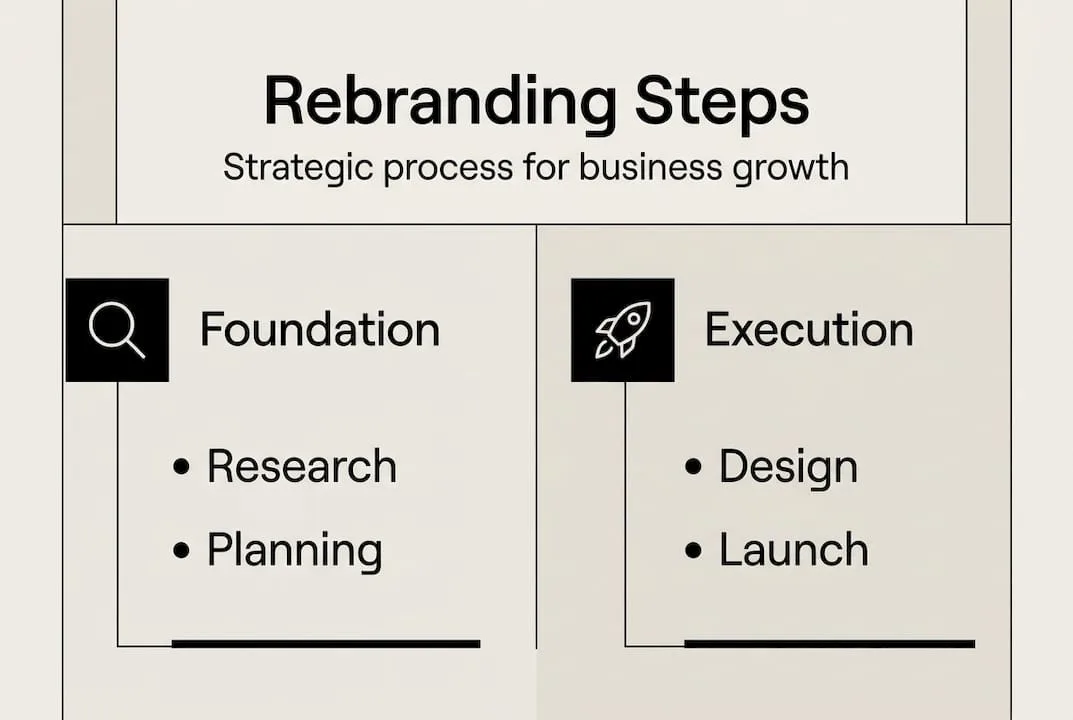
A rebrand needs every team on board. Marketing, sales, product, customer service and leadership must agree on objectives and messaging. When these teams work in silos, the result is an inconsistent experience that confuses customers and weakens brand equity. The best rebrands treat the work as an organisational change, not just a marketing project.
Types of rebrand, and why businesses do them
Rebrands are either proactive or reactive. Proactive rebranding positions a company for growth and competitive advantage before outside pressure forces change. Reactive rebranding responds to immediate challenges such as mergers, reputation crises or market disruption.
Proactive rebranding happens when a business chooses to evolve its identity. Companies moving into new markets, launching new products or repositioning against competitors often rebrand proactively. This approach leaves time for research, testing and a careful rollout, and it tends to go better because it is tied to planned business initiatives rather than a problem.

Reactive rebranding deals with urgent needs. Mergers and acquisitions often trigger rebrands to bring separate identities together under one brand. Reputation damage from scandals, product failures or bad publicity may mean distancing the business from past associations. New competitors or technology shifts can make an existing brand feel dated and force a rethink.
| Rebrand type | Trigger examples | Strategic focus | Typical timeline |
|---|---|---|---|
| Proactive full | Market expansion, new products, competitive differentiation | Growth and future positioning | 6 to 12 months |
| Reactive full | Merger, reputation crisis, obsolescence | Damage control and realignment | 3 to 6 months (accelerated) |
| Proactive refresh | Modernisation, changing audience | Visual updates and relevance | 3 to 4 months |
| Reactive refresh | Minor reputation issues, competitor pressure | Quick market response | 1 to 2 months |
The choice between a full rebrand and a refresh depends on your objectives and constraints. Full rebrands suit major strategic shifts, such as entering new markets or changing the business model. Refreshes work when brand equity is still strong but the visual identity feels dated. Many established companies use refreshes to stay current while protecting recognition built over decades.
Common business triggers for rebranding:
- Mergers and acquisitions that need a unified corporate identity
- Expansion into markets where the current branding doesn't resonate
- A shift in target audience that calls for new positioning and messaging
- Changes to products or services that outgrow the original brand
- Competitive pressure from brands with stronger, more modern identities
- Negative associations or reputation damage that call for a fresh start
Your specific motivation shapes every decision that follows. Different branding strategies suit different situations, so match the approach to the objective.
Key steps, challenges and best practice
The core stages are a brand audit, strategy, identity development, rollout and KPI monitoring. Working through them in order reduces risk and makes the outcome you want more likely. Each phase builds on the one before.
-
Run a brand audit and competitor analysis. Gauge current brand perception through customer surveys, employee interviews and market research. Look at competitor positioning to find room to differentiate. Document your existing assets, messaging and touchpoints so you know what needs to change.
-
Define objectives, audience, positioning and values. Set measurable goals such as growing market share, attracting new customer segments or improving brand perception scores. Build audience personas for the people you want to reach. Write down your value proposition and the core values that will guide every creative decision.
-
Develop the new identity: logo, messaging and style guidelines. Work with designers and copywriters on the visual and verbal identity. Test concepts with your target audience before finalising. Record everything in brand guidelines so it is applied consistently at every touchpoint.
-
Roll out internally first, with staff training. Employees are brand ambassadors and need to understand and accept the changes before customers see them. Train people on the new messaging, values and visual standards. Listen to concerns and use the feedback to refine the rollout.
-
Launch externally with a joined-up communication plan. Coordinate announcements across all channels at the same time so you control the story. Explain why you are changing and what it means for customers. Update physical and digital assets systematically to avoid confusion.
-
Track KPIs such as awareness, engagement and revenue. Measure the metrics you set during planning: brand awareness, customer sentiment, website traffic, lead generation and sales. Compare them with your pre-rebrand baseline.
The visual branding process needs particular care because visuals create the first impression. Professional design makes a rebrand look credible and polished rather than rushed.
Updating assets is usually the biggest practical challenge. Websites, social profiles, marketing materials, signage, packaging, uniforms, vehicles and countless other items all need changing. A detailed inventory and a phased rollout plan stop the work from overwhelming your team and budget.
Communicating the change is the other big challenge. Customers who love your current brand may resist. Clear, open communication about why you are rebranding and what stays the same helps keep their loyalty. Investors, partners and suppliers also need tailored messages explaining how the changes affect them.
Pro tip: tie the rebrand to real improvements in your product or culture. Brands that only change surface elements without fixing underlying problems usually struggle. Successful rebrands coincide with better operations, better service, improved products or genuine cultural change, which gives customers a real reason to look at the brand again.
Balance heritage with change. Identify the brand elements that drive loyalty and find ways to carry them into the new identity. Throwing out your heritage completely often backfires, while a thoughtful evolution keeps continuity.
Build the rebrand into your wider digital marketing plans for more impact. Time the launch alongside SEO work, content campaigns and paid advertising to make the most of the introduction period.
Evaluating a rebrand: success metrics and risks
A rebrand can pay off well or fall flat. Knowing what separates the two helps you avoid common pitfalls and set the project up to succeed.
Metrics that give an objective view of how the rebrand is doing:
- Return on investment (ROI), comparing rebrand costs with revenue gains attributed to the new brand
- Customer acquisition cost (CAC), showing how efficiently you win new customers after the rebrand
- Net promoter score (NPS), tracking satisfaction and likelihood to recommend
- Customer lifetime value (CLV), showing whether the rebrand attracts more valuable long-term customers
- Brand awareness and recall, from surveys and market research
- Website traffic, engagement and conversion rates, showing digital performance
- Sales revenue and market share growth, showing business impact
Set realistic timelines. Bynder's survey of marketers found that the average rebrand takes seven months from first discussions to rollout. Business results usually take longer to show as the market absorbs the change and perceptions shift, so don't judge a rebrand too early.
| Rebrand example | Industry | Outcome | What happened |
|---|---|---|---|
| Old Spice | Personal care | Success | Repositioned a dated brand for a younger audience and revived sales |
| Dunkin' | Food service | Success | Streamlined identity, broadened audience |
| Tropicana | Beverages | Failure | Packaging redesign confused shoppers, sales fell and the old design returned |
| Gap | Retail | Failure | New logo reverted after customer backlash |
Successful rebrands have a few things in common. They pair visual changes with real business improvements. They communicate clearly with stakeholders throughout. They keep valuable brand equity while updating what is genuinely dated. They invest in professional design and strategic planning rather than rushing to market.
Failed rebrands usually suffer from predictable problems:
- A gap between the brand promise and the actual customer experience
- Poor communication that leaves customers confused
- Ignoring brand heritage and alienating loyal customers
- Changing things that weren't broken while ignoring the real problems
- Too little research, leading to tone-deaf positioning
- Too little budget, forcing compromises in execution
Pro tip: judge the rebrand on business metrics, not vanity metrics like follower counts or website visits. Revenue growth, retention and profitability are the real measures of success. Beautiful design that doesn't move the business is wasted investment.
Good storytelling in branding helps customers understand and accept the change. Tell the story of how you have evolved, what you value and where you are going. Stories create emotional connections that visual changes alone can't.
Choosing between a full rebrand and a brand refresh needs an honest look at what actually needs fixing. If your positioning is still strong and only the visuals feel dated, a refresh saves resources and protects equity. If your business direction has changed fundamentally, a full rebrand serves you better in the long run.
Reduce risk through planning. Research thoroughly before committing to a direction. Test concepts with your audience. Write a detailed project plan with clear roles. Budget properly for professional execution. Plan for the things that might go wrong. This upfront work prevents expensive mistakes later.
How LOOM Brand Designs can support your rebrand
Changing your brand identity takes strategy, design and implementation working together. LOOM Brand Designs specialises in branding that lines up visual identity with business objectives. We guide you through each phase, from the first audit and strategy work to rollout and performance tracking.
Our Basic Branding Package gives businesses ready to refresh their market presence the essential support they need. We combine strategic positioning with professional design to create brand identities that resonate with your audience. Beyond core branding, our graphic design services keep the new identity consistent across your marketing materials, and our website design and development work brings the new brand to life online. Book a consultation to talk through how we can help you plan and deliver your rebrand.
What is rebranding? Frequently asked questions
What are the signs my business needs rebranding?
Common signs include falling sales despite good products, difficulty attracting your target audience, a visual identity that looks dated next to competitors, or major business changes such as a merger or a move into a new market. If customer perception no longer matches what you offer or what you stand for, a rebrand can bring the two back together.
How long does a typical rebrand take?
A full rebrand often takes six to nine months from planning to full implementation: roughly two to three months for research and strategy, two to three months for identity development and testing, and two to three months to roll out across every touchpoint. Rushed rebrands often fail, so give the process enough time.
Can a partial refresh be as effective as a full rebrand?
Yes, when your core positioning is still strong and only the visuals need updating. Refreshes cost less, take less time and protect existing brand equity while modernising your look. Full rebrands suit major strategic shifts, while refreshes suit businesses that simply need a more contemporary identity.
What are the main risks of rebranding?
The biggest risks are alienating loyal customers who identify with the current brand, spending money on changes that don't address real business problems, and causing confusion through poor communication. Weak execution due to a thin budget or missing expertise can damage credibility. Careful planning and professional support reduce these risks.
How do I measure if my rebrand was successful?
Compare revenue growth, customer acquisition costs, retention and market share before and after the rebrand. Track brand awareness and perception through surveys. Look at website traffic, engagement and conversion rates. A successful rebrand shows up in business outcomes over the following year or so, not just in better aesthetics or social media buzz.
The Hashtag Loom