

TL;DR:
- Email marketing gives SMBs direct, permission-based access to engaged customers, and Forbes Advisor puts its average return at about $36 for every $1 spent. Clear goals, segmentation, automation and list quality turn email into a dependable revenue channel. Relevance and relationships matter more than list size for deliverability, trust and long-term growth.
Email marketing has a reputation problem. Many small business owners assume it's outdated, overshadowed by social media and paid ads. Yet Forbes Advisor reports an average return of about $36 for every $1 spent on email marketing, which makes it one of the most cost-effective tools an SMB has. The real question isn't whether email marketing works. It's whether you're using it in a way that connects strategy to revenue. This guide covers why email delivers, the metrics that matter and the practical steps that turn a mailing list into a real growth channel.
Key takeaways
| Point | Details |
|---|---|
| Strong return | Email marketing offers a high return on investment for SMBs when it is run well. |
| Owned list advantage | Owning your audience means less reliance on algorithms and better long-term results. |
| Permission and relevance | Effective campaigns need recipient opt-in and carefully personalised, timely content. |
| Measure meaningful outcomes | Track success by leads and revenue, not just clicks or open rates. |
| Good habits drive growth | List hygiene, segmentation and automation keep email working over time. |
The real reason email marketing works for SMBs
Most SMBs treat email as an afterthought: a newsletter sent whenever there's something to say, or a promotional blast before a slow month. That barely scratches the surface. To see why email is so effective, look at what makes it structurally different from your other channels.
Unlike social media, email gives you a direct line to your customer. No algorithm decides whether your content reaches the right people, and no platform change can cut your reach overnight. When someone joins your list, they've invited you to talk to them. That's a very different relationship from a follower who scrolls past your posts.
As Martech.org points out, email platforms are increasingly the system of record for customer engagement, built on durable, permission-based relationships rather than rented reach.
That relationship is what our email marketing services are built around. Forbes Advisor's $36 figure is an average, and the businesses that get close to it measure email properly. When you start comparing digital channels across a typical SMB budget, email is often one of the cheapest ways to win and keep a customer.
Here's why email pulls ahead:
- Cost: The barrier to entry is low. Even premium email platforms cost a fraction of a paid ad budget and can reach thousands of customers per send.
- Control: You own your list. Social platforms can change their algorithms or suspend your account. Your email list belongs to you.
- Longevity: A well-kept list grows in value. Each new subscriber adds to an asset that gets stronger with every interaction.
- Relevance: Because people have opted in, your audience is pre-qualified. They've already shown interest, so you're not interrupting strangers.
- Trust: Opt-in subscribers are far more likely to open, click and buy than people reached through interruption advertising.
The businesses that get the most from email treat it as a strategic asset, not a tactical afterthought.
What makes email marketing measurable
Sending emails is easy. Knowing whether they drove revenue is where most SMBs fall short, and measurement is usually what separates businesses that see results from those that feel they're spinning their wheels.
Tying email engagement to business goals, rather than isolated metrics, is what separates campaigns that make money from campaigns that just get opened. Open rates tell you whether your subject line worked. Click rates tell you whether your content was compelling. Neither tells you whether you made money.
| Vanity metric | What it tells you | Business outcome metric | What it tells you |
|---|---|---|---|
| Open rate | Subject line effectiveness | Revenue per email | Direct sales impact |
| Click rate | Content engagement | Cost per acquisition | Marketing efficiency |
| List size | Audience volume | Customer lifetime value | Long-term growth potential |
| Unsubscribe rate | List health signal | Pipeline attributed | Sales contribution |
When you build your email programme around lifecycle-triggered automations tied to real customer behaviour, you stop chasing vanity numbers and connect email directly to your bottom line. Automation in marketing makes this manageable even for small teams.
Here's how to build a measurable email campaign:
- Define your revenue goal first. Are you converting leads, reactivating dormant customers or upselling existing buyers? Every campaign needs one clear objective tied to income.
- Set up tracking before you send. Add UTM parameters to every link so your analytics can trace conversions back to specific emails.
- Segment your list by behaviour. Send different messages to new subscribers, active customers and people who haven't opened in 90 days.
- Write a subject line that earns the open. Test two versions and track which one drives more purchases, not just more opens.
- Match your call to action to the goal. If the goal is a sale, the button should lead straight to the product. Remove friction at every step.
- Measure downstream, not just in the platform. Check your email platform for opens and clicks, then cross-reference your CRM or shop analytics to find the revenue each send brought in.
Pro tip: Set up a welcome sequence that starts the moment someone joins your list. People are most interested right after they sign up, so a prompt welcome series usually converts far better than a first message that arrives days or weeks later. It can lift revenue per subscriber without any extra ad spend.
Engagement metrics only show part of the picture. An email with a 45% open rate that drives no sales is underperforming. An email with a 15% open rate that turns 8% of readers into buyers is doing exactly what it should. Focus on what happens downstream.
Permission, personalisation and relevance: the keys to high-impact email
Here's something many business owners resist: a smaller, engaged list beats a large, indifferent one. The instinct to grow your list as fast as possible pushes many SMBs towards tactics that damage their results.

Permission-based email marketing builds trust, reduces spam complaints and improves deliverability. When recipients want to hear from you, inbox providers like Gmail and Outlook notice that positive signal and keep your emails out of the spam folder. When people mark your emails as spam because they never asked for them, deliverability suffers for everyone on your list, including the people who do want your emails.
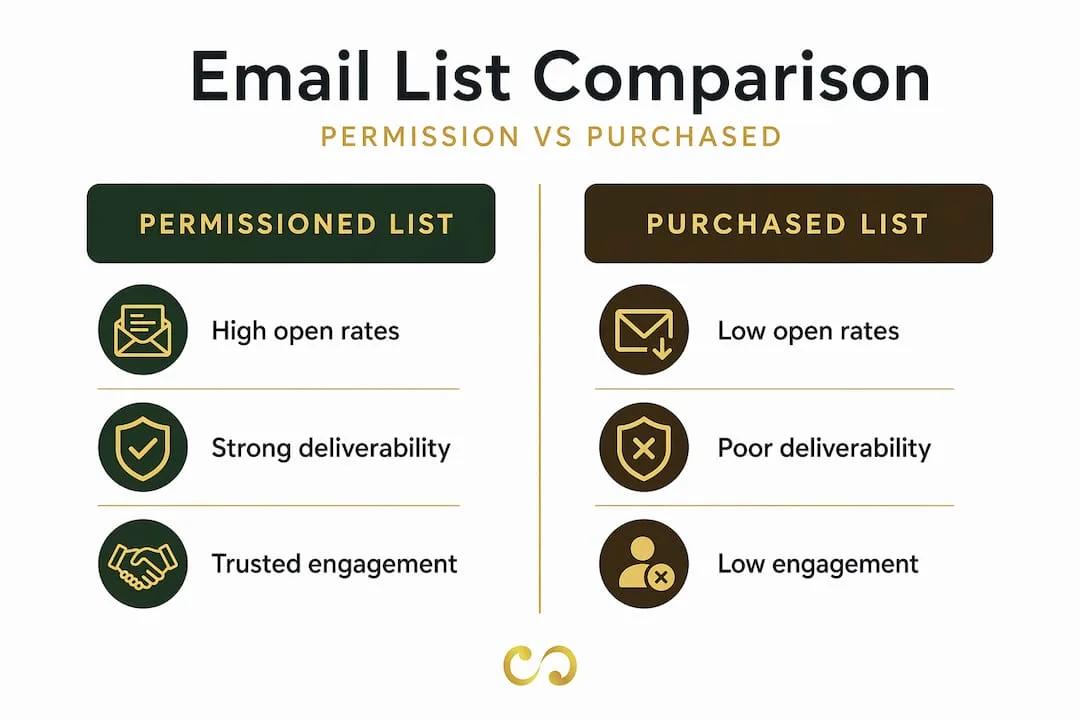
| Permissioned list | Purchased list |
|---|---|
| Healthy open rates | Very low open rates |
| Strong deliverability | High spam complaint risk |
| Lower unsubscribe rates | Mass unsubscribes common |
| Builds long-term trust | Damages sender reputation |
| Converts into loyal customers | Rarely converts |
Personalisation is powerful, but context matters more than most marketers admit. A birthday discount for a loyal customer feels thoughtful. Mentioning a product someone looked at once can feel invasive. Overreach or poor list quality will trigger unsubscribes faster than any subject line mistake.
Segments that work for SMBs:
- New subscribers: A welcome sequence that introduces your brand, sets expectations and gives early value before any sales pitch.
- Recent buyers: A post-purchase follow-up with product tips, a thank-you and a relevant upsell after 7 to 14 days.
- Inactive subscribers: A re-engagement campaign with a strong offer and a clear message that you'll remove them if they don't respond. This protects deliverability while giving cold contacts one last chance.
- High-value customers: An exclusive segment with early access, loyalty rewards or referral invitations. These contacts are worth more, so treat them that way.
- Location-based segments: Useful for businesses with a local presence or regional events.
For ongoing customer engagement, what works is sending the right message to the right person at the right moment in their journey with your brand. That's what relevance means in practice.
Pro tip: Always use double opt-in for new subscribers. It adds one extra step to sign-up, but it confirms each address is real and the person wants your emails. Your deliverability and engagement will be better for it.
Making email marketing work: habits for lasting results
Understanding the strategy is one thing. Building a system that works month after month is another. These steps pull everything above into a framework you can apply today.
- Set one clear revenue goal per email programme. Not "stay top of mind" or "increase engagement", but something specific, such as a target number of new service enquiries a month or a share of abandoned baskets recovered. Specific goals force intentional design.
- Build a permissioned list from day one. Use opt-in forms on your website, landing pages and checkout. Never import contacts who haven't explicitly agreed to receive your emails.
- Segment by real behaviour and context. Use the examples above as your starting point. Behaviour-based segments usually beat demographic-only targeting.
- Automate the high-value touchpoints. Welcome sequences, post-purchase follow-ups, re-engagement campaigns and abandoned basket emails should run automatically. These are the moments when buyer intent is highest and timing matters most.
- Keep up deliverability hygiene. Remove hard-bounced addresses straight away. Suppress inactive subscribers after 180 days. Authenticate your sending domain with SPF, DKIM and DMARC records. Deliverability isn't a one-off set-up; it's ongoing.
- Measure against downstream outcomes. Review pipeline and revenue attribution every quarter, not just the opens and clicks your email platform shows by default.
Email's value builds when you treat it as infrastructure rather than a one-off campaign tool. Each automation, each refined segment and each subscriber relationship adds to an asset that keeps paying back long after you've moved on.
Pro tip: Check your list health and engagement every quarter. Look at your last 90 days of sends, find subscribers with no opens or clicks, and either run a re-engagement campaign or remove them. A clean, engaged list beats a large, stale one. Streamlining your marketing workflow makes this kind of maintenance much quicker than most SMB owners expect.
Our perspective: the uncomfortable truth about email marketing
The SMBs that struggle with email marketing are often copying tactics built for large consumer brands with huge budgets, sophisticated data systems and teams of specialists. A retailer with millions of subscribers can afford to test every variable of every email. A business with a couple of thousand subscribers needs a different approach.
The uncomfortable truth is that volume isn't the goal. Most advice focuses on growing your list fast, sending more often and pushing up open rates. Those are the wrong priorities for most SMBs. The businesses that treat email as revenue infrastructure rather than a campaign tool are the ones that see growth build over time.
In practice, that means investing in the quality of each subscriber relationship rather than the size of your list. It means automations that respond to real behaviour instead of sending your whole database the same promotion every week. And it means measuring the revenue email brings in, not the vanity metrics on your dashboard.
A strong return is achievable, but only when email is measured against business goals rather than send statistics. A small, engaged list built on permission, relevance and revenue from day one will usually outperform a much bigger list of people who've stopped paying attention.
Stop sending more. Start sending better.
Take the next step: grow your business with proven marketing
Putting these principles to work needs the right foundation: strong branding, a website that performs and digital strategies that work together.
At LOOM Brand Designs, we build that foundation for growth-minded SMBs. Whether you're starting fresh with our basic branding package or scaling with our standard branding package, we connect brand strategy to revenue-focused digital marketing. Our website design and development services make sure your online presence supports every email campaign, automation and customer touchpoint you build. Ready to put these strategies to work? Explore our services and take the next step.
Frequently asked questions
How does email marketing ROI compare with other digital marketing channels?
Forbes Advisor puts email's average return at about $36 for every $1 spent, which compares well with most paid channels. For small businesses on a tight budget, it's often one of the most cost-effective channels available.
What is permission-based email and why does it matter?
Permission-based email uses lists where recipients have opted in voluntarily. That improves deliverability and trust, and it greatly reduces spam complaints and inbox filtering that hurt your sender reputation.
How should I measure my email marketing results?
Focus on business outcomes like leads, sales and revenue rather than open rates alone. Connecting email to downstream results is what separates campaigns that drive growth from those that just create activity.
Does buying email lists help my business grow?
No. Purchased lists badly harm deliverability and engagement because those contacts never asked to hear from you. Build a permissioned list from opt-ins for results that grow over time.
Why is deliverability important for email marketing?
Deliverability decides whether your emails reach the inbox at all. Your sender reputation affects every customer relationship and revenue opportunity tied to your email programme.
The Hashtag Loom