

TL;DR:
- SEO improves your website's visibility and brings in high-intent organic visitors, which makes it central to business growth.
- It matters even more with AI search, because well-optimised content gets cited across several discovery surfaces.
SEO, or search engine optimisation, is the work of improving your website's visibility in search engines so you attract high-intent organic visitors and grow steadily. For most businesses, organic search is one of the biggest sources of website visitors, and business owners who ignore it are handing customers to competitors who do not. This article covers why SEO matters, how it works alongside AI-powered search and what you need to do to make it work for your business.
Why SEO matters for bringing in qualified traffic
SEO is less about getting more visitors and more about getting the right visitors at the right moment. SEO reaches people who are actively searching for a solution, so every organic click comes from someone who already wants what you offer. That is very different from a social ad interrupting someone's feed.
The difference shows up in your numbers. Leads from search are often among the best a business gets, because the person came looking for you. Better leads convert at higher rates, which lowers your cost per acquisition and raises the revenue you get from each pound spent on marketing.
AI-powered search makes this more significant. Tools such as Google AI Overviews draw answers from well-optimised content, so your organic rankings now feed several discovery surfaces, not just the classic list of ten blue links.
What sets SEO traffic apart:
- High intent: people are actively looking for a solution, not passively scrolling.
- Sustained volume: organic traffic does not stop when a budget runs out.
- Reach across surfaces: optimised content can appear in standard results, AI Overviews, featured snippets and voice answers.
- Compounding returns: a well-ranked page keeps earning traffic for months or years without extra spend.
Pro tip: target long-tail keywords that reflect specific buyer questions. A page ranking for "best CRM for small law firms" brings in far more qualified visitors than one ranking for "CRM software".
What are the key benefits of SEO for business growth?
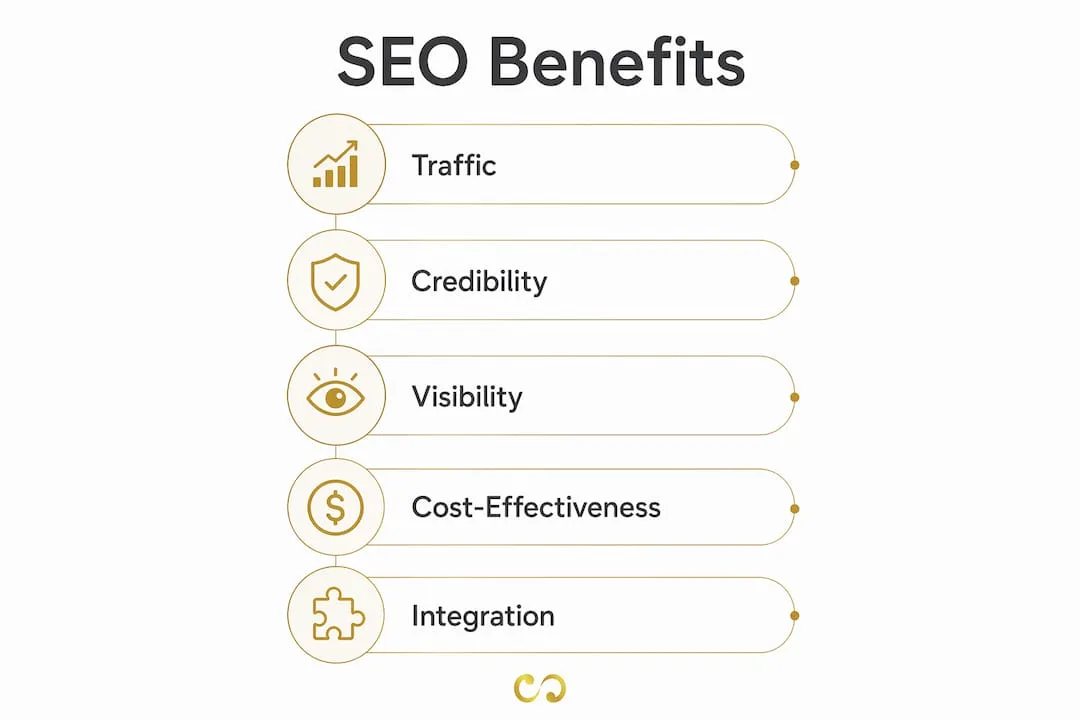
The benefits go well beyond traffic volume. They build over time and create assets that paid advertising cannot.
1. Free, lasting traffic. Paid ads stop sending traffic once the budget ends, but organic traffic keeps coming. A blog post that ranks on page one today can bring in leads for years with no cost per click. That is a very different financial model from pay-per-click advertising.
2. Credibility and trust. Ranking on the first page of Google signals authority. Many people trust organic results more than paid placements because they see them as earned rather than bought, and that trust carries over to your brand.
3. Visibility in AI-generated answers. Strong content shows up in AI tools such as ChatGPT and Perplexity. Businesses that rank well in traditional search are often the ones cited in AI answers too, which adds a second layer of organic exposure.
4. Cost-effectiveness over time. The upfront investment in content, technical fixes and link building keeps paying back long after the work is done. Paid channels need continuous spend to keep results going. SEO builds equity.
5. A better fit with the rest of your marketing. SEO working alongside your wider marketing makes the whole effort stronger. Content written for search also feeds email newsletters, social posts and sales materials, so one investment serves several channels.
Pro tip: turn your best-ranking blog posts into short video scripts, LinkedIn posts and email sequences. Content that already proves itself with search traffic is the best starting point for other channels.
How does AI change the importance of SEO?
AI has not made SEO less relevant. It has made it more important and more complex. Google's AI Overviews, ChatGPT and Perplexity all draw on well-optimised content to build their answers. If your content does not meet the quality signals these systems look for, it does not get cited.

Google describes content quality through E-E-A-T: experience, expertise, authoritativeness and trustworthiness. These signals shape both traditional results and AI-generated answers. A business that shows real experience in its content, backs up its claims and earns links from credible sources will consistently do better than one publishing generic articles.
How E-E-A-T signals apply:
| E-E-A-T signal | What it means | How to demonstrate it |
|---|---|---|
| Experience | First-hand knowledge of the topic | Case studies, original data, author bios |
| Expertise | Deep subject knowledge | Detailed how-to content, credentials |
| Authoritativeness | Recognition from other credible sources | Backlinks, press mentions, citations |
| Trustworthiness | Accurate, transparent and secure content | HTTPS, clear sourcing, honest claims |
The AI search shift also means your content competes across more surfaces at once. One well-optimised page can appear in a standard results page, an AI Overview, a voice answer and a featured snippet. That reach is only open to businesses that treat SEO as a core practice rather than an afterthought.
Ranking on page one is no longer the whole goal. The aim now is to be the source AI systems trust enough to cite when people ask questions your business can answer.
How to build SEO into your marketing strategy
SEO works best when it is part of your marketing from the start, not bolted on afterwards. These practices separate businesses that see real results from those that go round in circles.
Start with intent, not keywords. Keyword research is a way of understanding what customers want. Before writing anything, work out whether the searcher wants information, wants to compare options or is ready to buy. Each needs a different format and a different call to action.
Balance content quality with technical health. Core Web Vitals and accessibility affect both rankings and customer satisfaction. A well-written article on a slow, awkward mobile site will struggle to rank. Technical SEO, including site speed, mobile-first design and clean URLs, is the foundation good content sits on.
Avoid quick fixes. Buying links, keyword stuffing and publishing thin AI content at scale bring short-term gains and long-term penalties. Google's updates keep targeting these patterns. Lasting SEO comes from being genuinely helpful.
A practical checklist for keeping SEO healthy:
- Check your site for broken links and crawl errors at least once a quarter.
- Refresh high-traffic pages with up-to-date information and examples every year.
- Link related content together to spread authority across your site.
- Monitor Core Web Vitals in Google Search Console and fix performance problems promptly.
- Publish content that answers the questions customers ask in sales calls or support tickets.
SEO works with your other channels, not instead of them. It delivers leads, sales and revenue best when combined with content marketing, paid search and social media. Paid ads bring immediate traffic while SEO builds long-term authority, and social media amplifies the content SEO shows is valuable. The channels reinforce each other. To see how SEO fits a full growth plan, read our guide to digital marketing tactics that combine organic and paid channels.
Pro tip: use the Performance report in Google Search Console to find pages ranking in positions 5 to 15. They are close to page one and often need only targeted improvements, such as stronger internal links or updated content, to break through.
Key takeaways
SEO is one of the best-returning channels for businesses that stick with it, because organic traffic builds over time while paid traffic stops the moment spending stops.
| Point | Details |
|---|---|
| Organic traffic is a major source | Organic search is one of the largest sources of website visitors for most businesses. |
| Lead quality is high | Searchers arrive already looking for a solution, so organic leads tend to be strong. |
| AI extends SEO's reach | Well-optimised content gets cited in ChatGPT, Perplexity and Google AI Overviews. |
| E-E-A-T shapes rankings | Experience, expertise, authoritativeness and trustworthiness define content quality in AI-era search. |
| Technical health matters | Site speed, mobile-friendliness and Core Web Vitals affect both rankings and conversions. |
SEO is a long game, and that is why it wins
I have worked with business owners who wanted to pause SEO the moment paid ads started bringing quick wins. That is almost always a mistake. Paid traffic is rented. Stop paying and it disappears. SEO is owned. The content you build today keeps working next year and the year after.
What I find most underestimated is the credibility effect. When a potential customer searches for a solution and finds you ranking organically, they arrive with a level of trust no ad can manufacture. That trust shortens sales cycles and lifts order values in ways that are hard to measure but very real.
The businesses I have seen struggle with SEO share one pattern. They treat it as a one-off project rather than an ongoing practice. They publish a batch of content, see modest results and move on. SEO rewards consistency. The brands that publish regularly, fix technical issues as they come up and build authority through real expertise are the ones that lead their categories over three to five years.
For local businesses in particular, local SEO is still badly underused. Most small and mid-sized businesses are not competing with national brands for local searches. They are competing with other local firms, many of which have done almost no SEO at all. That gap is an opportunity.
My honest advice: treat SEO as infrastructure, not a campaign. Build it properly, maintain it consistently and it becomes one of the most durable advantages your business can have.
Pawan
How LOOM Brand Designs builds your SEO foundation
A strong SEO strategy starts with a website search engines can read and people want to stay on. LOOM Brand Designs builds custom websites with SEO best practice built in from the start, including fast load times, mobile-first design and clean site structure.
For businesses ready to pair strong design with a full digital strategy, our enterprise website and digital strategy consultation brings SEO, branding and growth planning together. If you are starting from scratch, our basic branding package gives you the visual identity your business needs to compete online.
FAQ
Why is SEO important for small businesses?
SEO gives small businesses access to high-intent customers without the ongoing cost of paid advertising. Organic rankings build credibility and bring steady traffic that grows over time.
How long does SEO take to show results?
Many businesses start to see meaningful organic growth within three to six months of consistent work. Competitive industries can take longer, but the results last longer than paid channels.
Does SEO still work with AI-powered search?
Yes, and it matters more than before. Tools such as ChatGPT and Google AI Overviews cite well-optimised content, so strong organic rankings now bring visibility across several discovery surfaces.
What is E-E-A-T and why does it matter?
E-E-A-T stands for experience, expertise, authoritativeness and trustworthiness. Google uses these ideas to judge content quality for both traditional and AI-generated search results.
How does SEO compare to paid advertising?
Paid ads bring immediate traffic but stop when the budget ends. SEO builds visibility that lasts and grows, which makes it more cost-effective over a year or more.
The Hashtag Loom