
TL;DR:
- Organic social reach is limited, so paid social ads are often needed for targeted visibility.
- Social media ads deliver measurable growth through precise targeting and retargeting.
- Successful advertising needs a clear brand, consistent messaging and a place in your wider marketing.
Most small business owners put a lot of time into organic social posts, believing consistency alone will build their audience. It rarely does. Organic social reach keeps shrinking on the major platforms, and businesses that rely on it alone slowly become invisible. Social media ads change that quickly. They put your brand in front of the people most likely to buy, not just whoever happens to scroll past. This article covers the real limits of organic social, how paid ads deliver measurable growth, and how to use them well.
Key takeaways
| Point | Details |
|---|---|
| Ads expand reach | Paid social ads help small businesses reach more customers than organic posts alone. |
| Targeting improves return | Detailed targeting puts your ads in front of the right audience. |
| Integration multiplies impact | Social ads combined with your other marketing build more growth and recognition. |
| Expert advice pays off | Professional help prevents costly ad mistakes and gets you results sooner. |
The limitations of organic social media
Organic social media feels free, so it is easy to assume it can carry your growth. That assumption costs more than most businesses realise. Understanding what social media marketing involves means accepting a hard truth: platforms are businesses too, and their feeds are built around what keeps people scrolling and what advertisers pay for, not around what benefits your brand.
Over the past decade, the algorithms on Facebook, Instagram and LinkedIn have shown business pages to a smaller share of their followers. For a small business posting a few times a week in the hope of going viral, the maths does not add up.
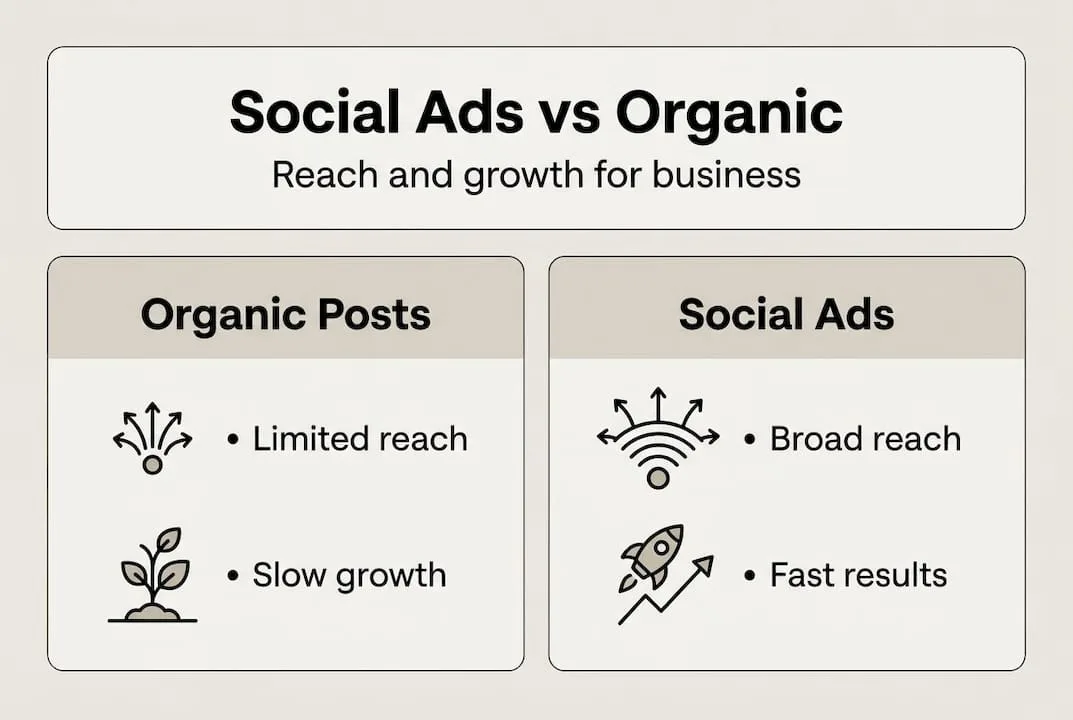
Here is how organic and paid reach tend to differ on the main platforms:
| Platform | Organic reach | Paid reach |
|---|---|---|
| A small share of your followers | Your chosen target audience, scaled by budget | |
| A share of followers, higher for strong content | Highly scalable with budget | |
| Often better than other platforms for business posts | Precise B2B targeting by job title and industry | |
| TikTok | Unpredictable and trend-dependent | Broad reach to new audiences |
Even where organic reach holds up better, such as LinkedIn, you are still only reaching part of your audience. People are also becoming more selective about what they engage with, which makes it harder still for business posts to stand out organically.
Common pitfalls for small businesses that skip paid ads:
- Spending hours on content that most followers never see
- Relying on hashtags and trends that change faster than your posting schedule
- Missing high-intent buyers who do not follow your account yet
- Losing ground to competitors running consistent paid campaigns
- Having no reliable way to test messages or creative at scale
Pro tip: Posting consistently still matters for credibility, but it should be the floor of your strategy, not the ceiling. Even a modest budget to promote your best organic posts can extend their reach without creating anything new.
With the limits of organic social clear, here is how ads fill the gaps.
How social media ads drive business growth
Paid social ads do more than raise visibility. They create a direct, measurable path from attention to revenue. That is the big difference from organic content, where the link between a post and a sale is fuzzy at best.
Social ads give you scalable exposure that organic content cannot match. When you run a paid campaign, you choose who sees it, when they see it and what you want them to do next. That level of control is valuable for any small business trying to grow efficiently.
Paid social works best as one of several digital marketing tactics, and the creative matters as much as the targeting. Strong graphic design makes people stop scrolling; generic stock imagery gets ignored.
Three main ways social media ads help small businesses grow:
- Brand growth: Ads put your business in front of people who have never heard of you, building recognition without waiting for an algorithm to favour your posts.
- Lead generation: Lead forms on Facebook, Instagram and LinkedIn collect prospect details inside the platform, which removes friction from signing up.
- Retargeting: Showing ads to people who have visited your website or engaged with your content keeps your brand in mind while they decide.
What makes paid social stand apart:
- Fast feedback: launch a campaign today and have data tomorrow
- Budget control: set your daily spend and pause whenever you like
- A/B testing: run two versions of an ad side by side to see what works
- Cross-platform reach: run coordinated campaigns across Facebook and Instagram from one dashboard
Organic content builds trust slowly. Paid ads speed that up by putting your message in front of the right people at the right moment. Next, how to build campaigns around your own goals.
Targeting strategies for effective social ads
The biggest advantage social ads have over traditional advertising is targeting. You are not buying a billboard and hoping the right person drives past. You are choosing who sees your ad based on detailed audience data.
Good targeting is central to getting a return from paid advertising. Platforms like Facebook and LinkedIn offer audience options that did not exist a decade ago. Marketers call it segmentation, but in practice it means knowing your customer and using the platform's tools to find more people like them.

Basic and advanced targeting compared:
| Targeting type | Basic approach | Advanced approach |
|---|---|---|
| Demographics | Age, gender, location | Job title, industry, life events (where the platform offers them) |
| Interests | Broad category targeting | Niche, behaviour-based signals |
| Retargeting | All website visitors | Visitors to specific pages, abandoned baskets |
| Lookalike audiences | Basic similarity matching | Platform AI modelling from several signals |
A solid SME brand strategy starts with a clear picture of your audience, and that clarity leads straight to better targeting. If you know your customer is a female small business owner aged 35 to 50 in a particular region with an interest in branding and design, you can build that audience in Meta Ads Manager in a few minutes.
Ways to sharpen your targeting:
- Narrow by location and age to avoid spending on unlikely buyers
- Use retargeting to bring back website visitors who did not convert the first time
- Try the AI audience suggestions built into Meta and LinkedIn
- Exclude existing customers from acquisition campaigns so you do not pay to reach them twice
- Change one variable at a time so you know what is driving the result
Pro tip: Lookalike audiences are one of the quickest growth levers for small businesses. Upload your customer email list (with the right consent in place) to Facebook or LinkedIn, and the platform will find new people with similar characteristics. It is how a local business starts reaching promising prospects it would never have found organically.
With targeting covered, here is how social ads fit into the bigger picture.
Making social ads part of your overall marketing
Running social ads in isolation is like lighting one burner and expecting the whole hob to heat up. The real power comes when paid social works in step with your other channels, so your ads, website, emails and content all tell the same story.
Joined-up campaigns tend to beat single-channel ones. When someone sees your ad on Instagram, clicks through to your website and then receives a follow-up email with a related offer, the experience feels coherent, and that builds trust faster than any single touchpoint.
AI marketing tools make this coordination easier for small teams than it used to be. Automated sequences, dynamic ad creative and real-time reporting help smaller teams work efficiently. Avoiding branding mistakes across channels, such as inconsistent logos, mismatched tone or conflicting offers, matters even more when you run several channels at once.
Practical ways to bring the channels together:
- Use the same message across ad copy, landing pages and email sequences
- Launch social ads and email campaigns for the same offer at the same time
- Track the full customer journey across channels in Google Analytics 4
- Reuse your best organic posts as ad creative to save production time
Pro tip: Line up paid social with seasonal content and email promotions. When all three run together around one offer, the combined effect is far greater than each channel working alone.
The uncomfortable truth about social media ads for small businesses
Few marketing guides say this plainly: social media ads expose every weakness in your business faster than almost anything else. If your landing page is confusing, your ads will send traffic that leaves straight away. If your brand message is unclear, even a precisely targeted campaign will underperform. Paid ads are an accelerator, not a fix.
We have seen small businesses spend heavily on viral-style video when a simple, clear offer with a strong call to action would have done better for far less. Wanting to look impressive on social media is one of the most expensive mistakes in this space.
Brands that get clear first and then scale with ads do better than those that throw budget at ads in the hope of fixing a broken funnel. Your ad is only as strong as the page it sends people to and the brand behind it.
Treat paid social as the amplifier it is. Sharpen your message, tidy up your website, tighten your offer, then let ads add fuel.
Strengthen your online presence with expert branding and ad support
Everything in this article works only as well as the brand behind it. If your visual identity, messaging and website are not aligned, even a well-targeted campaign will leave money on the table.
At LOOM Brand Designs, we help small businesses build the foundation that makes ad spend count. From our basic branding package, which gives your business a professional identity, to full website design and development that turns ad traffic into customers, we cover the whole journey. We also handle video editing and social ad creative so your campaigns look as sharp as they perform. If you would like to see what a coordinated digital strategy could look like for your business, get in touch.
Frequently asked questions
How much should a small business spend on social media ads?
Start with a modest monthly test budget you are comfortable losing while you learn, then increase it as you find what works. Social ads can be scaled gradually, so you never need to risk more than your results justify.
Which platforms are best for social media advertising?
Facebook and Instagram suit many small businesses, but the right platform depends on where your audience spends time, along with your industry and whether you sell to consumers or other businesses.
Can social media ads really boost brand awareness and sales?
Yes, when campaigns are built around clear objectives, strong creative and a website that converts. Ads build recognition and drive sales you can measure.
What targeting options are available in social media ads?
You can target by age, location, interests, behaviours and lookalike audiences, and retarget people who already know you. Good targeting means your budget reaches the most relevant prospects.
Should I run my own ads or hire an expert?
If you are new to paid social, working with an expert cuts out a lot of costly trial and error. Professional guidance helps you avoid the most common budget-wasting mistakes.
The Hashtag Loom